Listen to this Post
Introduction:
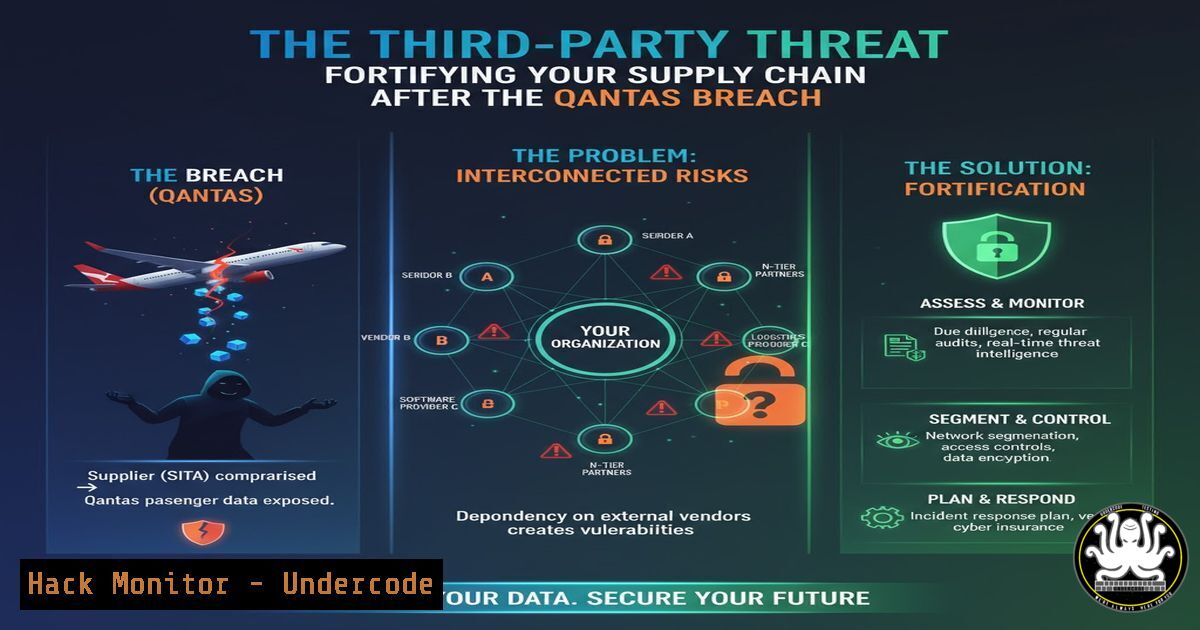
The recent Qantas data breach, which exposed the information of 5.7 million customers, was not a direct assault on the airline’s core systems. Instead, hackers exploited a call centre worker at a third-party supplier, highlighting the critical and often overlooked vulnerability of the digital supply chain. This incident underscores a modern cybersecurity truth: your defense is only as strong as your weakest vendor’s security posture.
Learning Objectives:
- Understand the mechanisms of social engineering and third-party credential theft.
- Learn to implement technical controls to detect and prevent lateral movement from third-party connections.
- Develop a strategy for continuous third-party risk monitoring and vendor security assessment.
You Should Know:
1. Social Engineering Defense: Simulating Phishing Campaigns
Human error remains the primary attack vector. Training is essential, but validating that training through simulated attacks is critical.
` Example Phishing Email for Internal Training (Do not use maliciously)`
`Subject: Urgent: Your Salesforce Credentials Require Verification`
`From: “IT Support” `
`Body: “Dear Employee, Our records indicate your Salesforce login has experienced unusual activity. To prevent account suspension, please verify your credentials immediately at: http://yourcompany-login-secure.portal[.]fake”`
`Step-by-step guide:`
`1. Use a security awareness platform like GoPhish (open-source) or a commercial equivalent to set up a campaign.`
`2. Craft a believable email template mimicking a common service used by your third-party partners, like Salesforce.`
`3. Select a target group, such as employees with access to privileged systems.`
`4. Send the simulated phishing email and track open rates, click-through rates, and credential submission rates.`
`5. Provide immediate, constructive feedback to those who fail the test, turning the incident into a learning opportunity.`
2. Principle of Least Privilege: Enforcing Access Controls
Third-party users should only have the absolute minimum access required to perform their duties.
` PowerShell: Audit User Permissions in Active Directory`
`Get-ADUser -Filter -Properties MemberOf | Select-Object Name, MemberOf | Export-Csv -Path “C:\temp\AllUserPermissions.csv” -NoTypeInformation`
`Step-by-step guide:`
`1. Run this PowerShell script on a Domain Controller (or with appropriate AD modules) to export a list of all users and their group memberships.`
`2. Analyze the CSV file, paying special attention to accounts used by third-party vendors or service accounts.`
`3. Identify users with excessive privileges, such as membership in the “Domain Admins” or “Schema Admins” groups.`
4. Use the `Remove-ADGroupMember` cmdlet to revoke unnecessary group memberships. For example:Remove-ADGroupMember -Identity “Domain Admins” -Members “ThirdPartyContractor” -Confirm:$false“
`5. Implement a periodic review process (e.g., quarterly) to re-audit these permissions.`
3. Network Segmentation: Containing a Breach
Prevent lateral movement by isolating third-party access points into a segmented network zone.
` Cisco ASA Firewall ACL to restrict third-party VLAN`
`access-list ThirdParty_VLAN extended deny ip any any`
`access-list ThirdParty_VLAN extended permit tcp 10.10.30.0 255.255.255.0 host 10.10.10.50 eq 443`
`access-list ThirdParty_VLAN extended permit tcp 10.10.30.0 255.255.255.0 host 10.10.10.50 eq 22`
`Step-by-step guide:`
`1. Define a dedicated VLAN (e.g., 10.10.30.0/24) for all third-party connections.`
`2. Create an Access Control List (ACL) on your firewall that by default denies all traffic.`
`3. Add explicit permit rules only for the specific protocols and internal hosts the third party requires. In this example, the third-party VLAN can only reach host 10.10.10.50 on HTTPS (443) and SSH (22) ports.`
`4. Apply this ACL to the interface or security zone corresponding to the third-party VLAN.`
`5. This containment ensures that if a third-party account is compromised, the attacker’s ability to move laterally to other critical systems is severely limited.`
4. Monitoring for Anomaly: Detecting Credential Theft
Use logging and monitoring to detect unusual login patterns that may indicate stolen credentials.
` Sigma Rule for Detecting Multiple Failed Logins Followed by Success (Example)`
`title: Multiple Failed Logins Followed by Success`
`logsource:`
` product: windows`
` service: security`
`detection:`
` selection:`
` EventID: 4625 Failed login`
` selection2:`
` EventID: 4624 Successful login`
` timeframe: 5m`
` condition: selection | count() by TargetUserName > 3 and selection2`
`Step-by-step guide:`
`1. Ensure Windows Audit Policy is configured to log events 4624 (successful logon) and 4625 (failed logon).`
`2. Ingest these logs into a SIEM (Security Information and Event Management) system.`
`3. Create a correlation rule, like the Sigma rule above, that triggers an alert if a user account has more than 3 failed logins followed by a successful login within a 5-minute window.`
`4. Tune the rule thresholds (e.g., count and timeframe) to match your environment’s normal “noise” level.`
`5. Integrate this alert into your SOC’s playbook for immediate investigation.`
5. Cloud Security Posture: Hardening SaaS Configurations
The Qantas breach involved a third-party Salesforce platform. Misconfigurations in SaaS applications are a prime target.
` Salesforce: Apex Class Security Review (Manual Process)`
`Step-by-step guide:`
`1. Log in to your Salesforce setup.`
`2. Navigate to Setup > Platform Tools > Development > Apex Classes.`
`3. Review each Apex class, paying special attention to those with “Without Sharing” keyword, which bypasses user permissions.`
`4. Validate that classes handling sensitive data have proper CRUD (Create, Read, Update, Delete) and FLS (Field Level Security) checks.`
`5. Regularly run the “Security Health Check” (Setup > Security > Health Check) to identify critical risks like weak password policies or open external object configurations.`
6. Vulnerability Management: Patching the Vendor Attack Surface
Attackers often use known vulnerabilities to gain an initial foothold.
` Nmap Scan to Check for Common Vulnerabilities`
`nmap -sV –script vuln `
`Step-by-step guide:`
`1. Use Nmap, a network discovery tool, to scan systems accessible to third parties.`
2. The `-sV` flag probes open ports to determine service/version info.
3. The `--script vuln` flag activates the Nmap Scripting Engine (NSE) to check for a wide range of known vulnerabilities.
`4. Run this scan against your DMZ or third-party access segment. Note: Ensure you have explicit authorization before scanning any system.`
`5. Analyze the results and prioritize patching for systems with critical or high-severity vulnerabilities identified by the scripts.`
7. API Security: The Hidden Gateway
Third-party integrations often rely on APIs, which can be a weak link if not properly secured.
` Curl Command to Test for Broken Object Level Authorization (BOLA)`
`curl -H “Authorization: Bearer
`curl -H “Authorization: Bearer
`Step-by-step guide:`
`1. This test checks if User A can access the resources (e.g., orders) of User B by simply changing the user ID in the API endpoint.`
`2. Using an access token for a legitimate user (USER_A), make a request to an API endpoint that includes a user-specific object ID (e.g., 12345).`
`3. Note the response. Then, change the object ID in the URL to one that belongs to a different user (e.g., 67890).`
`4. If the second request returns a “200 OK” with User B’s data, the API has a critical BOLA vulnerability.`
`5. Remediation requires the backend to strictly check that the authenticated user has permission to access the specific object ID requested.`
What Undercode Say:
- Your Perimeter is Now Virtual: The castle-and-moat security model is obsolete. Your attack surface includes every employee at every vendor with access to your data.
- Compliance ≠ Security: A vendor passing a yearly audit does not guarantee they are secure today. Continuous monitoring is non-negotiable.
The Qantas breach is a textbook example of supply chain compromise, but it’s the operational response that defines long-term resilience. Organizations must shift from trusting vendors to verifying their security posture continuously. This involves technical controls like micro-segmentation and strict access management, but also contractual and procedural ones, mandating security standards and conducting regular penetration tests that include third-party access paths. The goal is to create a defensible ecosystem, not just a defensible network.
Prediction:
The success of attacks like the one on Qantas will catalyze a massive shift towards automated, real-time third-party risk management platforms and the widespread adoption of Zero Trust architectures. Insurance underwriters will increasingly mandate strict vendor security controls for policy issuance, creating a financial imperative for robust supply chain security. We will see the rise of “cyber supply chain audits” becoming as standard as financial audits, forcing a new era of transparency and accountability across entire business ecosystems.
🎯Let’s Practice For Free:
IT/Security Reporter URL:
Reported By: Kash Sharma – Hackers Feeds
Extra Hub: Undercode MoN
Basic Verification: Pass ✅


