Listen to this Post
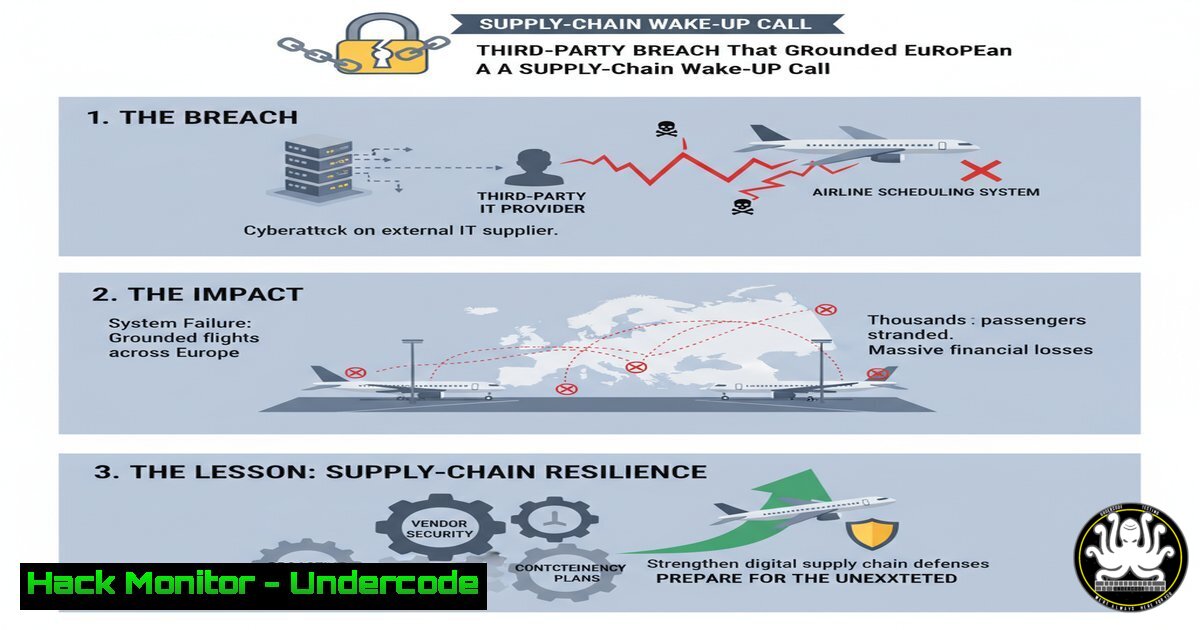
Introduction:
A recent cyber attack on a third-party check-in system at Berlin Brandenburg Airport (BER) caused significant operational disruptions, leading to manual processing and cascading delays across major European hubs like Heathrow and Brussels. This incident underscores the critical yet often overlooked vulnerability inherent in modern supply-chain dependencies, where a single compromised vendor can cripple core business functions. It serves as a stark reminder for organizations to rigorously test their vendor-outage playbooks and validate manual fallback procedures.
Learning Objectives:
- Understand the critical risks associated with third-party supply-chain dependencies in critical infrastructure.
- Learn to implement and validate manual fallback procedures for essential services.
- Gain practical skills in identity threat detection and hardening for third-party and service accounts.
You Should Know:
1. Mapping Your External Attack Surface
The first step in mitigating third-party risk is knowing your exposure. Tools like `amass` can be used to discover assets owned by your vendors that interact with your environment.
 Use amass to enumerate subdomains and assets associated with a third-party vendor
amass enum -active -d third-party-vendor.com -brute -w /usr/share/wordlists/subdomains.txt -o vendor_assets.txt
This command performs active enumeration (-active) on the target domain (-d), uses brute forcing (-brute) with a wordlist (-w), and outputs the results to a file. Regularly running this on critical vendors helps you understand their digital footprint and potential points of failure or intrusion that could impact you.
2. Validating Manual Fallback Procedures: A Tabletop Exercise
Rehearsing manual processes is not about memorizing commands but testing workflow. For a scenario like a downed check-in system, create a step-by-step runbook and test it under pressure. Key commands for IT teams might include:
 On a Linux-based jump host, quickly grant temporary access to a manual processing station
sudo usermod -aG vpn-access manual-ops-user
sudo systemctl restart sshd  Ensure the group membership is active
This grants a user (manual-ops-user) access to the VPN group, a common requirement for accessing internal resources. The runbook must document not just these commands, but also who has the authority to execute them, and how to verify the manual system is functioning correctly.
3. Hardening Service Account Credentials
A compromised third-party service account can be catastrophic. Implementing strict control and monitoring is paramount.
 On Windows, use PowerShell to audit service accounts for weak password policies
Get-ADServiceAccount -Filter  -Properties PasswordLastSet, PasswordNotRequired | Where-Object {$<em>.PasswordNotRequired -eq $true -or $</em>.PasswordLastSet -lt (Get-Date).AddDays(-365)} | Format-Table Name, PasswordLastSet, PasswordNotRequired
This PowerShell command queries Active Directory for all service accounts (Get-ADServiceAccount) and filters for those with passwords set to never expire or that haven’t been changed in over a year. These are prime targets for attackers and must be remediated immediately.
4. Implementing Network Segmentation for Vendors
Never grant third-party systems unrestricted network access. Use firewalls to segment their access to only necessary systems.
 On a Linux host acting as a firewall, use iptables to restrict a vendor's IP to a specific port on one internal server
sudo iptables -A INPUT -p tcp -s 192.0.2.100 --dport 443 -d 10.0.1.50 -j ACCEPT
sudo iptables -A INPUT -p tcp -s 192.0.2.100 -j DROP
The first rule allows the vendor’s source IP (-s 192.0.2.100) to access port 443 on your internal server 10.0.1.50. The second, more critical rule then drops all other traffic from that source IP. This contains any potential breach originating from the vendor.
5. Monitoring for Lateral Movement from Third-Party Systems
Assume a vendor breach will happen and monitor for suspicious activity originating from their systems.
 Use Zeek (formerly Bro) to monitor network traffic for anomalous connections from a vendor subnet
filter {
if [bash][ip] == "192.0.2.0/24" and not [bash][ip] in ["10.0.1.50", "10.0.1.51"] {
mutate { add_tag => [ "Vendor_Lateral_Movement" ] }
}
}
This example log filtering rule (e.g., for Elasticsearch) tags any network traffic from the vendor’s IP range (192.0.2.0/24) that is going to any internal IP other than the two explicitly allowed servers. This creates a high-fidelity alert for investigation.
6. API Security: Hardening Third-Party Integrations
Vendor systems often connect via APIs. These must be rigorously secured against abuse.
 Use curl to test an API endpoint for missing rate limiting - WARNING: Only do this on your own systems!
curl -X POST https://your-api.com/v1/checkin -H "Authorization: Bearer $TOKEN" -d '{"data":"test"}' &
 Repeat this command rapidly 100s of times to test for rate limiting
If the API accepts all requests without throttling, it is vulnerable to denial-of-service or brute-force attacks. Implement rate limiting, strict authentication, and input validation on all API endpoints exposed to vendors.
7. Incident Communication: Locking Down External Comms
During an incident, secure, simple communication channels are vital to avoid confusion.
 Quickly deploy a temporary, authenticated status page using a simple Python HTTP server
echo "

<h1>Incident Status: Active - Manual Ops</h1>

Updated: $(date)

" > status.html
python3 -m http.server 8080 --directory /path/to/status/dir --bind 0.0.0.0
 Then, use iptables to restrict access to the status page to only corporate IPs
sudo iptables -A INPUT -p tcp --dport 8080 -s 203.0.113.0/24 -j ACCEPT
sudo iptables -A INPUT -p tcp --dport 8080 -j DROP
This creates a simple status page and serves it internally. The firewall rules ensure only the corporate network range (203.0.113.0/24) can access it, preventing information leakage while keeping internal teams informed.
What Undercode Say:
- Supply Chain is the New Battlefield. This incident is not an anomaly but a blueprint. Attackers are strategically targeting smaller, less-secure vendors as a backdoor into larger, more valuable organizations. The security perimeter now extends far beyond your own network.
- Manual Workflows are a Critical Security Control. The ability to revert to manual operations is not a business continuity feature—it is a last-line-of-defense cybersecurity control. Organizations that cannot operate without a specific vendor have effectively outsourced their security to that vendor’s lowest level of security hygiene.
This analysis confirms that the traditional security model is broken. The focus must shift from solely defending the internal castle to actively fortifying and monitoring the entire kingdom of connected vendors. Proactive vendor risk assessments, enforceable security contracts, and continuous monitoring of third-party access are no longer optional; they are the bedrock of modern cybersecurity resilience. The airports that weathered this storm best were undoubtedly those that had recently rehearsed their “vendor-outage” playbooks.
Prediction:
The aviation sector incident will catalyze stringent new regulations for critical infrastructure, mandating compulsory and auditable third-party risk management programs. We will see a rapid shift towards ‘Zero Trust’ principles for supply-chain access, where implicit trust in vendors is replaced with continuous verification of their security posture. Within two years, cyber insurance premiums will become prohibitively expensive for organizations that cannot demonstrate validated manual fallbacks for critical third-party dependencies, making these exercises a financial imperative as well as an operational one.
🎯Let’s Practice For Free:
IT/Security Reporter URL:
Reported By: https://lnkd.in/p/d8y_2a_Z – Hackers Feeds
Extra Hub: Undercode MoN
Basic Verification: Pass ✅


