
Listen to this Post
Introduction:
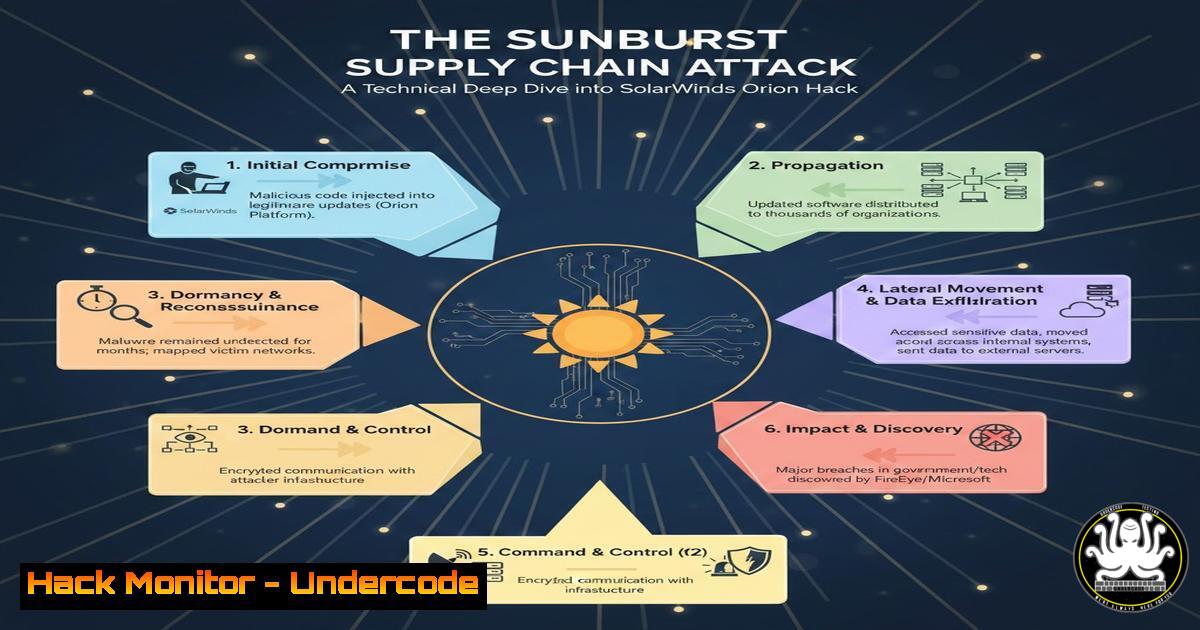
The SUNBURST attack represents one of the most sophisticated supply chain compromises in cybersecurity history, where threat actors injected malicious code into the SolarWinds Orion software updates. This incident compromised over 18,000 organizations, including multiple U.S. federal agencies, demonstrating how trusted software updates can become devastating attack vectors. Understanding this attack is crucial for modern defense strategies against nation-state adversaries.
Learning Objectives:
- Understand the mechanics of software supply chain attacks and how legitimate digital signatures were bypassed
- Master detection techniques for identifying SUNBURST indicators across Windows and Linux environments
- Learn defensive strategies to protect CI/CD pipelines and software build processes
- Analyze post-exploitation TTPs used by the threat actors (APT29/Cozy Bear)
- Implement verification protocols for third-party software integrity
You Should Know:
1. Initial Compromise: The SUNBURST Backdoor Analysis
The attack began when malicious code was injected into the SolarWinds.Orion.Core.BusinessLayer.dll component during the build process. This code remained dormant for up to two weeks before attempting to communicate with command-and-control servers using domain generation algorithms (DGAs).
For Windows forensics, check for the specific malicious DLL version:
 Check SolarWinds DLL versions
Get-ChildItem -Path "C:\Program Files\SolarWinds\Orion\" -Filter "SolarWinds.Orion.Core.BusinessLayer.dll" -Recurse |
ForEach-Object {
$version = [System.Diagnostics.FileVersionInfo]::GetVersionInfo($<em>.FullName)
if ($version.FileVersion -like "2020.2.100" -or $version.FileVersion -like "2019.4.5200") {
Write-Host "Potentially vulnerable file found: $($</em>.FullName)" -ForegroundColor Red
Write-Host "Version: $($version.FileVersion)"
}
}
Linux-based network defenders can analyze DNS logs for suspicious beaconing:
 Check DNS logs for known SUNBURST domains
grep -E "avsvmcloud|appsync-api|panoramictest" /var/log/named.log 2>/dev/null ||
echo "Checking alternative log paths..."
grep -E "avsvmcloud|appsync-api" /var/log/dnsmasq 2>/dev/null

Monitor network connections from Orion servers
sudo tcpdump -i any -n host solarwinds-orion-server and dst port 443 -A | grep -i "avsvmcloud"
2. Detection Strategies: IOCs and Behavioral Analytics
The attack utilized sophisticated obfuscation techniques. The malicious payload was encrypted and only activated after checking specific system conditions. Here’s how to identify compromise indicators:
Windows Event Log Analysis:
 Check for suspicious service installations
Get-WinEvent -FilterHashtable @{
LogName='System'
ID=7045
} | Where-Object { $<em>.Message -match "SolarWinds" -and $</em>.Message -match "Network Service" }

Examine scheduled tasks created during compromise window
$compromiseDate = "2020-12-01"
Get-ScheduledTask | Where-Object { $_.Date -gt $compromiseDate } |
Select-Object TaskName, State, Actions

Check registry for persistence mechanisms
reg query "HKLM\SOFTWARE\Microsoft\Windows\CurrentVersion\Run" /s
reg query "HKLM\SOFTWARE\WOW6432Node\Microsoft\Windows\CurrentVersion\Run" /s
Network-based detection using Zeek (Bro):
 Monitor HTTP user agents associated with SUNBURST
zeek -C -r suspicious-traffic.pcap
cat http.log | awk -F '\t' '{print $10}' | grep -i "Mozilla/5.0 (Windows NT 10.0; Win64; x64) AppleWebKit/537.36" | uniq -c

Check for DNS TTL anomalies
cat dns.log | awk '{if($7 < 300 && $7 > 0) print $0}' | grep "avsvmcloud"
3. Malware Analysis: Deconstructing the SUNBURST Payload
The SUNBURST backdoor used sophisticated evasion techniques including sleep timers and domain generation algorithms. For reverse engineering on Linux:
 Static analysis with radare2
r2 SolarWinds.Orion.Core.BusinessLayer.dll
[bash]> aaa
[bash]> iz~DGA  Find strings related to domain generation

Check for encoded resources using strings and base64 decoding
strings -n 8 SolarWinds.Orion.Core.BusinessLayer.dll | grep -E "^[A-Za-z0-9+/=]{20,}" | while read line; do
echo $line | base64 -d 2>/dev/null
done

YARA rules for detection
cat > sunburst.yara << 'EOF'
rule SUNBURST_DLL {
meta:
description = "Detects SolarWinds SUNBURST backdoor"
strings:
$mz = "MZ"
$comp = "SolarWinds.Orion.Core.BusinessLayer"
$c2_pattern = /avsvmcloud|panoramictest|freescanonline/
condition:
$mz at 0 and $comp and any of ($c2_pattern)
}
EOF

yara -r sunburst.yara /path/to/suspicious/files/
4. Cloud Environment Hardening and Detection
AWS-specific detection for post-exploitation activity commonly seen after SUNBURST compromises:
 Check CloudTrail for suspicious API calls
aws cloudtrail lookup-events --lookup-attributes AttributeKey=EventName,AttributeValue=AssumeRole \
--start-time 2020-12-01 --query 'Events[?contains(Username, <code>solarwinds</code>)]'

Analyze IAM role assumptions
aws iam list-roles --query "Roles[?contains(RoleName, 'Orion')]"

GuardDuty findings review
aws guardduty list-findings --detector-id $(aws guardduty list-detectors --query DetectorIds[bash] --output text) \
--finding-criteria Criterion={Severity={Gte=4}}

<dl>
<dt>Azure Sentinel KQL query for detection</dt>
<dd>'
AzureDiagnostics
| where Resource contains "solarwinds"
| where OperationName contains "keyvault"
| extend parsed = parse_json(Properties_s)
| where parsed.user_agent contains "Mozilla"
| project TimeGenerated, CallerIpAddress, UserAgent
'
5. Linux Forensic Analysis for Cross-Platform Compromise
While SUNBURST targeted Windows primarily, attackers often used Linux jump boxes:
 Check for modified system binaries
sudo debsums -c 2>/dev/null | grep -v "OK$"
rpm -Va | grep '^..5'  For RHEL/CentOS

Monitor for unusual cron jobs
for user in $(cut -f1 -d: /etc/passwd); do
crontab -u $user -l 2>/dev/null | grep -v "^"
done

Check LD_PRELOAD hijacking attempts
sudo grep -r "LD_PRELOAD" /proc//environ 2>/dev/null

Analyze network connections from SolarWinds management servers
sudo lsof -i -P -n | grep solarwinds
sudo netstat -tunap | grep ESTABLISHED | grep -E ":(443|80)"
6. Mitigation Strategies and Hardening CI/CD Pipelines
Prevent future supply chain attacks with these security controls:
 Git signing and verification
git config --global commit.gpgsign true
git config --global tag.gpgsign true
git verify-commit HEAD

Docker image signing with Notary
notary init myregistry/solarwinds-orion
docker trust sign myregistry/solarwinds-orion:2020.2.100

SBOM generation with Syft
syft packages solarwinds-orion:latest -o spdx-json > sbom.json
grype sbom:sbom.json  Vulnerability scanning

<dl>
<dt>Jenkins pipeline security</dt>
<dd>'
pipeline {
agent any
stages {
stage("Security Scan") {
steps {
dependencyCheck additionalArguments: "-o ./ --scan ./"
dependencyCheckPublisher pattern: "dependency-check-report.xml"
}
}
}
}
'
7. Advanced Persistence Removal and System Cleanup
Complete eradication requires thorough system cleaning:
 Remove malicious service and quarantine DLLs
Stop-Service -Name "SolarWindsOrion" -Force
sc.exe delete "SolarWindsOrion"

Force remove file with admin privileges
takeown /F "C:\Program Files\SolarWinds\Orion\SolarWinds.Orion.Core.BusinessLayer.dll"
icacls "C:\Program Files\SolarWinds\Orion\SolarWinds.Orion.Core.BusinessLayer.dll" /grant administrators:F
Remove-Item -Path "C:\Program Files\SolarWinds\Orion\SolarWinds.Orion.Core.BusinessLayer.dll" -Force

Certificate cleanup
Get-ChildItem Cert:\LocalMachine\My | Where-Object { $_.Issuer -match "SolarWinds" } | Remove-Item

Reset compromised service accounts
net user solarwinds_svc  /domain /passwordchg:yes
What Undercode Say:
- Supply chain attacks demonstrate that trust in software vendors must be verified through cryptographic signing and integrity checks at multiple levels
- Defense requires shifting left—implementing security in CI/CD pipelines, code signing, and continuous validation of third-party dependencies
- The attack’s sophistication (12-14 day sleep timer, DGA, encrypted C2) proves that basic signature-based detection is insufficient; behavioral analytics and threat hunting are essential
- Organizations must maintain offline, immutable backups of critical systems to recover from software supply chain compromises
- The incident exposed the danger of “trusting trust”—the build servers themselves must be secured as part of the trusted computing base
Prediction:
The SUNBURST attack will catalyze regulatory mandates for software bill of materials (SBOM) across critical infrastructure sectors by 2025. Expect to see mandatory code signing requirements for government software vendors and real-time integrity monitoring for CI/CD pipelines. As nation-states continue targeting software supply chains, the industry will likely adopt hardware-based root of trust solutions (like TPMs) for build servers, and AI-powered anomaly detection will become standard in development environments to identify subtle code injection attempts during the build process.
▶️ Related Video (80% Match):
🎯Let’s Practice For Free:
IT/Security Reporter URL:
Reported By: Rayjbjang One – Hackers Feeds
Extra Hub: Undercode MoN
Basic Verification: Pass ✅


