Listen to this Post
Introduction:
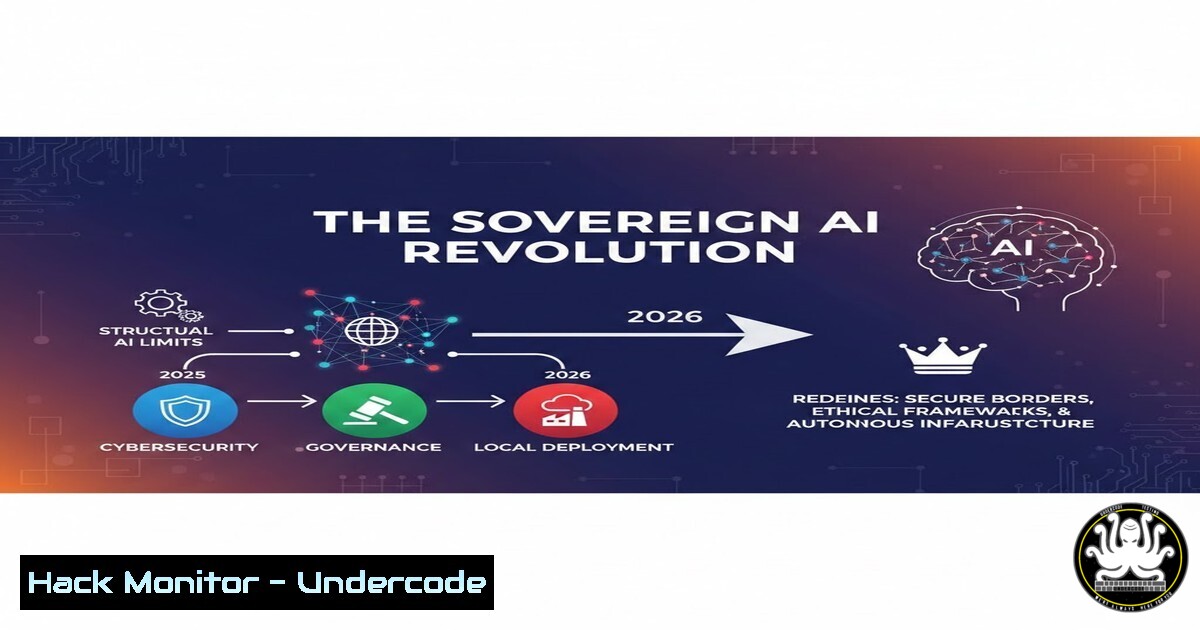
The retrospective analysis of 2025 marks a pivotal doctrinal shift in artificial intelligence, conclusively demonstrating that scale and architectural complexity alone cannot produce genuine comprehension. This revelation dismantles the emergent cognition paradigm, forcing a transition towards structurally governable, metrics-driven AI systems. For cybersecurity and IT professionals, this mandates a fundamental realignment from cloud-dependent inference to sovereign, epistemically admissible local AI deployments where control, privacy, and verifiable understanding are paramount.
Learning Objectives:
- Understand the core structural limitations of contemporary AI architectures and the invalidation of emergent cognition.
- Master the emerging governance frameworks (LISS/PSIS) and metrics (CPJ, Φᵢ, Rᵍ) critical for compliant AI deployment.
- Implement and secure sovereign edge AI infrastructures, transitioning from cloud APIs to locally governed inference models.
- The Architectural Ceiling: Why Comprehension Failed to Emerge
The key finding of 2025 is that fluency is not understanding. Systems like AlphaEvolve and SPICE generate coherent outputs but operate without genuine comprehension, bounded by their representational architectures. Backpropagation, the core of modern deep learning, is identified as structurally non-epistemic—it optimizes for pattern matching, not knowledge formation. This creates critical security and reliability gaps, as models can be manipulated or can “hallucinate” sensitive information with high confidence.
Step‑by‑step guide: Auditing an AI System for Epistemic Risk
1. Identify Inference Source: Determine if your model is a cloud API call (e.g., openai.ChatCompletion.create) or a local instance. Cloud models are inherently opaque.
2. Log and Analyze Input/Output Pairs: For a local model, use a logging interceptor. For a Flask API serving an LLM, you might log prompts and completions:
import logging
logging.basicConfig(filename='ai_audit.log', level=logging.INFO)

def query_model(prompt):
completion = local_llm.generate(prompt)
logging.info(f"PROMPT: {prompt} | COMPLETION: {completion}")
 Check for confidence flags or uncertainty metrics if the model provides them
return completion
3. Implement a Hallucination Detector: Use a secondary, rule-based or embedding-similarity check to flag outputs that may be fabrications or deviate from sourced context.
4. Report on CPJ (Comprehension per Joule): While a formal CPJ metric is emerging, proxy it by measuring the computational cost (GPU wattage via `nvidia-smi –loop=1` on Linux or GPU profiling tools on Windows) versus the task accuracy on a validated benchmark.
- LISS/PSIS: The Operational Governance Framework for High-Assurance AI
LISS (Logical Instruction Structuring Schema) and PSIS (Physical Instruction Structuring Schema) move governance from post-hoc compliance to pre-emptive instruction-level control. LISS defines the logical constraints (e.g., “do not generate code with buffer overflow vulnerabilities”), while PSIS governs the physical execution environment (e.g., “run only on air-gapped, FIPS-validated hardware”). This is critical for IT governance, API security, and compliance with regulations like the EU AI Act.
Step‑by‑step guide: Implementing a Basic LISS Rule Enforcer
- Schema Definition: Define your instruction schema in a structured format like YAML.
liss_rules.yaml
prohibitions:</li>
</ol>

- action: generate
object: code
condition: contains_pattern: "gets() | strcpy()"
- action: disclose
object: internal_network_topology
2. Integrate a Pre-Processor: Before sending a prompt to the model, scan it against the LISS rules.
import yaml
import re

with open('liss_rules.yaml') as f:
rules = yaml.safe_load(f)

def preprocess_prompt(user_prompt):
for rule in rules['prohibitions']:
if rule['condition'].startswith('contains_pattern:'):
pattern = rule['condition'].split(':', 1)[bash].strip()
if re.search(pattern, user_prompt, re.IGNORECASE):
return "[bash] Prompt violates LISS rule."
return user_prompt
3. Enforce PSIS via System Hardening: On your deployment server (e.g., Ubuntu 22.04), enforce PSIS by restricting resources.
 Use systemd to create a cgroup for the AI service, limiting its capabilities
sudo systemctl set-property ai-service.service CPUQuota=50% MemoryMax=4G
 Block unauthorized network access using iptables/nftables
sudo nft add rule inet filter output ip daddr != 192.168.1.100 tcp dport 443 reject
- The Great Shift: Deploying and Hardening Sovereign Edge LLMs
The structural inadmissibility of cloud AI for comprehension-critical tasks drives a mass migration to local/edge LLMs. This offers epistemic sovereignty and data privacy but introduces new attack surfaces: the model weights, the inference server, and the hardware stack must be secured.
Step‑by‑step guide: Securing a Local LLM Deployment with Ollama
1. Deploy the Model: Use a tool like Ollama on a dedicated server.Pull and run a fine-tuned SLM (Small Language Model) ollama pull llama3.1:8b ollama serve & Runs the inference server locally
2. Harden the Inference API: Ollama’s default endpoint (
localhost:11434) is unauthenticated. Place it behind a reverse proxy with API key authentication (e.g., using Nginx and a simple auth module)./etc/nginx/sites-available/ollama_secure location /api/generate { proxy_pass http://localhost:11434/api/generate; Simple token authentication if ($http_authorization != "Bearer YOUR_SECRET_API_KEY") { return 403; } proxy_set_header Host $host; }3. Enable Audit Logging: Ensure all inferences are logged for non-repudiation. Modify the Ollama systemd service file (
/etc/systemd/system/ollama.service) to redirect logs to a secured, append-only file usingStandardOutput=append:/var/log/ollama_audit.log.- The New Metrics: Measuring CPJ and Epistemic Yield
Benchmarking shifts from pure accuracy to epistemic yield metrics like CPJ (Comprehension per Joule) and Φᵢ (Instruction Integrity). For cybersecurity, this means evaluating an AI system not just on if it detected a threat, but on how efficiently and understandably it did so, with full auditability.
Step‑by‑step guide: Profiling Local AI Model Efficiency
1. Monitor Hardware Utilization: Use detailed profiling tools.
- Linux: Use `sudo perf stat ollama run llama3.1:8b “Analyze this log file…”` to get CPU/cycle counts. Simultaneously, use `nvidia-smi –query-gpu=power.draw,utilization.gpu –format=csv -l 1` to log GPU power.
- Windows: Use `typeperf “\GPU Engine()\Utilization Percentage”` and PowerShell to query performance counters.
- Calculate a CPJ Proxy: Run a standardized set of comprehension tasks (e.g., Q&A on a technical document). Aggregate total energy consumed (Joules) and divide by the task accuracy score. Lower CPJ is better, indicating higher comprehension efficiency.
- Integrate into Monitoring: Feed these metrics into your SIEM (e.g., Splunk, Elastic SIEM) via a custom script to create dashboards for AI resource governance and anomaly detection.
-
Agentic AI Security: Process as the New Vulnerability
With 40% of AI project failures attributed to process issues, securing agentic AI workflows is paramount. An agent that can execute code, call APIs, and make autonomous decisions vastly expands the attack surface. The principle of least privilege and strict instruction sandboxing is non-negotiable.
Step‑by‑step guide: Sandboxing a Python-Executing AI Agent
- Use a Restricted Execution Environment: For an agent that generates and runs Python code, never allow direct
exec(). - Implement a Secure Sandbox: Use containerization or secure Python modules.
import docker
import tempfile</li>
</ol>

<p>def execute_agent_code_untrusted(code_string):
client = docker.from_env()
 Create a temporary file with the code
with tempfile.NamedTemporaryFile(mode='w', suffix='.py', delete=False) as f:
f.write(code_string)
code_path = f.name
 Run in a disposable, network-less container with no external mounts
container = client.containers.run(
'python:3.9-slim',
f'python /tmp/code.py',
volumes={code_path: {'bind': '/tmp/code.py', 'mode': 'ro'}},
network_mode='none',  Critical: no network access
mem_limit='100m',
cpu_quota=50000,
remove=True
)
output = container.decode('utf-8')
return output
3. Log All Actions: Ensure the agent’s reasoning chain and every executed command are immutably logged to a Security Information and Event Management (SIEM) system.
What Undercode Say:
- Sovereignty is Non-Negotiable: The era of trusting critical reasoning to opaque cloud AI APIs is over. High-assurance environments will mandate local, governable inference.
- Governance is Structural, Not Stochastic: Effective AI security cannot be bolted on; it must be architecturally embedded through frameworks like LISS/PSIS from the instruction level up.
- Efficiency Equals Security: The new metrics (CPJ, Φᵢ) are not just performance indicators; they are security controls. An inefficient, energy-guzzling AI model is more likely to be a poorly comprehending, unpredictable, and exploitable system.
The analysis confirms a tectonic shift from optimism in scale to rigor in structure. For cybersecurity, this transforms AI from a black-box tool into a governable infrastructure component. The attack surface moves from the model’s output to its instruction schema, energy profile, and local execution environment. Failing to adopt sovereign AI practices will not just be a competitive disadvantage but a severe governance and security liability.
Prediction:
By the end of 2026, regulatory frameworks in critical sectors (defense, finance, healthcare) will formally incorporate CIITR metrics and LISS/PSIS-like schemas, making “epistemic auditability” a legal requirement for AI deployment. This will create a two-tier AI ecosystem: one of convenient, cloud-based conversational tools, and another of highly secured, locally deployed sovereign AI systems handling sensitive functions. The latter will become a primary target for sophisticated supply-chain and hardware-level attacks, spurring a new cybersecurity niche focused on epistemic integrity and inference infrastructure protection.
▶️ Related Video (74% Match):
🎯Let’s Practice For Free:
IT/Security Reporter URL:
Reported By: Stuart Wood – Hackers Feeds
Extra Hub: Undercode MoN
Basic Verification: Pass ✅🔐JOIN OUR CYBER WORLD [ CVE News • HackMonitor • UndercodeNews ]
📢 Follow UndercodeTesting & Stay Tuned:
- The Great Shift: Deploying and Hardening Sovereign Edge LLMs


