Listen to this Post
Introduction:
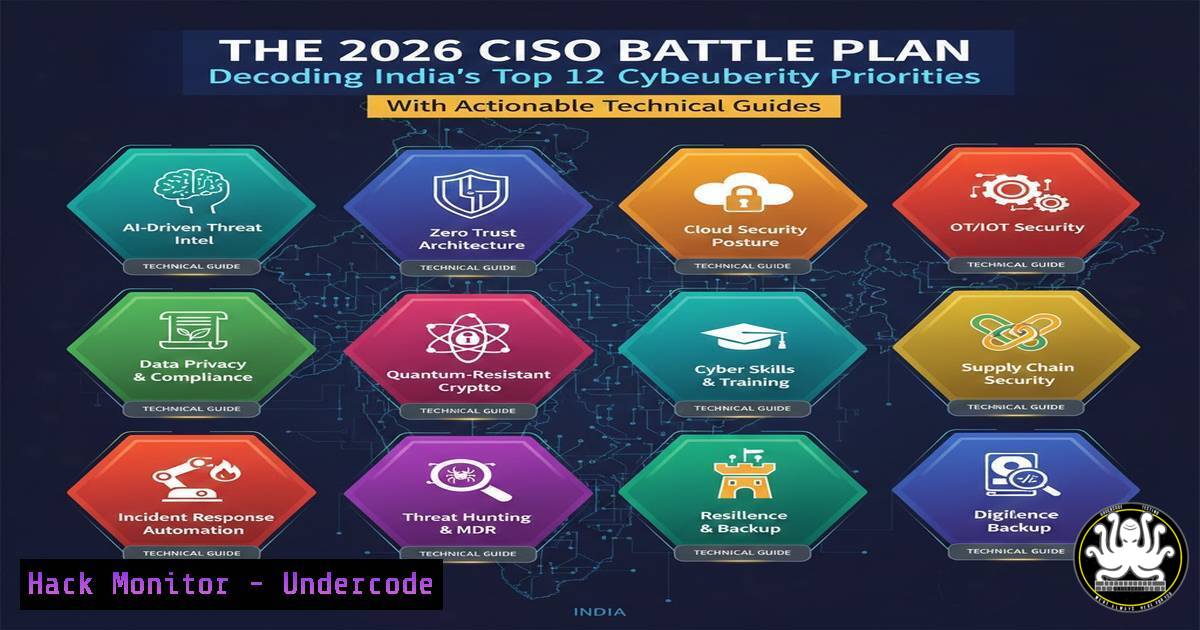
The cybersecurity landscape is undergoing a seismic shift, driven by regulatory pressures like India’s DPDP Act and the explosive adoption of AI and multi-cloud environments. For Indian CISOs, the 2026 priorities outlined by industry leaders are not just a checklist but a strategic blueprint for survival and resilience. This article delves into the core technical and governance challenges, transforming high-level priorities into actionable security postures. We will dissect critical areas such as AI security governance, Zero Trust architecture implementation, and cloud hardening, providing concrete steps, commands, and configurations to bridge the gap between strategy and execution.
Learning Objectives:
- Understand the technical implications of India’s DPDP Act 2025 and implement foundational Data Protection Impact Assessments (DPIAs).
- Architect and enforce a Zero Trust Identity and Access Management (IAM/PAM) model in hybrid environments.
- Harden multi-cloud (AWS/Azure) deployments against common misconfigurations and implement offensive security testing routines.
You Should Know:
- DPDP Act 2025 Compliance: From Legal Text to Technical Controls
The Digital Personal Data Protection (DPDP) Act 2025 mandates a principles-based approach to data privacy. A DPIA is not just a paperwork exercise; it’s a continuous technical process to identify and mitigate risks in data processing activities.
Step‑by‑step guide:
Step 1: Data Discovery and Classification: You cannot protect what you don’t know. Use tools to scan your data repositories.
Linux (using `find` and `grep` for basic discovery):
 Find files containing potential personal identifiers like Aadhaar or PAN patterns
find /path/to/data -type f -name ".csv" -o -name ".json" -o -name ".txt" | xargs grep -l "[0-9]{4}\s[0-9]{4}\s[0-9]{4}" 2>/dev/null
Cloud (AWS Macie / Azure Purview): Enable these native services for automated discovery and classification of sensitive data in S3 buckets and Azure Blob Storage.
Step 2: Map Data Flows: Document how personal data moves through your applications using tools like OWASP Threat Dragon or network diagramming software.
Step 3: Implement Technical Safeguards: Based on classification, enforce encryption (at-rest and in-transit), strict access controls, and data retention policies.
AWS S3 Bucket Encryption & Policy:
{
"Version": "2012-10-17",
"Statement": [
{
"Effect": "Deny",
"Principal": "",
"Action": "s3:GetObject",
"Resource": "arn:aws:s3:::your-sensitive-bucket/",
"Condition": {
"Bool": {"aws:SecureTransport": false}
}
}
]
}
- AI/GenAI Security Risks and Governance: Securing the Prompt Pipeline
AI security extends beyond model theft to include prompt injection, data poisoning, and sensitive information leakage through training data or outputs.
Step‑by‑step guide:
Step 1: Implement Input Sanitization and Guardrails: Treat all LLM inputs as untrusted. Use a dedicated security layer to validate and sanitize prompts.
Python Example (Basic Sanitization):
import re
def sanitize_prompt(user_input):
 Remove potential system prompt leaks or dangerous commands
blacklist = ['system:', 'ignore previous', 'sudo', 'rm -rf']
pattern = re.compile('|'.join(re.escape(cmd) for cmd in blacklist), re.IGNORECASE)
sanitized = pattern.sub('[bash]', user_input)
 Truncate length to limit prompt injection complexity
return sanitized[:1000]
Step 2: Enforce Output Filtering and Logging: Scan all model outputs for PII, confidential data, or harmful content before delivery. Log all interactions for audit and anomaly detection.
Step 3: Adopt a Secure AI Development Lifecycle (SAIDL): Integrate security checks at each stage: data sourcing, model training, deployment, and monitoring.
3. Zero Trust IAM/PAM: Assume Breach, Verify Explicitly
Zero Trust dismantles the traditional network perimeter. The core principle is “never trust, always verify,” applied to every user, device, and application request.
Step‑by‑step guide:
Step 1: Implement Strong Multi-Factor Authentication (MFA): Enforce MFA universally, using phishing-resistant methods like FIDO2/WebAuthn security keys.
Windows (Azure AD/Entra ID) PowerShell:
 Enforce MFA for all users (via Conditional Access policy in Azure AD Portal is recommended)
 Audit users without MFA registered:
Get-MsolUser -All | Where-Object {$_.StrongAuthenticationMethods.Count -eq 0} | Select-Object UserPrincipalName
Step 2: Adopt Just-In-Time (JIT) and Just-Enough-Privilege (JEP) Access: For privileged accounts (PAM), use solutions that provide temporary, elevated access.
Linux (using `sudo` with time-based restrictions – conceptual):
 In /etc/sudoers.d/privileged_users
 User 'admin' can run commands as root only between 9 AM and 5 PM
admin ALL=(ALL) TIMEOUT=60, TIMED=9:00-17:00 /usr/bin/systemctl
Step 3: Micro-segment Network Access: Use identity-aware proxies (e.g., Zscaler, Cloudflare Zero Trust) and software-defined perimeters to grant access to specific applications, not the entire network.
- Cloud Security in Multi-Cloud AWS/Azure: The Hardening Blueprint
Misconfigurations are the primary attack vector in the cloud. Consistency and automation are key across providers.
Step‑by‑step guide:
Step 1: Enable Foundational Logging and Monitoring:
AWS: Enable AWS CloudTrail for all regions, Amazon GuardDuty, and configure S3 access logs.
Azure: Enable Azure Activity Log, Microsoft Defender for Cloud, and diagnostic settings for all resources.
Step 2: Enforce Encryption and Secure Networking:
Azure CLI (Enable Storage Encryption):
az storage account update --name <storage_account> --resource-group <resource_group> --encryption-services blob file
AWS CLI (Deny Public S3 Buckets):
aws s3api put-public-access-block --bucket <bucket-name> --public-access-block-configuration "BlockPublicAcls=true,IgnorePublicAcls=true,BlockPublicPolicy=true,RestrictPublicBuckets=true"
Step 3: Automate Compliance Scanning: Use Infrastructure as Code (IaC) scanners like tfsec, checkov, or `cft_nag` to scan Terraform and CloudFormation templates before deployment.
5. Offensive Security/Continuous Testing: The Attacker’s Mindset
Proactive vulnerability discovery through continuous penetration testing and red teaming is non-negotiable.
Step‑by‑step guide:
Step 1: Automated Vulnerability Scanning: Integrate SAST, DAST, and SCA tools into your CI/CD pipeline.
Using OWASP ZAP CLI in a Pipeline:
docker run -v $(pwd):/zap/wrk/:rw -t owasp/zap2docker-stable zap-baseline.py \
-t https://your-test-app.com -g gen.conf -r testreport.html
Step 2: Regular Purple Team Exercises: Simulate real-world attacks (using frameworks like MITRE ATT&CK) and test your detection (Blue Team) and response capabilities simultaneously.
Step 3: External Attack Surface Management (EASM): Continuously discover and assess internet-facing assets, including shadow IT, using tools like `projectdiscovery.io` suites.
What Undercode Say:
- Strategic Convergence: The 2026 priorities highlight a convergence of compliance (DPDP), emerging tech risk (AI), and foundational security architecture (Zero Trust, Cloud). Success requires treating them as interconnected, not siloed.
- The Efficiency Imperative: “Tool consolidation for budget efficiency” is a critical admission. The future belongs to integrated platforms (XDR, CNAPP) that reduce complexity and alert fatigue, rather than a sprawl of point solutions.
- Analysis: The list is a definitive move from reactive, perimeter-based security to a proactive, data-centric, and identity-aware model. The inclusion of “Board-level cyber diplomacy” underscores that the CISO’s role is now as much about translating technical risk into business terms as it is about managing firewalls. The emphasis on AI security and nation-state threats indicates preparedness for both technological disruption and sophisticated geopolitical cyber campaigns. The most successful CISOs will be those who can execute on the technical hardening detailed in this guide while simultaneously elevating their narrative to the boardroom.
Prediction:
By 2026, we will see a clear divide between organizations that treated these priorities as a cohesive strategy and those that approached them in a fragmented manner. AI-driven attacks, particularly through sophisticated prompt injection and poisoned datasets, will cause significant breaches, making AI governance a top spending area. Compliance with the DPDP Act will evolve from a baseline requirement to a competitive advantage in consumer trust. Furthermore, the consolidation of security tools will accelerate, driven by AI-powered security operations platforms that can autonomously correlate threats across identity, endpoint, and cloud, making the current SIEM-centric model increasingly obsolete.
▶️ Related Video (78% Match):
https://www.youtube.com/watch?v=D4fYyu305jg
🎯Let’s Practice For Free:
IT/Security Reporter URL:
Reported By: Praveensk007 Cybersecurity – Hackers Feeds
Extra Hub: Undercode MoN
Basic Verification: Pass ✅


