
Listen to this Post
Introduction:
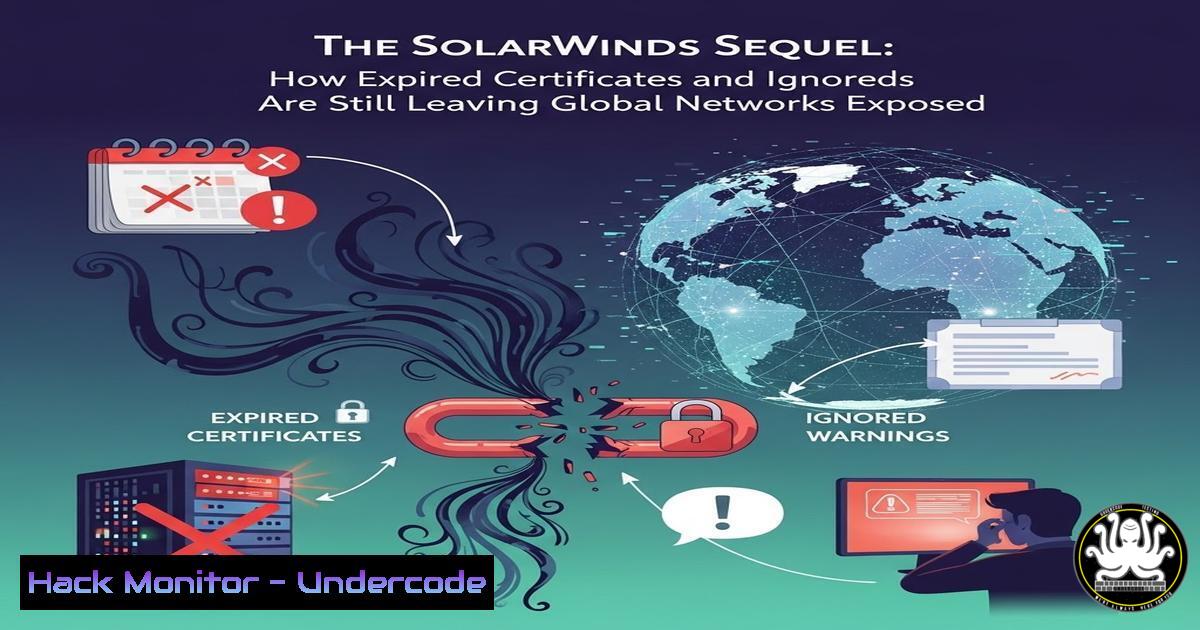
The 2020 SolarWinds supply-chain attack was a watershed moment in cybersecurity, compromising thousands of high-profile organizations through trusted software updates. Despite this catastrophic lesson, recent analysis reveals that fundamental security negligence, including expired TLS certificates and unhardened internet-facing assets, persists at the company. This ongoing failure transforms a potential lesson in resilience into a case study in repeated, avoidable risk.
Learning Objectives:
- Understand the critical role of disciplined certificate lifecycle management in preventing basic trust failures.
- Learn how to actively discover, inventory, and harden your organization’s internet-facing assets to reduce attack surfaces.
- Implement continuous monitoring and validation workflows to ensure security warnings are acted upon, not ignored.
You Should Know:
- The Crippling Impact of Expired and Misconfigured TLS Certificates
The post highlights that SolarWinds infrastructure was observed with expired TLS certificates, triggering browser security warnings. This is not a minor oversight; it’s a critical failure in maintaining the trust and integrity of services. An expired certificate breaks the chain of trust, can cause service outages, and opens the door to man-in-the-middle (MITM) attacks where traffic can be intercepted or spoofed. It signals a profound breakdown in basic IT hygiene and asset management processes.
Step-by-Step Guide to Proactive Certificate Management:
Discovery & Inventory: You cannot manage what you don’t know. Use tools to scan your domains and subdomains.
Command (Linux – using `openssl` and `nmap`):
 Get certificate details for a specific host
openssl s_client -connect yourdomain.com:443 -servername yourdomain.com 2>/dev/null | openssl x509 -noout -dates -subject

Use nmap to check certificates on a range of hosts
nmap --script ssl-cert -p 443 yournetwork-range/24
Tool Recommendation: Implement an automated certificate discovery and inventory tool like certspotter, LetsMonitor.org, or enterprise solutions from Venafi or HashiCorp Vault.
Monitoring & Automation:
- Centralize Tracking: Maintain a dynamic inventory of all certificates (public and internal), including issuer, expiry date, and associated service.
- Set Alerts: Configure alerts to trigger at 30, 14, and 7 days before expiry. Never rely on a single alert.
- Automate Renewal: Where possible, use automated renewal (e.g., ACME protocol with Let’s Encrypt, automated processes in Windows Certificate Server).
Example Certbot Renewal (Linux):
 Test renewal dry-run
sudo certbot renew --dry-run
 Set up automated renewal via cron (usually pre-configured)
sudo systemctl status certbot.timer
2. Internet Asset Inventory and Attack Surface Reduction
Andy Jenkinson’s direct warning stressed: “If the Internet Assets are Not Secured, the chances of falling victim to cyber crime is greatly increased.” An unknown or unmanaged asset is a liability.
Step-by-Step Guide to Asset Discovery and Hardening:
External Discovery (The Attacker’s View):
- Passive Enumeration: Use tools like
Amass,Subfinder, or `theHarvester` to passively find subdomains and assets associated with your domains.amass enum -passive -d yourcompany.com
- Active Scanning (Authorized Only): Use `nmap` or `masscan` to identify open ports and services on discovered IP ranges.
nmap -sV -O --top-ports 1000 -iL discovered_ips.txt
Internal Inventory Reconciliation:
- Cross-reference externally discovered assets with your internal CMDB (Configuration Management Database).
- Tag Assets: Classify assets as “Approved/Managed,” “Approved/Unmanaged,” or “Unauthorized.”
3. Harden Immediately: For all approved assets, ensure:
Unnecessary ports are closed.
Services are patched and minimally configured.
Default credentials are changed.
Only TLS 1.2/1.3 is enabled with strong cipher suites.
- Building an Actionable Threat Intelligence and Warning Response Loop
The post reveals that direct threat intelligence was provided to SolarWinds leadership but was largely ignored. Having a process to act on findings is as crucial as the findings themselves.
Step-by-Step Guide to Operationalizing Warnings:
- Formalize Intake: Create a dedicated, ticketed intake process (e.g., Jira Service Desk, dedicated email alias) for all security warnings, internal and external.
- Triage & Prioritize: Implement a risk-based scoring model (e.g., CVSS) to prioritize warnings. An expired certificate on a customer login portal is a P1 (Critical), not a P3.
- Assign & Track: Every ticket must have a clear owner, SLA for acknowledgment, and a resolution deadline. Use dashboards for management oversight.
- Verify Closure: Closure requires verification, not just a stated fix. Re-scan the asset to confirm the certificate is renewed or the vulnerability is patched.
4. Implementing Continuous Security Validation (CSV)
Assume your defenses will have gaps. CSV actively and safely tests your security controls against known TTPs (Tactics, Techniques, and Procedures).
Step-by-Step Guide to Basic CSV:
Concept: Use safe, controlled exploits to test your environment. Think of it as continuous penetration testing.
Tool Setup (Example with `Metasploit` for internal testing):
1. Authorize Testing: Obtain explicit, written authorization for defined systems and windows.
2. Set Up a Test Environment: Start with a non-production replica.
3. Run a Safe Test Module:
 Example: Testing for weak SMB protocols (MS17-010 EternalBlue simulation)
use auxiliary/scanner/smb/smb_version
set RHOSTS 192.168.1.0/24
run
4. Analyze & Remediate: Document any failures in security controls (e.g., patch management, firewall rules) and remediate.
5. Cloud and Hybrid Environment Hardening
Modern infrastructure like SolarWinds’ likely spans cloud and on-premise. Misconfiguration is the primary risk.
Step-by-Step Guide to Critical Cloud Hardening Checks:
AWS CLI Command Examples:
1. Find Publicly Accessible S3 Buckets:
aws s3api list-buckets --query "Buckets[].Name"
aws s3api get-bucket-policy-status --bucket NAME --profile prod
2. Check for Security Groups with Overly Permissive Rules:
aws ec2 describe-security-groups --filters "Name=ip-permission.cidr,Values=0.0.0.0/0" --query "SecurityGroups[].[GroupId,GroupName]"
Azure CLI Command Example (Check for Storage Account Public Access):
az storage account list --query "[].{Name:name, RG:resourceGroup, PublicAccess:allowBlobPublicAccess}" --output table
Action: Ensure all cloud storage is private by default, implement mandatory tagging, and use IaC (Infrastructure as Code) scanning tools like Checkov, Terraform Scan, or CSPM (Cloud Security Posture Management) tools.
What Undercode Say:
- Negligence is a Choice, Not a Circumstance: The SolarWinds case post-2020 shifts from being a victim of a sophisticated APT to an exemplar of negligent security management. Ignoring direct, actionable warnings on basic hygiene like certificate management is an indefensible operational failure.
- The “Busy Fool” Paradox: The post’s warning about becoming “busy fools” cleaning up preventable incidents is acute. Security teams investing in advanced threat intel while failing to lock foundational doors are misallocating resources, leading to burnout and breach.
Analysis: This situation transcends a single company’s failure. It represents a critical failure in governance, accountability, and security culture. The CISO and board are ultimately responsible for ensuring that warnings transition into actionable workflows with verification. When a company of this profile, serving government and critical infrastructure, repeatedly fails at Security 101, it erodes trust in the entire ecosystem and invites regulatory scrutiny. The lesson is universal: a vulnerability ignored due to perceived “low sophistication” is the very gap that will be exploited, and the court of public opinion (and potentially law) will judge the negligence harshly.
Prediction:
In the next 12-24 months, we will see regulators and large enterprise customers move beyond contractual security clauses to demand provable, auditable evidence of foundational security hygiene. This will manifest as mandatory independent audits of certificate management, asset inventories, and patch latency metrics for critical software vendors. Companies that fail to demonstrate this operational discipline will face exclusion from major procurement lists, massive liability lawsuits following breaches, and potentially new industry-specific cybersecurity licensing requirements that could put them out of business. The era of “trust us” is over; the era of “prove it” has begun.
▶️ Related Video (78% Match):
🎯Let’s Practice For Free:
IT/Security Reporter URL:
Reported By: Andy Jenkinson – Hackers Feeds
Extra Hub: Undercode MoN
Basic Verification: Pass ✅


