Listen to this Post
Introduction:
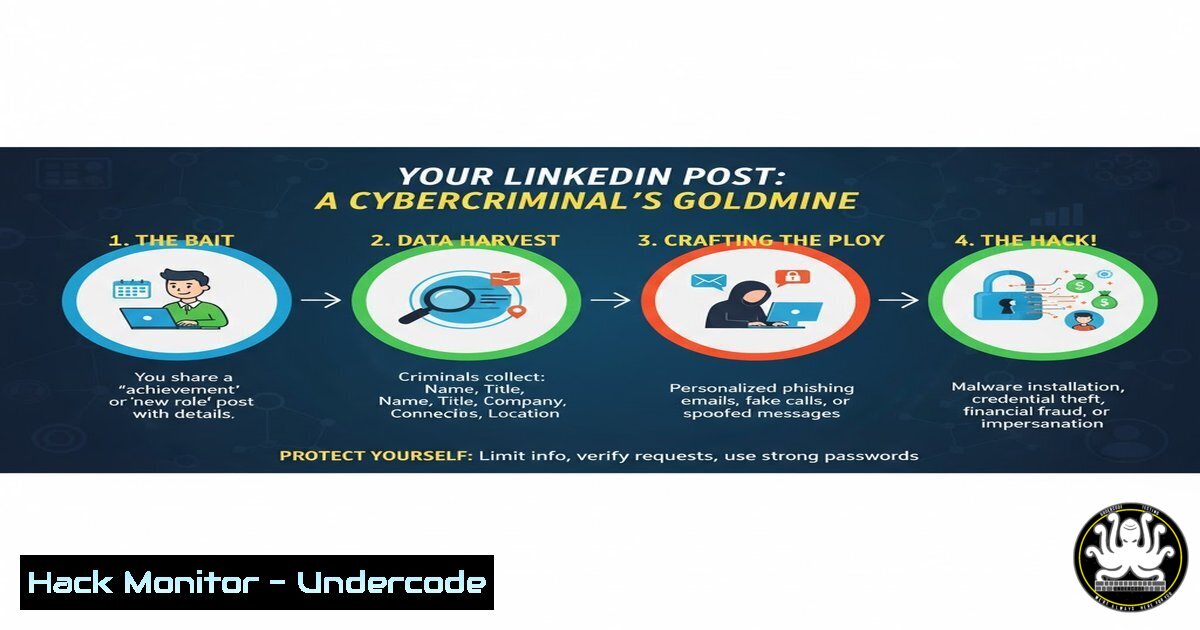
In an era of digital oversharing, a celebratory post about a new job can seem harmless. However, this public information serves as a foundational element for sophisticated social engineering and targeted phishing attacks. Understanding how threat actors weaponize such data is crucial for both personal and corporate cybersecurity.
Learning Objectives:
- Identify the specific data points in social media posts that are valuable for reconnaissance.
- Implement technical controls to detect and prevent credential harvesting and spear-phishing.
- Apply OSINT (Open-Source Intelligence) techniques defensively to audit your own digital footprint.
You Should Know:
1. The Anatomy of a Reconnaissance Post
A simple job announcement post provides a shocking amount of data for an attacker’s reconnaissance phase. This information is used to build a profile for targeted attacks.
Step-by-step guide explaining what this does and how to use it.
– Target Identification: The post confirms the target’s full name (Medina Z.), current employer (Saint Gobain), and role (Chargée de communication interne). This is primary intelligence.
– Timeline Establishment: The mention of a two-month search and a start date around March provides a timeline for when the target was most vulnerable and is now new in the role, a prime target for fake “IT onboarding” phishing emails.
– Social Graph Mapping: The public thanks to colleagues like “Antoine Fossaluzza” and “Lauryne Henrio” maps out the target’s immediate professional network. Attackers can impersonate these individuals in whaling attacks.
– Defensive Action: Conduct regular audits of your public social media profile. Use a tool like `Sherlock` (Linux) to find associated accounts.
 Install and use Sherlock to find associated social media accounts
git clone https://github.com/sherlock-project/sherlock.git
cd sherlock
python3 -m pip install -r requirements.txt
python3 sherlock "Medina Z"
2. Weaponizing Data for Spear-Phishing
With the gathered intelligence, attackers craft highly convincing phishing emails that bypass traditional spam filters.
Step-by-step guide explaining what this does and how to use it.
– Email Spoofing: An attacker might send an email spoofed from “Antoine Fossaluzza antoine.fossaluzza@saint-gobain.com” with the subject “Onboarding Documents – URGENT”.
– Payload Delivery: The email contains a link to a fake SharePoint or corporate login page designed to harvest credentials.
– Defensive Mitigation: Implement DMARC, DKIM, and SPF records for your domain to prevent email spoofing. For Windows administrators, check your SPF record using PowerShell:
 PowerShell to resolve and check TXT records for SPF
Resolve-DnsName -Type TXT "saint-gobain.com" | Where-Object { $_.Strings -match "v=spf1" }
– User Training: Train employees to hover over links to verify the actual URL and to be wary of urgent requests for credentials.
3. Building a Defensive Home Lab with SIEM
A Security Information and Event Management (SIEM) system can aggregate logs and detect phishing campaign patterns.
Step-by-step guide explaining what this does and how to use it.
– Set Up ELK Stack: A free, open-source SIEM solution. Start by installing Elasticsearch, Logstash, and Kibana on a Linux server.
 Update and install Java (required for ELK)
sudo apt update && sudo apt install openjdk-11-jdk -y

Import Elasticsearch GPG key and add repository
wget -qO - https://artifacts.elastic.co/GPG-KEY-elasticsearch | sudo apt-key add -
echo "deb https://artifacts.elastic.co/packages/7.x/apt stable main" | sudo tee /etc/apt/sources.list.d/elastic-7.x.list

Install Elasticsearch, Logstash, and Kibana
sudo apt update && sudo apt install elasticsearch logstash kibana

Start and enable services
sudo systemctl daemon-reload
sudo systemctl enable elasticsearch kibana
sudo systemctl start elasticsearch kibana
– Forward Email Logs: Configure your mail server to forward SMTP logs to Logstash for analysis.
– Create Detection Rules: In Kibana, create a detection rule for a high volume of emails with “onboarding” in the subject line from external domains.
4. Hardening Cloud API Security
Attackers who phish credentials may target cloud APIs (e.g., Microsoft Graph API for Office 365) to exfiltrate data.
Step-by-step guide explaining what this does and how to use it.
– Enable Multi-Factor Authentication (MFA): MFA is the single most effective control against credential theft. Enforce it for all users, especially those in communication roles.
– Audit Application Permissions: Regularly review which third-party applications have access to your corporate environment.
– For Microsoft 365: Go to Azure Active Directory > Enterprise Applications > All Applications. Review and remove any suspicious or unused applications.
– Use Conditional Access Policies: Create policies that block sign-in attempts from unfamiliar locations or non-compliant devices.
5. Vulnerability Exploitation: The Human Element
The human is often the most exploitable vulnerability. Training must go beyond basic awareness.
Step-by-step guide explaining what this does and how to use it.
– Simulated Phishing Campaigns: Use open-source tools like `Gophish` to run internal phishing simulations.
 Download and install Gophish
wget https://github.com/gophish/gophish/releases/download/v0.12.1/gophish-v0.12.1-linux-64bit.zip
unzip gophish-v0.12.1-linux-64bit.zip
sudo ./gophish
– Create Realistic Templates: Build a phishing email template based on the “job announcement” scenario to test employee vigilance.
– Measure and Educate: Provide immediate feedback to users who fail the test, turning the simulation into a training moment.
6. Digital Footprint Analysis with OSINT
Proactively manage your online presence before an attacker uses it against you.
Step-by-step guide explaining what this does and how to use it.
– Google Yourself: Perform regular searches for your name, email address, and company to see what is publicly available.
– Use Maltego: A powerful OSINT tool to graphically map relationships and data leaks.
– Download Maltego CE and use the “Transform Hub” to install transforms for domain and person searches.
– Lock Down Privacy Settings: Review and tighten privacy settings on LinkedIn, Facebook, and other social platforms. Assume anything public will be found by adversaries.
What Undercode Say:
- Your Celebration is Their Reconnaissance. Every public detail about your professional life is a data point that can be weaponized in a targeted attack. The line between personal sharing and corporate security is thinner than ever.
- Technical Controls Are Useless Without User Awareness. The most expensive SIEM and the strictest firewall rules can be undone by a single click on a well-crafted spear-phishing link. Continuous, realistic security training is not optional.
The analysis reveals a critical disconnect: individuals view social media as a personal space for career milestones, while cybersecurity professionals see an uncontrolled public data leak. The post by Medina Z., while positive and well-intentioned, is a textbook example of the raw material used for Advanced Persistent Threat (APT) campaigns. It provides identity verification, social proof, and a timeline—all of which increase the success rate of phishing by orders of magnitude. Defending against this requires a cultural shift where employees are educated to be the first line of defense, understanding the security implications of their digital interactions.
Prediction:
The future of social engineering will be dominated by AI-powered hyper-personalization. We will see a rise in attacks where AI analyzes thousands of posts to generate perfectly timed, context-aware phishing messages that mimic the writing style of the target’s trusted colleagues. Deepfake audio and video, used in vishing (voice phishing) attacks, will become commonplace, with AI synthesizing a manager’s voice to authorize fraudulent transactions. The only effective defense will be a zero-trust architecture combined with pervasive, AI-enhanced behavioral analytics that flag anomalous communication patterns, making the human element less of a vulnerability.
🎯Let’s Practice For Free:
IT/Security Reporter URL:
Reported By: Medina Zeciri – Hackers Feeds
Extra Hub: Undercode MoN
Basic Verification: Pass ✅


