Listen to this Post
Introduction:
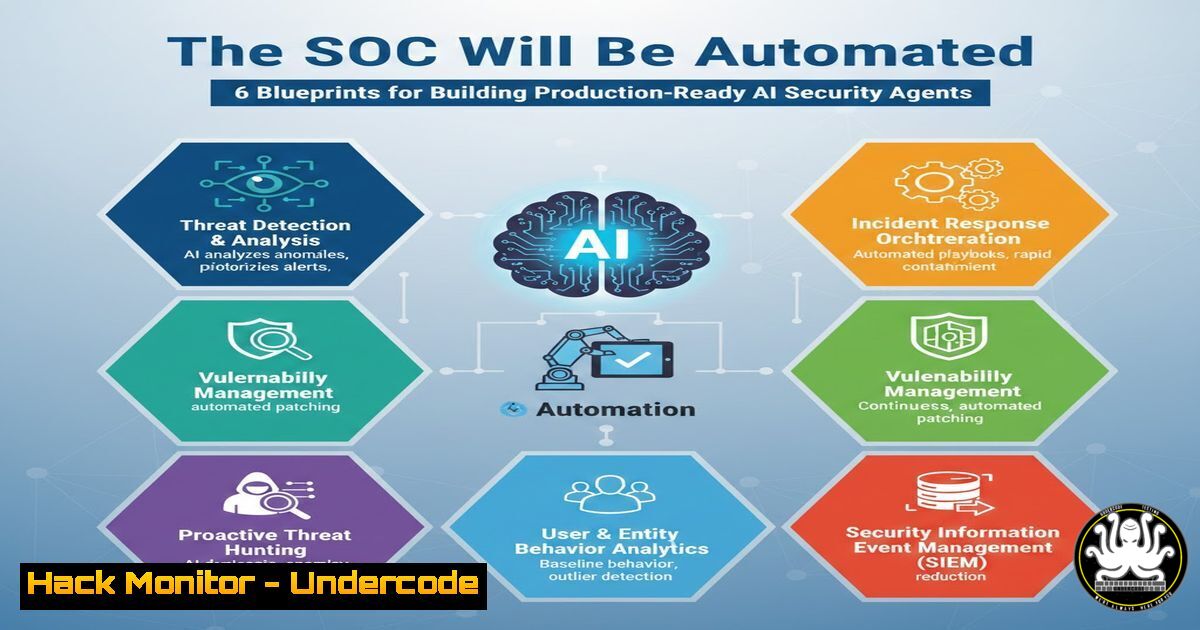
The cybersecurity industry is standing at a precipice. While large language models have democratized access to information, they have historically been unreliable for autonomous operations in the Security Operations Center (SOC). The content shared by industry leaders highlights a critical shift: moving from isolated LLM queries to persistent, collaborative, and observable agentic systems. This article synthesizes those insights into a technical blueprint for building AI agents that don’t just chat, but actively defend networks, hunt threats, and harden cloud environments with verifiable reliability .
Learning Objectives:
- Objective 1: Architect multi-agent systems with persistent memory and decision traceability for forensic analysis.
- Objective 2: Implement automated evaluation frameworks (“LLM Judges”) to score agent performance against security KPIs.
- Objective 3: Deploy recursive language models and context graphs to handle long-term threat hunting across massive datasets.
You Should Know:
1. Implementing a Reasoning Ledger for Threat Analysis
Traditional SOC tools log what happened (IPs, hashes, timestamps). AI agents must log why they took action. Using open-source tooling like Thoughtbox, we can create a durable reasoning chain for every investigation .
Step‑by‑step guide: Installing an MCP Server for Observability
To ensure your security agent’s decision-making is auditable, you need a Model Context Protocol (MCP) server for reasoning.
 Install the Thoughtbox MCP server globally
npx -y @kastalien-research/thoughtbox

Configure it for your SOC environment (e.g., with Code)
 Edit ~/./settings.json
{
"mcpServers": {
"thoughtbox": {
"command": "npx",
"args": ["-y", "@kastalien-research/thoughtbox"]
}
}
}
What this does: This creates a “reasoning ledger.” When your agent investigates an alert, it outputs structured thoughts (e.g., “Thought 1: Cross-referencing IP with VirusTotal…”). This allows analysts to later replay the agent’s logic, which is crucial for compliance (e.g., GDPR/PCI-DSS investigations) where you must prove why a system was quarantined .
2. Building an Automated Evaluation Framework
As noted in the discourse, “LLM Judges aren’t the shortcut you think.” To trust an agent in production, you must constantly evaluate it. The UK AI Security Institute’s Inspect Cyber framework provides a standardized way to do this .
Step‑by‑step guide: Evaluating an Agent on a Capture The Flag Challenge
 Install Inspect Cyber
pip install inspect-cyber

Create a basic evaluation for a phishing analysis agent
 Create a file: eval_phishing_agent.py
from inspect_cyber import eval_task, sandbox

@sandbox.ubuntu
def task_analyze_email():
 The agent is given an email file
email_content = "URGENT: Reset your password here: http://evil.com"
 Expected output: The agent must extract the URL and mark it malicious
return {
"instruction": "Analyze this email for phishing indicators",
"files": {"email.eml": email_content}
}

Run the evaluation against your agent
inspect eval eval_phishing_agent.py --model openai/gpt-4
What this does: This framework spins up isolated sandboxes, runs the agent against thousands of scenarios, and scores its ability to correctly identify threats without hallucinating. It moves the agent from “demoware” to a measurable security tool .
3. Building a Context Graph for Persistent Memory
Agents today forget conversations. In cybersecurity, context is king. If an agent discovered a lateral movement path yesterday, it must remember it today. The “Context Graph” approach allows agents to store relationships between entities (users, files, processes) .
Step‑by‑step guide: Implementing a Vector Memory Store
Using a combination of ChromaDB and LangChain, you can give your agent long-term memory.
 Python script for agent memory
import chromadb
from langchain.embeddings import OpenAIEmbeddings

Initialize persistent memory
chroma_client = chromadb.PersistentClient(path="./security_memory")
collection = chroma_client.get_or_create_collection(name="ioc_memory")

When agent finds an IoC
def remember_ioc(ioc_value, ioc_type, analysis):
embedding = OpenAIEmbeddings().embed_query(analysis)
collection.add(
documents=[bash],
embeddings=[bash],
metadatas=[{"type": ioc_type, "value": ioc_value, "timestamp": "2026-02-28"}],
ids=[f"{ioc_type}_{ioc_value}"]
)

When investigating a new alert, the agent recalls similar past events
def recall_similar_events(query):
results = collection.query(query_texts=[bash], n_results=5)
return results['documents'][bash]
What this does: This allows the agent to build a corporate memory of attacker TTPs. If it sees an IP address, it can recall if that IP was associated with a past ransomware campaign without re-querying external APIs .
4. Deploying Recursive Language Models for Log Analysis
Modern logs are massive. A standard LLM cannot process 10 million lines of Windows Event Logs. Recursive Language Models (RLMs) solve this by allowing an agent to spawn child agents to process chunks of data .
Step‑by‑step guide: RLM Logic for Splunk Data
 Conceptual RLM code using Google ADK
class LogAnalysisAgent:
def analyze_logs(self, query, log_data_chunks):
 If the log data is too big, delegate
if len(log_data_chunks) > 1000:
child_tasks = []
for chunk in log_data_chunks[:10]:  Parallel processing
child = LogAnalysisAgent()
 Recursive call - agent spawns agent
child_tasks.append(child.analyze_logs(query, [bash]))
 Aggregate results
return self.aggregate(child_tasks)
else:
 Process small chunk locally
return self.llm_analyze(query, log_data_chunks)
What this does: This architecture allows the system to scale horizontally. If you need to find a specific error code across petabytes of logs, the agent splits the job, processes it in parallel, and synthesizes the findings. This is how we move beyond the context window limitations of current models .
5. API Security and Tool Calling Hardening
Agentic AI is only as safe as the APIs it calls. A compromised agent with API keys can delete cloud infrastructure. The AgentGuard framework suggests using the orchestrator itself to validate safety constraints .
Step‑by‑step guide: Implementing Safety Constraints in AWS
 Example: Hardening an agent that manages AWS security groups
 Instead of giving the agent direct AWS keys, use a middleware

Middleware script (agent_safe_wrapper.py)
import subprocess
import json

def execute_aws_command(agent_command):
 Parse the command the agent wants to run
 e.g., "aws ec2 authorize-security-group-ingress --group-id sg-xxxx --protocol tcp --port 22 --cidr 0.0.0.0/0"

SAFETY CHECK: Block public SSH access
if "--port 22" in agent_command and "--cidr 0.0.0.0/0" in agent_command:
return {"error": "Blocked by AgentGuard: Public SSH access is prohibited."}

If safe, execute
result = subprocess.run(agent_command, shell=True, capture_output=True, text=True)
return json.loads(result.stdout)

The agent calls this function instead of raw subprocess
What this does: This creates a Read-Only or Constrained-Execution layer. The agent can suggest changes, but the wrapper enforces the “Principle of Least Privilege” at the code level, preventing zero-day prompt injections from wreaking havoc on your cloud estate .
What Undercode Say:
- Observability is Non-Negotiable: In security, a “black box” AI is a liability. Implementing reasoning ledgers (like Thoughtbox) turns agent decisions into forensic evidence. You must be able to audit why an agent blocked a user or flagged a binary .
- Evaluation is the Hard Part: The community consensus is clear—building the agent is easy; proving it works reliably is the actual engineering challenge. Frameworks like Inspect Cyber are becoming mandatory for compliance in regulated industries .
- Hybrid Architectures Win: The future is not one giant model, but a swarm of specialized agents (for log analysis, for IAM review, for threat intel) communicating via memory graphs. This mirrors the shift from monolithic SIEMs to data lakes .
Prediction:
By Q4 2026, we will see the first “Fully Autonomous SOC” vendors emerge, where 95% of Level 1 and Level 2 alerts are triaged, investigated, and remediated by collaborative agent swarms without human intervention. However, this will be immediately followed by regulatory scrutiny, forcing the standardization of agent evaluation frameworks (like Inspect Cyber) into law, similar to how SOX mandated financial controls. The battle will shift from “Can we automate?” to “Can we prove the automation is secure?” .
▶️ Related Video (82% Match):
🎯Let’s Practice For Free:
IT/Security Reporter URL:
Reported By: Dylan Williams – Hackers Feeds
Extra Hub: Undercode MoN
Basic Verification: Pass ✅


