Listen to this Post
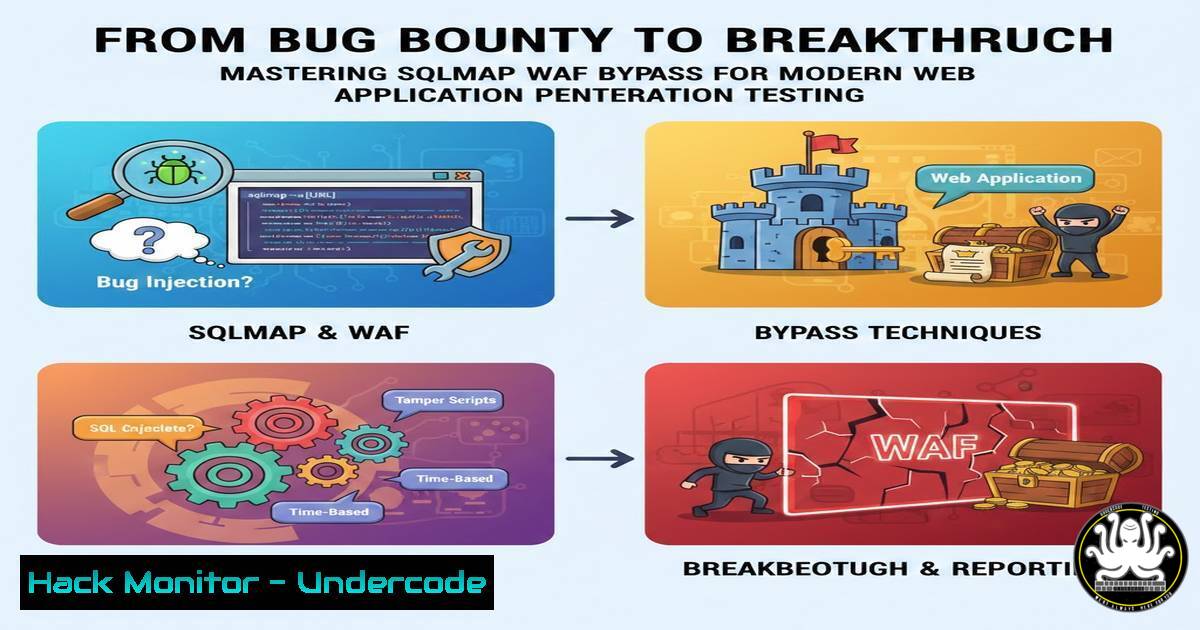
Introduction:
In the high-stakes arena of bug bounty hunting, the difference between a “Not Applicable” and a critical payout often hinges on a penetration tester’s ability to circumvent Web Application Firewalls (WAFs). As highlighted by a recent community post featuring a successful bounty reward, the evolution of SQL injection tools requires testers to move beyond basic automation. This article dissects a real-world SQLMap command used to bypass security filters, explaining the mechanics of each switch, how to adapt to tool deprecations, and how to integrate these techniques into a robust offensive security methodology.
Learning Objectives:
- Analyze advanced SQLMap switches for evading modern WAF configurations during POST-based assessments.
- Identify deprecated SQLMap options and adapt command structures using current tool capabilities and tamper scripts.
- Implement a multi-layered evasion strategy combining HTTP header manipulation, parameter obfuscation, and aggressive payload levels.
- Apply these techniques within the context of responsible disclosure and bug bounty program rules of engagement.
You Should Know:
1. Deconstructing the Evasion Command
The foundation of this analysis is a command shared following a successful bounty payout: sqlmap -u "https://target.com/endpoint" --data="userid=admin&passwd=admin" --method POST --identify-waf --random-agent -v 3 --tamper="between,randomcase,space2comment" --level=5 --risk=3 --dbs. This command targets a login endpoint, attempting to enumerate databases while actively trying to hide from application-layer security filters.
Step‑by‑step guide explaining what this does and how to use it:
1. Target Specification: `-u` defines the vulnerable endpoint. `–data` specifies the POST parameters (userid and passwd) being injected.
2. Method Enforcement: `–method POST` ensures the request type is explicitly set, overriding any automatic detection.
3. Fingerprinting: `–identify-waf` instructs SQLMap to probe the target and attempt to identify the specific WAF software in use (e.g., Cloudflare, ModSecurity). Note: This specific switch is now deprecated.
4. Obfuscation: `–random-agent` rotates the User-Agent header to avoid detection based on signatured bot strings. `-v 3` sets the verbosity to “Info,” showing the payloads being sent in real-time, which is crucial for debugging why a WAF might be blocking you.
5. Tampering: `–tamper=”between,randomcase,space2comment”` loads scripts that modify the payload:
– between: Replaces “>” with “NOT BETWEEN 0 AND ” and “<” with “BETWEEN AND “.
– randomcase: Randomizes the case of each keyword character (e.g., SELECT -> sElEcT).
– space2comment: Replaces space characters with comments //.
6. Intensity: `–level=5` (tests all headers and payloads) and `–risk=3` (uses heavy time-based injections) maximize the chance of finding a vulnerability but increase the risk of account lockouts or Denial of Service.
2. Handling Deprecations: The Shift from --identify-waf
A critical observation from the community discussion (pointed out by Fiaz Ahmed) is that the `–identify-waf` switch is obsolete. Modern SQLMap versions perform WAF identification automatically as part of the detection phase. Relying on outdated switches can lead to command failures or incomplete assessments.
Step‑by‑step guide on modern WAF identification and bypass adaptation:
1. Run Automated Identification: Simply omit the deprecated switch. SQLMap v1.6+ will automatically issue a `–wizard` or standard detection request that includes WAF fingerprinting.
 Modern equivalent (without the obsolete flag)
sqlmap -u "https://target.com/endpoint" --data="userid=admin&passwd=admin" --random-agent --level=3 --risk=2
2. Analyze the Output: Look for lines like `
 testing connection to the target URL` followed by <code>[bash] checking if the target is protected by some kind of WAF/IPS</code>.
3. Manual Verification: If SQLMap reports a WAF, use the `--flush-session` flag to start fresh and manually test tamper scripts.
[bash]
 Flush old data and test a specific tamper against a detected WAF
sqlmap -u "https://target.com/endpoint" --data="userid=admin&passwd=admin" --tamper=apostrophemask,bluecoat --flush-session --batch
4. Check Tool Version: Always verify your tool version to ensure compatibility with switches. `sqlmap –version`
3. Customizing Tamper Scripts for Specific WAFs
The generic tamper combination (between,randomcase,space2comment) is a good starting point, but effective bypassing requires tailoring the scripts to the specific WAF identified. Different WAFs (ModSecurity, AWS WAF, F5 ASM) have distinct parsing weaknesses.
Step‑by‑step guide on selecting and ordering tamper scripts:
1. List Available Tamper Scripts: SQLMap includes dozens of scripts. Review them to understand their function.
 List all available tamper scripts with descriptions
sqlmap --list-tampers
2. Targeted Selection:
– For ModSecurity (LibModSecurity), try --tamper=modsecurityversioned,modsecurityzeroversioned.
– For AWS WAF, try --tamper=between,multiplespaces,charencode.
– For generic Cloudflare, start with --tamper=space2comment,randomcase,versionedkeywords.
3. Order of Operations: Tamper scripts are executed in the order listed. Place scripts that normalize the query structure (like between) before those that add randomness (like randomcase) to ensure the base logic remains intact.
 Example: Structural changes first, then obfuscation
sqlmap -u "https://target.com/api/login" --data="user=admin&pass=test" --tamper="between,space2comment,randomcase" --dbs
4. Aggressive Enumeration: Balancing Level and Risk
Using `–level=5 –risk=3` is a double-edged sword. It increases coverage by testing heavy time-based blinds and a wider range of DBMS-specific syntax, but it significantly increases traffic and the probability of detection by security teams.
Step‑by‑step guide on graduated intensity escalation:
1. Start Conservative: Begin with `–level=1 –risk=1` to confirm the injection without causing noise.
2. Escalate Headers: If initial attempts fail, move to `–level=2` or --level=3. This tests User-Agent, Referer, and Host headers for second-order injections.
 Test for reflective injection in headers
sqlmap -u "https://target.com/page" --cookie="session=abc" --level=3 --risk=1
3. Introduce Risk: Only apply `–risk=2` or `–risk=3` if the injection point is confirmed but time-based extraction is failing. `–risk=3` uses OR-based payloads, which can modify data if the database permissions are loose.
 Use high risk only for read-only data extraction on a staging target
sqlmap -u "https://test.example.com/search.php" --data="q=test" --level=5 --risk=3 --no-cast
5. Debugging Evasion with Verbose Output
The `-v 3` switch is essential for understanding why a payload is being blocked. It reveals the exact HTTP requests sent and the responses received, allowing the tester to manually refine the attack.
Step‑by‑step guide on using verbose mode for manual refinement:
1. Capture the Payload: Run a scan with -v 3. Identify the specific payload that triggered a block (look for HTTP 403, 406, or a custom block page in the output).
2. Manual Replication: Copy the full request (headers + POST body) from the verbose output into a tool like Burp Suite Repeater.
3. Incremental Modification: Manually modify the payload in Repeater.
– Change comment syntax: `//` vs. `%23` vs. -- -.
– Swap encoding: URL encode keywords (%53%45%4C%45%43%54) vs. double URL encode.
4. Integrate Findings: Once a manual modification works, either write a custom tamper script or combine existing ones that replicate the successful pattern.
What Undercode Say:
– Key Takeaway 1: Automation is a starting point, not a finish line. The true value of a bug bounty hunter lies in the ability to read tool output, interpret verbose logs, and manually craft payloads when automated tamper scripts fail.
– Key Takeaway 2: Toolchain hygiene is critical. Using deprecated switches like `–identify-waf` not only breaks the scan but indicates a lack of engagement with current documentation, leading to missed vulnerabilities and wasted time.
The shared SQLMap command serves as a perfect case study in the evolution of web security testing. It demonstrates that while tools like SQLMap abstract the complexity of SQL injection, the underlying mechanics of WAF evasion—header manipulation, payload obfuscation, and traffic management—remain a deeply manual and analytical craft. Security professionals must view these commands not as black-box solutions, but as configurable frameworks to be dissected, debugged, and adapted to the unique fingerprint of each target environment. The shift from automated WAF identification to integrated, invisible detection underscores the industry’s move toward more intelligent, context-aware offensive tooling.
Prediction:
As WAFs increasingly integrate machine learning for behavioral analysis, the current generation of static tamper scripts will become less effective. The future of SQL injection tools will likely pivot toward “adversarial payload generation,” where tools use AI to dynamically mutate payloads based on real-time feedback from the WAF, mimicking the human-driven iterative process currently performed manually by top-tier penetration testers.
▶️ Related Video (78% Match):
🎯Let’s Practice For Free:
IT/Security Reporter URL:
Reported By: Https: – Hackers Feeds
Extra Hub: Undercode MoN
Basic Verification: Pass ✅


