
Listen to this Post
Introduction:
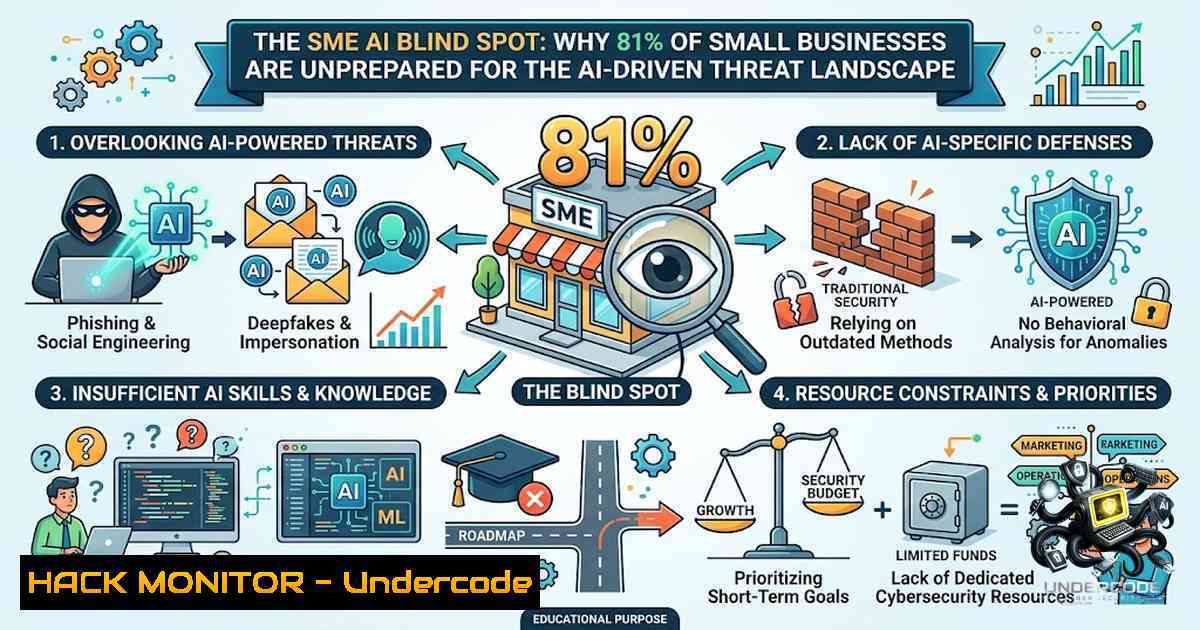
Small and medium-sized enterprises are adopting artificial intelligence at an unprecedented pace—yet security readiness is lagging dangerously behind. Recent research reveals that eight in ten SMBs remain unprepared or in early stages of preparedness for AI-related threats, while one in two SMBs reported a cyber incident or data breach in the past year. As AI-enabled phishing, vulnerability exploitation, and deepfakes emerge as leading concerns—cited by 36%, 32%, and 31% of businesses respectively—the gap between AI adoption and AI security has become the defining cybersecurity challenge for SMEs in 2026.
Learning Objectives:
- Understand the AI attack surface specific to SME environments, including shadow AI and embedded AI within SaaS platforms
- Implement practical zero-trust governance frameworks proportionate to business risk and operational constraints
- Secure AI API integrations against prompt injection, data exfiltration, and credential compromise
- Deploy monitoring and logging controls to detect anomalous AI system behaviour without enterprise-grade resources
- Align AI security practices with established frameworks including NIST AI RMF, OWASP LLM Top 10, and CISA guidance
You Should Know:
- Mapping the SME AI Attack Surface: Discovery and Inventory
The first step in securing AI adoption is understanding what AI systems actually exist within your organisation. Many SMEs unknowingly expose themselves to risk through “shadow AI”—employee use of unauthorised AI tools embedded within SaaS platforms they already pay for. You cannot protect what you cannot see.
Start by conducting a comprehensive AI inventory. This is not about creating a complex spreadsheet that becomes obsolete; it is about establishing a living document that tracks every AI system, its data inputs, outputs, and access controls. Document all AI tools including chatbots, code assistants, content generators, and any automated decision-making systems.
On Linux systems, network monitoring can help identify unauthorised AI traffic:
 Monitor outbound API traffic to detect shadow AI usage
sudo tcpdump -i any -1 'host api.openai.com or host api.anthropic.com or host api.google.com' -v

Log DNS queries to AI service domains
sudo journalctl -f -u systemd-resolved | grep -E "openai|anthropic|gemini|claude|cohere"
For Windows environments, use PowerShell to monitor process network connections:
 Identify processes connecting to known AI API endpoints
Get-1etTCPConnection -State Established | Where-Object {$_.RemoteAddress -match "openai|anthropic|googleapis"} | Select-Object LocalPort, RemoteAddress, OwningProcess

Get process details for suspicious connections
Get-Process -Id (Get-1etTCPConnection -State Established | Where-Object {$_.RemoteAddress -match "openai"}).OwningProcess
- Zero-Trust AI Governance: Practical Controls for Resource-Constrained Teams
The zero-trust model is not reserved for enterprise security teams. SMEs can implement proportionate controls that significantly reduce risk without overwhelming operational capacity. A risk-based approach works best: start with AI use cases that matter most to the business, then apply controls proportionate to the potential impact of failure.
The five core components of SME-friendly zero-trust AI governance are identity verification, device security, network segmentation, continuous monitoring, and policy enforcement.
Step-by-step implementation guide:
- Move beyond static passwords to multi-factor authentication for all AI tool access. Require MFA for every employee accessing AI platforms, including content generators, coding assistants, and data analysis tools.
-
Implement endpoint protection on all devices accessing AI systems. Deploy endpoint detection and response (EDR) solutions that can identify suspicious behaviour. For Linux, consider open-source options:
 Install and configure Wazuh agent for endpoint monitoring
curl -s https://packages.wazuh.com/key/GPG-KEY-WAZUH | apt-key add -
echo "deb https://packages.wazuh.com/4.x/apt/ stable main" | tee /etc/apt/sources.list.d/wazuh.list
apt-get update && apt-get install wazuh-agent
systemctl enable wazuh-agent && systemctl start wazuh-agent
- Segment your network to isolate AI systems from critical business data. Create separate VLANs or network zones for AI processing workloads.
-
Establish AI governance policies with clear approval authority. Designate who can approve new AI tool adoption and under what conditions.
-
Identify and consolidate shadow AI usage to approved, vetted tools. Run regular audits of software installations and cloud service subscriptions.
-
Securing AI API Integrations: Keys, Prompts, and Data Boundaries
AI API integrations present two distinct security surfaces: the ordinary service surface (keys, endpoints, users, and data) and the model-mediated surface (untrusted instructions, data exfiltration, unsafe tool requests, and output that influences downstream systems). Security work must cover both.
API key management is non-1egotiable. Never hardcode API keys in source code, configuration files, or environment variables that are committed to version control. Use secrets management solutions:
 Linux: Store API keys securely using pass or gpg
pass insert ai/openai_api_key
 Retrieve in scripts
export OPENAI_API_KEY=$(pass ai/openai_api_key)

Use hashicorp vault for production environments
vault kv put secret/ai/openai key=sk-...
vault kv get -field=key secret/ai/openai
For Windows PowerShell:
 Store encrypted credentials in Windows Credential Manager
$cred = Get-Credential
$cred.Password | ConvertFrom-SecureString | Set-Content "C:\secure\openai_cred.txt"

Retrieve in scripts
$password = Get-Content "C:\secure\openai_cred.txt" | ConvertTo-SecureString
$cred = New-Object System.Management.Automation.PSCredential("apikey", $password)
Prompt injection defence requires treating all user inputs as potentially malicious. Implement input sanitisation and validation at the application layer before passing prompts to AI models. Consider these controls:
- Limit prompt length and complexity
- Implement content filtering for known injection patterns
- Use system prompts that explicitly restrict the model’s ability to modify system instructions
- Log all prompts and responses for security auditing
Data minimisation is critical: never send more data to an AI API than absolutely necessary. Redact personally identifiable information (PII), financial data, and intellectual property before transmission. Implement data loss prevention (DLP) controls:
 Python: Basic PII redaction before sending to AI API
import re

def redact_pii(text):
 Email redaction
text = re.sub(r'\b[A-Za-z0-9._%+-]+@[A-Za-z0-9.-]+.[A-Z|a-z]{2,}\b', '[bash]', text)
 Phone number redaction (US format)
text = re.sub(r'\b\d{3}[-.]?\d{3}[-.]?\d{4}\b', '[bash]', text)
 API key detection
text = re.sub(r'sk-[A-Za-z0-9]{48,}', '[bash]', text)
return text
4. Cloud Hardening for AI Workloads
Most SMEs leverage cloud-based AI services, making cloud security posture management essential. Apply these hardening measures to your cloud environment:
AWS:
 Enable AWS Config to track AI service configurations
aws configservice put-configuration-recorder --configuration-recorder name=default,roleARN=arn:aws:iam::account-id:role/config-role

Enable CloudTrail for all AI service API calls
aws cloudtrail create-trail --1ame ai-trail --s3-bucket-1ame your-bucket --is-multi-region-trail

Restrict AI service access with IAM policies
aws iam create-policy --policy-1ame AIServiceRestrictions --policy-document file://ai-policy.json
Azure:
 Enable Azure Policy for AI resource compliance
New-AzPolicyDefinition -1ame "AIResourceRestrictions" -Policy "{
'if': {
'allOf': [
{'field': 'type', 'equals': 'Microsoft.CognitiveServices/accounts'},
{'field': 'Microsoft.CognitiveServices/accounts/sku.name', 'notEquals': 'S0'}
]
},
'then': {'effect': 'deny'}
}"

Enable diagnostic logging for AI services
Set-AzDiagnosticSetting -ResourceId $resourceId -Enabled $true -Category "AuditEvent"
Google Cloud Platform:
 Enable AI Platform API and set up logging
gcloud services enable aiplatform.googleapis.com
gcloud logging sinks create ai-sink storage.googleapis.com/your-bucket --include-children

Create service account with least privilege
gcloud iam service-accounts create ai-service --display-1ame "AI Service Account"
gcloud projects add-iam-policy-binding your-project --member="serviceAccount:[email protected]" --role="roles/aiplatform.user"
5. Continuous Monitoring and Anomaly Detection
Without enterprise-grade Security Operations Centres (SOCs), SMEs can still implement effective monitoring using open-source and low-cost solutions. The key is establishing baselines and alerting on deviations.
Linux: Set up auditd for AI system monitoring
 Monitor access to AI configuration files
auditctl -w /etc/ai/config.yaml -p wa -k ai_config_changes
auditctl -w /opt/ai/models/ -p r -k ai_model_access

Monitor AI process execution
auditctl -a always,exit -S execve -F uid!=root -k ai_process_execution

Review audit logs
ausearch -k ai_config_changes --format default
Windows: Configure PowerShell logging for AI activity
 Enable PowerShell script block logging for AI-related scripts
Set-ItemProperty -Path "HKLM:\SOFTWARE\Policies\Microsoft\Windows\PowerShell\ScriptBlockLogging" -1ame "EnableScriptBlockLogging" -Value 1

Set up Windows Event Forwarding for AI systems
wevtutil set-log "Microsoft-Windows-PowerShell/Operational" /enabled:true /retention:false /maxsize:100000

Monitor AI API key usage in event logs
Get-WinEvent -LogName "Security" | Where-Object {$_.Message -match "openai|anthropic"} | Select-Object TimeCreated, Message
Implement basic SIEM capabilities using open-source solutions like Wazuh or Elastic Stack. Configure alerts for:
– Unusual outbound traffic volumes to AI API endpoints
– Failed authentication attempts on AI platforms
– Large data transfers to AI services
– Changes to AI system configurations outside maintenance windows
– Access to AI systems from unusual geographic locations or during off-hours
6. Training and Awareness: Building the Human Firewall
The most sophisticated technical controls are ineffective without a security-conscious workforce. SMEs must invest in AI-specific cybersecurity training that addresses:
AI-enabled phishing awareness: Attackers are using generative AI to craft highly convincing phishing emails that bypass traditional detection. Train employees to identify subtle inconsistencies in tone, urgency, and request patterns that may indicate AI-generated content.
Data handling practices: Establish clear policies on what types of data can be entered into AI systems. Prohibit the use of customer PII, trade secrets, financial data, or internal strategy documents in public AI tools.
Safe prompt engineering: Educate staff on the risks of prompt injection and how to structure prompts that minimise security exposure.
Incident reporting: Create a non-punitive culture where employees feel comfortable reporting suspicious AI activity or accidental data exposure.
The RSM Cyber2SME Programme and similar initiatives provide practical webinars covering cybersecurity, safe AI use, and data protection for SME employees. CISA’s Project UpSkill offers accessible cybersecurity training resources, while the NIST Cybersecurity Framework 2.0 Small Business Quick-Start Guide provides a structured approach to risk management.
What Undercode Say:
- The AI adoption-security gap is widening, not narrowing. Eight in ten SMBs are unprepared for AI-related threats, yet adoption continues to accelerate. This creates an expanding attack surface that threat actors are actively exploiting.
-
SMEs cannot afford enterprise-grade security, but they cannot afford to ignore AI risks either. The solution lies in proportionate, risk-based controls that address the most probable and painful threats first. Start with inventory, move to governance, then layer on technical controls.
-
Content creation may be the entry point, but it is far from the only risk. While many SMEs currently use AI for content generation, the real security challenges emerge when AI integrates with business-critical systems, customer data, and automated decision-making.
-
The human element remains the strongest and weakest link. Employees who understand AI risks are your best defence; those who don’t are your greatest vulnerability. Training must keep pace with the rapidly evolving threat landscape.
-
Regulatory compliance is coming. Frameworks like the EU AI Act and NIST AI RMF establish standards that will increasingly apply to SMEs. Early adoption of secure AI practices is not just about protection—it is about future-proofing your business against regulatory requirements.
Prediction:
-
+1 SMEs that prioritise AI security will gain a competitive advantage as customers and partners increasingly demand evidence of responsible AI use. Trust will become a differentiator, not just a compliance checkbox.
-
-1 The majority of SMEs that continue ad-hoc AI adoption without security controls will experience at least one significant AI-related security incident within the next 18 months, with costs potentially crippling for smaller operations.
-
+1 The emergence of SME-focused AI security tools and managed services will democratise access to enterprise-grade protection, levelling the playing field for businesses with limited IT resources.
-
-1 AI-enabled social engineering attacks will become increasingly difficult to detect, with deepfakes and AI-generated content eroding trust in digital communications. SMEs will need to implement new verification protocols for financial transactions and sensitive communications.
-
+1 The integration of AI security into mainstream cybersecurity frameworks will drive standardisation and simplify implementation for SMEs, reducing the perceived complexity of AI governance.
▶️ Related Video (74% Match):
https://www.youtube.com/watch?v=25RzUPo0qng
🎯Let’s Practice For Free:
🎓 Live Courses & Certifications:
Join Undercode Academy for Verified Certifications
🚀 Request a Custom Project:
Secure, high-velocity infrastructure and disruptive technological engineering. Contact our engineering team for high-tier development and proprietary systems:
[email protected]
💎 Smart Architecture | 🛡️ Secure by Design | ⭐ Trusted by Thousands
IT/Security Reporter URL:
Reported By: Crawfordwarnock So – Hackers Feeds
Extra Hub: Undercode MoN
Basic Verification: Pass ✅


