Listen to this Post
Introduction:
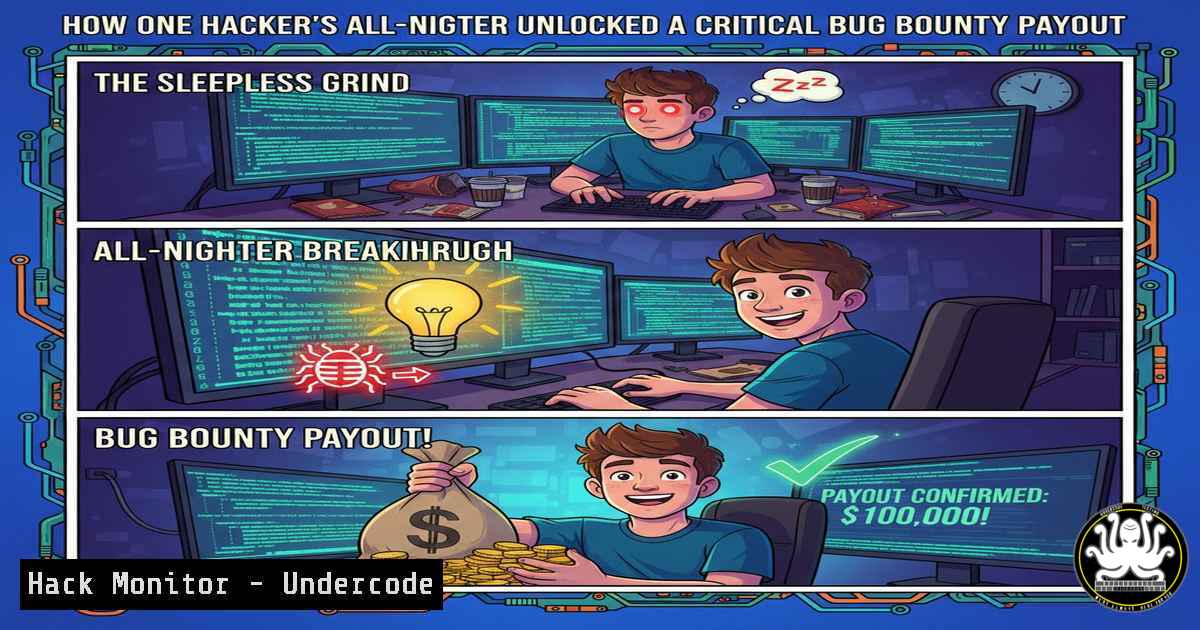
The path to a successful bug bounty discovery is rarely a straight line; it is a meticulous, often grueling process of re-testing endpoints, breaking application flows, and comparing server responses. As demonstrated by a security researcher’s recent sleepless night culminating in a triaged Bugcrowd submission, the difference between a missed vulnerability and a paid finding lies in persistent, document-driven investigation. This article deconstructs the core methodologies behind effective bug hunting, transforming vague “grind” into a repeatable technical workflow for aspiring researchers.
Learning Objectives:
- Master a systematic approach for endpoint analysis and differential response comparison.
- Integrate automated reconnaissance with manual, in-depth testing of business logic flaws.
- Develop a professional workflow for documenting and reporting findings to maximize triage speed and payout potential.
You Should Know:
1. Strategic Reconnaissance and Endpoint Enumeration
The first step is expanding the attack surface beyond the initial target. Automated tools discover hidden endpoints, parameters, and subdomains, which become the raw material for manual testing.
Step‑by‑step guide explaining what this does and how to use it.
Command (Linux): Use `ffuf` for rapid content discovery and `amass` for subdomain enumeration.
 Discover directories and files
ffuf -w /path/to/wordlist.txt -u https://target.com/FUZZ -fc 403,404

Enumerate subdomains passively
amass enum -passive -d target.com -o subdomains.txt
Tool Configuration: Proxy all traffic through Burp Suite or OWASP ZAP. Configure the proxy in your browser (e.g., 127.0.0.1:8080) and ensure the tool’s CA certificate is installed to intercept HTTPS traffic.
Process: Catalog all discovered endpoints in a spreadsheet or note-taking app like Obsidian or Notion. Note the HTTP method, parameters, cookies, and any interesting response headers for each.
2. Breaking Application Flows and Logic
Automated scanners miss complex business logic vulnerabilities. This requires manually understanding the intended user flow and then manipulating it.
Step‑by‑step guide explaining what this does and how to use it.
Technique: Test for flawed state changes. For example, after adding an item to a cart, can you manipulate the POST request to set the price to zero or a negative value?
Burp Suite Repeater: Capture a legitimate request (e.g., POST /cart/update). In Repeater, modify parameter values like price, quantity, or product_id. Look for success responses with invalid data.
Example Test: Change `{“item_id”: “A123”, “quantity”: 1}` to {"item_id": "A123", "quantity": -1}. Does the application accept it, potentially creating a credit? Does changing a `user_id` parameter in a profile update request affect another user’s data (IDOR)?
3. Differential Response Analysis
Comparing responses is crucial for identifying information leaks, access control issues, and subtle error messages.
Step‑by‑step guide explaining what this does and how to use it.
Manual Comparison: Use Burp Suite’s “Compare” feature (right-click on two responses in Proxy history). Look for differences in status codes, length, and content.
Automated Script (Python Example): Write a script to test for IDOR by swapping IDs and comparing responses.
import requests

cookies = {'session': 'your_cookie'}
for id in range(1000, 1005):
resp = requests.get(f'https://target.com/api/user/{id}/info', cookies=cookies)
if resp.status_code == 200 and "admin" in resp.text:
print(f"Potential IDOR on ID {id}: {resp.text[:200]}")
Focus Areas: Compare responses as an authenticated vs. unauthenticated user, as a regular user vs. an admin, and with valid vs. invalid input. Differences in error messages can reveal underlying technology stacks or SQL injection vectors.
4. Digging into Documentation and JS Files
API documentation and client-side JavaScript are treasure troves of undiscovered endpoints and parameters.
Step‑by‑step guide explaining what this does and how to use it.
Source Code Analysis: Use browser DevTools (Ctrl+Shift+I) to inspect the Network tab and Sources tab. Look for /docs/, /swagger/, `/api/v1/` endpoints, and `.js` files.
Command (Linux): Extract endpoints from JavaScript files.
 Download all JS files from a page
waybackurls target.com | grep ".js$" | uniq | sort > jsfiles.txt

Search for API endpoints and keys within those files
for url in $(cat jsfiles.txt); do curl -s $url | grep -E "(api|key|token|endpoint|path)" >> findings.txt; done
Process: Manually examine the identified JS files for hardcoded API keys, internal endpoint paths, and debug functions left in production builds.
5. Weaponizing Nuclei for Validation
Once a potential vulnerability class is identified (e.g., SSRF, XSS), use targeted templates to validate at scale.
Step‑by‑step guide explaining what this does and how to use it.
Tool: ProjectDiscovery’s Nuclei. It uses community-powered templates to scan for known vulnerabilities.
Command: Run nuclei against your list of discovered URLs or subdomains with specific templates.
 Scan for common vulnerabilities
nuclei -l all_urls.txt -t /nuclei-templates/http/exposures/ -o nuclei_results.txt

Use a specific template for, say, AWS key detection
nuclei -l jsfiles.txt -t /nuclei-templates/http/exposures/aws/aws-keys.yaml
Important: Never run broad, untargeted scans on bug bounty programs without permission. Use nuclei to validate hypotheses on specific endpoints you have manually discovered.
6. Crafting the Report for Rapid Triage
A clear, concise, and evidence-packed report is what turns a finding into a payout.
Step‑by‑step guide explaining what this does and how to use it.
1. Clear and specific. “Reflected XSS via unescaped `search` parameter on https://target.com/search.”
2. Summary: Briefly describe the vulnerability type and impact.
3. Steps to Reproduce: Numbered list, including exact URLs, request/response pairs (with Burp or curl snippets), and any required authentication.
4. Proof of Concept (PoC): A working exploit, like a script or a simple video (using asciinema or screen recording).
5. Impact: Explain what an attacker could achieve (data theft, account takeover, etc.).
6. Remediation: Suggest a fix (e.g., “Implement proper input validation and output encoding”).
What Undercode Say:
- The Grind is a Systematic Process: Success is not random; it is the product of a disciplined, repeatable cycle of discovery, testing, comparison, and documentation. The “sleepless night” is effective only when channeled through a structured methodology.
- Manual Ingenuity Beats Automation: While tools like ffuf and nuclei are force multipliers, the high-value bugs—especially in logic flaws—are uncovered by a researcher’s critical thinking and willingness to test assumptions outside normal parameters.
The researcher’s milestone underscores a fundamental truth in modern security: platforms reward the meticulous. The convergence of automated enumeration and deep, context-aware manual testing creates the highest yield. This approach turns the overwhelming scope of a target into a manageable, investigative process where perseverance is measured not just in hours, but in the quality of evidence produced.
Prediction:
The bug bounty landscape will increasingly favor researchers who combine automated efficiency with deep system analysis skills. As standard vulnerabilities (like simple XSS) are caught earlier by internal scans, bounty programs will see a rise in payouts for complex, chained attacks involving business logic, API abuse, and cloud service misconfigurations. Researchers who invest in understanding specific technology stacks (e.g., Kubernetes, GraphQL, serverless architectures) and can articulate the business impact of their findings will dominate the leaderboards. The “grind” will evolve from sheer volume of tests to the precision of hypothesis-driven security research.
▶️ Related Video (82% Match):
🎯Let’s Practice For Free:
IT/Security Reporter URL:
Reported By: Aryan Rohit – Hackers Feeds
Extra Hub: Undercode MoN
Basic Verification: Pass ✅


