Listen to this Post
Introduction:
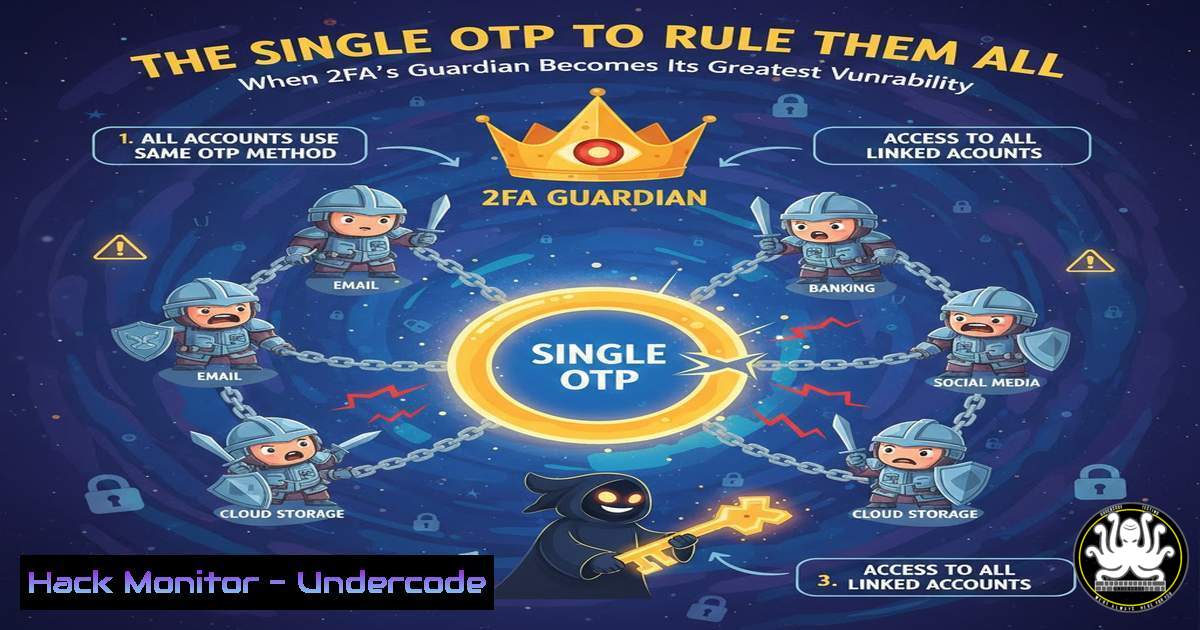
A security researcher’s recent bug bounty discovery has exposed a critical, yet often misunderstood, flaw in two-factor authentication (2FA) implementation. The vulnerability, dismissed by the target platform as “functionality,” allows a single One-Time Password (OTP) to be reused for multiple high-privilege actions, completely undermining the security principle of 2FA. This incident serves as a stark case study in flawed session and token management within authentication workflows.
Learning Objectives:
- Understand the security flaw that allows a single OTP to enable, authenticate with, and disable 2FA.
- Learn methodologies to test for OTP reuse and session validation vulnerabilities in web applications.
- Implement secure OTP generation, validation, and lifecycle management in your own applications.
You Should Know:
1. Deconstructing the “Functionality”: The OTP Reuse Flaw
The core flaw is not in the OTP algorithm itself, but in the application’s logic for validating the OTP’s context and state. A properly implemented 2FA system should treat each OTP as a single-use credential bound to a specific intent (e.g., “enable 2FA,” “authenticate session,” “disable 2FA”). In the discovered case, the server validated only that the OTP code was correct and recent, not what action it was issued for. This allowed the sequence described in the post:
- User requests to enable 2FA. System sends OTP_A.
- User submits OTP_A to complete 2FA setup. System enables 2FA.
3. User logs out.
- User begins a new login with username/password. System prompts for 2FA OTP.
- User submits the same OTP_A. System accepts it and grants a full session.
- User navigates to disable 2FA. System prompts for a confirmation OTP.
- User submits OTP_A again. System disables 2FA, removing the security layer entirely.
This renders 2FA useless, as an attacker who intercepts the initial OTP (e.g., via phishing, SIM swap, or malware) gains full, persistent control over the account.
- Testing for OTP and Session State Validation Flaws
To test for such vulnerabilities, you can use a proxy tool like Burp Suite or OWASP ZAP.
Step-by-step guide:
- Intercept the Flow: Configure your browser to use the proxy. Go through the 2FA setup process, intercepting the request where the OTP is submitted to the `/enable-2fa` endpoint.
- Capture the OTP: Note the OTP value and the session cookie (e.g., `sessionid` or
JSESSIONID) from this request. - Reuse in Different Context: Log out. Start a new login process until you reach the 2FA prompt. Submit the captured OTP instead of the new one. Use the new session token from this login attempt.
- Automate the Test: Use Burp’s Repeater tool to send the OTP to different endpoints (
/verify-login,/disable-2fa) with appropriate session cookies. Observe if the system accepts it.
Example Burp Repeater Request to `/api/verify-2fa` during login:
POST /api/verify-2fa HTTP/1.1
Host: vulnerable-app.com
Cookie: session=NEW_SESSION_TOKEN_HERE
Content-Type: application/json

{"otp":"123456"}
5. Check for Intent Binding: The key test is to use the OTP from step 2 in this new request. If it succeeds, a critical flaw exists.
3. Secure OTP Implementation: Server-Side Commandments
The mitigation must occur on the server. Each OTP must be cryptographically tied to its intended action.
Step-by-step guide for developers:
- Generate with Context: When generating an OTP, create a server-side record that includes the user ID, the OTP hash, an expiry timestamp (e.g., 2 minutes), and a specific intent flag (
action: 'ENABLE_2FA',action: 'LOGIN').
Example Python (using `secrets` and `hashlib`):
import secrets
import hashlib
import time

def generate_secure_otp_record(user_id, action):
raw_otp = f"{secrets.randbelow(106):06d}"  6-digit OTP
otp_hash = hashlib.sha256(f"{raw_otp}{user_id}{action}".encode()).hexdigest()
expiry = time.time() + 120  2 minutes
 Store otp_hash, user_id, action, expiry in a temporary database (e.g., Redis)
store_in_redis(key=otp_hash, value={'user': user_id, 'action': action, 'expiry': expiry})
return raw_otp  Send this to the user
2. Validate with Context: Upon OTP submission, hash it with the requesting user’s ID and the current action context. Look up this hash in your temporary store.
def validate_otp(submitted_otp, user_id, current_action):
submitted_hash = hashlib.sha256(f"{submitted_otp}{user_id}{current_action}".encode()).hexdigest()
record = get_from_redis(submitted_hash)
if not record or record['user'] != user_id or record['action'] != current_action or record['expiry'] < time.time():
return False
 Delete the OTP record immediately upon successful use
delete_from_redis(submitted_hash)
return True
3. Absolute Invalidation: The OTP record must be deleted upon use or expiry, preventing any reuse.
4. Leveraging WebAuthn for Phishing-Resistant 2FA
The ultimate solution to OTP interception is moving to phishing-resistant factors. WebAuthn (FIDO2) uses public-key cryptography.
Step-by-step guide for integration:
- Client-Side: Use the browser’s `navigator.credentials` API (
create()for registration, `get()` for authentication). - Server-Side: Utilize a library like `SimpleWebAuthn` (Node.js, Python, etc.) to handle the complex public-key verification.
Example server endpoint for registration verification (Python – `py_webauthn` library):from webauthn.helpers import verify_registration_response</li> </ol> @app.route('/verify-registration', methods=['POST']) def verify_registration(): user = get_current_user() registration_data = request.get_json() Verify the authenticator's signature against the public key verification = verify_registration_response( credential=registration_data, expected_challenge=retrieve_challenge_from_session(user.id), stored challenge expected_origin="https://your-app.com", expected_rp_id="your-app.com", ) Store the credential's public key for this user save_credential_for_user(user.id, verification.credential_public_key) return jsonify(success=True)3. Fallback Strategy: Offer WebAuthn as the primary method, with time-based OTPs (TOTP) as a backup, ensuring the OTP implementation is secured as per section 3.
- Incident Response: When a Flawed OTP System is Exploited
If you discover this vulnerability in your production system, act immediately.
Step-by-step guide:
- Immediate Mitigation: Temporarily disable the flawed 2FA functionality or force a re-authentication and OTP re-issuance for all users. Audit logs for anomalous OTP reuse patterns.
Linux command to quickly analyze web server logs for multiple OTP submissions (example usingawk):Search for patterns of the same OTP value used multiple times awk '/POST.verify.otp/ {print $7}' access.log | sort | uniq -c | sort -nr | head -20 - User Communication: Inform users of a potential security incident, recommend they review account activity, and prepare for a mandatory 2FA reset.
- Code Patch: Develop and deploy the fix based on the intent-binding principle described in section 3.
- Retrospective: Conduct a root-cause analysis. Why was this logic flaw missed in code review and security testing? Update threat models and test cases.
What Undercode Say:
- The Principle of Intent is Non-Negotiable: Any authentication token, especially an OTP, must be intrinsically bound to a single, specific action. Validation without context is validation without security.
- “Functionality” is the Most Dangerous Dismissal: Classifying a clear logical security flaw as intended behavior represents a profound failure in security culture and threat modeling, leaving users exposed under a false sense of protection.
This case is not an edge-case bug; it is a fundamental design failure. The platform’s defense reveals a prioritization of user convenience over security integrity, a trade-off that should never be made silently. The researcher’s find underscores that the weakest link in 2FA is often not cryptography, but the surrounding application logic.
Prediction:
The convergence of increased mobile malware and AI-powered social engineering will make OTP interception more prevalent. Flaws like OTP reuse will be weaponized at scale, leading to significant account takeover campaigns. This will accelerate the mandatory adoption of phishing-resistant FIDO2/WebAuthn standards by major platforms, potentially within the next 2-3 years, rendering SMS and app-based OTPs as legacy fallbacks only. Furthermore, regulatory frameworks may begin to explicitly mandate intent-binding and single-use guarantees for all authentication tokens, moving beyond vague “multi-factor” requirements to prescribe secure implementation patterns.
🎯Let’s Practice For Free:
IT/Security Reporter URL:
Reported By: Jeet %F0%9F%87%AE%F0%9F%87%B3 – Hackers Feeds
Extra Hub: Undercode MoN
Basic Verification: Pass ✅🔐JOIN OUR CYBER WORLD [ CVE News • HackMonitor • UndercodeNews ]
📢 Follow UndercodeTesting & Stay Tuned:


