Listen to this Post
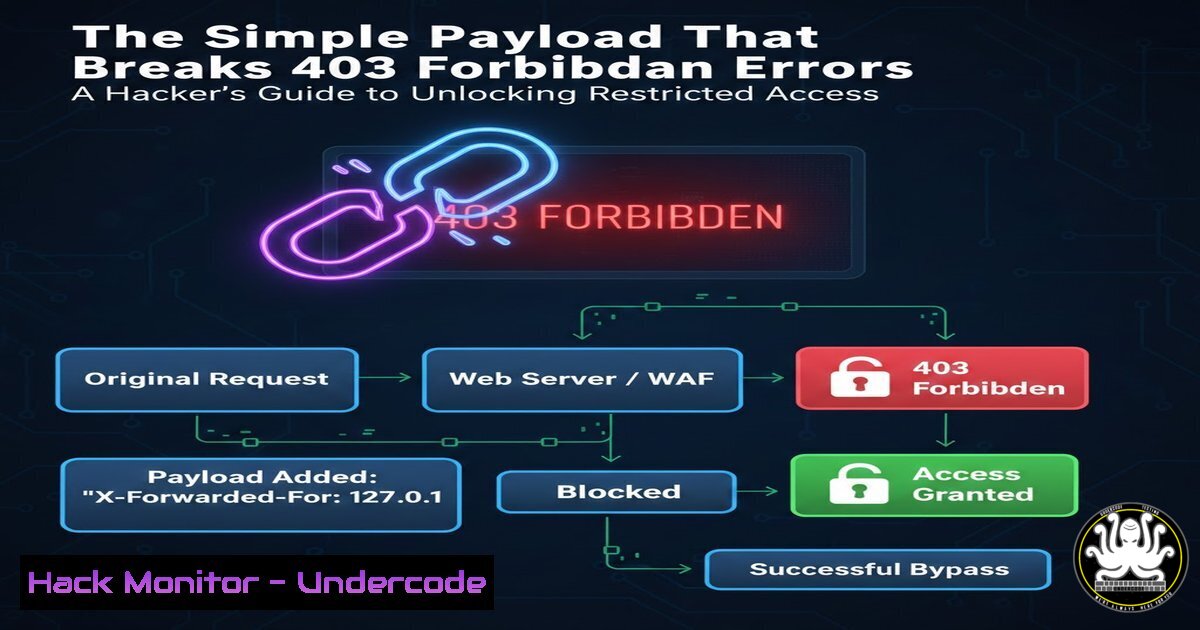
Introduction:
In the world of web application security, a 403 Forbidden status code is a common defensive wall, signaling that access to a resource is denied. However, as demonstrated in a recent bug bounty disclosure, this wall can often be circumvented with surprisingly simple techniques, exposing critical assets. This article deconstructs the `;%09..` payload and other advanced methods used by ethical hackers to bypass authorization checks, turning a definitive “no access” message into a potential pathway for exploitation.
Learning Objectives:
- Understand the mechanics behind the `;%09..` path traversal payload and why it fails common security filters.
- Learn a practical methodology for testing and exploiting 403 bypass techniques, from reconnaissance to proof-of-concept.
- Discover multiple alternative bypass vectors including HTTP method tampering, header manipulation, and path normalization quirks.
You Should Know:
- Deconstructing the Primary Payload: URL Encoding and Path Traversal
The disclosed payload `;%09..` is a clever combination of two techniques. The semicolon (;) is often used as a parameter delimiter, which can confuse poorly configured web servers or proxies. The `%09` is the URL-encoded representation of a horizontal tab (a whitespace character), which might be interpreted differently than a standard space. The double dots (..) are a classic path traversal attempt. When appended to a restricted URL (e.g.,/admin/), it becomes/admin/;%09... The server might misinterpret this, potentially stepping “out” of the intended directory and serving content from a parent or sibling path that shouldn’t be accessible.
Step-by-step Guide:
- Reconnaissance: Identify a target endpoint that returns a 403 Forbidden status, such as
/admin,/config, or/api/internal. - Initial Test: Use `curl` or Burp Suite Repeater to send a request to the forbidden path.
curl -v http://target-site.com/admin
- Apply the Payload: Append the `;%09..` sequence to the URL. Test variations like
/admin/;%09..,/admin/..;/, or/admin/%09/.curl -v "http://target-site.com/admin/;%09.."
- Analyze Response: Look for a change in HTTP status code (to 200 OK or 302 Found) or different response content length. A successful bypass may reveal directory listings or grant access to the administrative panel.
2. Exploiting Path Normalization Flaws
Web servers and application firewalls (WAFs) often “normalize” URLs before applying security rules, removing redundant elements. Attackers can exploit this by adding extra characters that are stripped during normalization, causing a mismatch between the path checked by the security rule and the path actually processed by the application.
Step-by-step Guide:
- Test with Double Encoding: Try encoding the forward slash or dots. For example, `%2f` for `/` or `%252e` for a doubly-encoded dot.
curl -v "http://target-site.com/admin%2f"
- Test with Extraneous Slashes: Add multiple slashes, which might be collapsed to a single slash after checks.
curl -v "http://target-site.com////admin///panel"
- Test with Case Variations: On case-sensitive back-end systems behind case-insensitive proxies, try
ADMIN,Admin, orAdMiN.
3. Bypassing Checks with HTTP Method Tampering
Authorization logic is sometimes only enforced on common HTTP methods like `GET` and POST. Switching to a less common method can sometimes bypass these checks entirely.
Step-by-step Guide:
- In Burp Suite, intercept a `GET` request to a 403 endpoint.
- Send the request to Repeater and change the HTTP method to
HEAD,POST,PUT,PATCH,TRACE, or even invented methods likeXGET. - Cross-reference with
POST: If a `GET` to `/admin` is blocked, try sending a `POST` request to the same endpoint with an empty body or default parameters.curl -v -X POST http://target-site.com/admin curl -v -X HEAD http://target-site.com/admin
4. Leveraging HTTP Request Headers for Access
Specific HTTP headers can alter the perceived source or nature of a request, tricking the application into thinking it originates from a trusted location or is less dangerous.
Step-by-step Guide:
- Spoof Localhost: Add headers like
X-Forwarded-For: 127.0.0.1,X-Real-IP: 127.0.0.1, or `X-Original-URL` to impersonate internal traffic. - Bypass WAFs: Headers such as `X-Originating-URL` or `Referer` can sometimes be used to override the perceived request path.
- Change Content-Type: If a `GET` request is blocked, try converting it to a `POST` request and set `Content-Type: application/x-www-form-urlencoded` with a benign body.
curl -v -X POST -H "X-Forwarded-For: 127.0.0.1" -d "test=1" http://target-site.com/admin
5. Targeting the API and Cloud Infrastructure Layer
Modern applications built on cloud infrastructure and APIs introduce new attack surfaces. Misconfigurations in cloud storage (like AWS S3 buckets) and API gateways are prime targets.
Step-by-step Guide:
- Cloud Storage Bypass: For a suspected S3 bucket URL (
https://company.s3.amazonaws.com/private/`), try:/api/v2/admin
Different bucket region endpoints: `https://company.s3.eu-west-1.amazonaws.com/private/`
Alternative S3 URL formats: `https://s3.amazonaws.com/company/private/`
2. API Version/Path Bypass: If `/api/v1/admin` is blocked, try:
<h2 style="color: yellow;"> Older/Newer versions:,/api/admin</h2>admin.site.com`) is blocked, try accessing the service directly via its underlying IP address, which may have weaker firewall rules.
Adding trailing slashes or file extensions: `/api/v1/admin/` or `/api/v1/admin.json`
3. Bypass via IP Address: If a domain name (
6. System Commands for Reconnaissance and Automation
Ethical hackers use command-line tools to automate the testing of multiple bypass vectors efficiently.
Step-by-step Guide with Commands:
- Use `ffuf` (Fuzz Faster U Fool) for Content Discovery: This tool can fuzz for hidden paths and test bypasses against a 403 endpoint.
Fuzz for directories behind a 403
ffuf -w /usr/share/wordlists/common.txt -u http://target-site.com/admin/FUZZ -fc 403
Test multiple bypass suffixes
ffuf -w bypass-payloads.txt -u http://target-site.com/admin/FUZZ -fc 403
(A sample `bypass-payloads.txt` might include:
;%09..,..;/,/%2f,//,.json) - Windows PowerShell Equivalent: You can use `Invoke-WebRequest` in a loop to test a list of payloads.
$payloads = @(';%09..', '..;/', '%2f')
foreach ($p in $payloads) {
$url = "http://target-site.com/admin/$p"
$resp = Invoke-WebRequest -Uri $url -Method Get -UseBasicParsing
if ($resp.StatusCode -ne 403) { Write-Host "Possible Bypass: $url" }
}
What Undercode Say:
- The Illusion of Security: A 403 status code is not a security control; it is merely an indicator. Relying on it as a primary defense mechanism, without proper authorization checks at the application logic level, creates a false sense of security that skilled testers routinely shatter.
- The Human Factor in Automation: While tools like `ffuf` are indispensable for scale, the initial discovery of a novel payload like `;%09..` stems from a deep, creative understanding of how parsers interpret data. The most effective security testing marries automated brute force with manual, intelligent experimentation based on application behavior.
The analysis reveals a fundamental security anti-pattern: the placement of access controls on a gateway, proxy, or web server, rather than within the core application. When the request path is interpreted differently by the various components in the chain (CDN, WAF, proxy, backend server), authorization fails. This technique is not about brute force but about finding the semantic gap between these systems. It highlights why a defense-in-depth strategy, with consistent authorization enforced at the application’s business logic layer, is non-negotiable for robust security.
Prediction:
The sophistication and variety of 403 bypass techniques will increase, driven by the growing complexity of web architectures involving serverless functions, edge computing, and multi-cloud deployments. We will see a rise in bypasses targeting API-specific gateways and GraphQL endpoints. Furthermore, the integration of AI in security tools will cut both ways: while it will help defenders model normal behavior more accurately, offensive security researchers will eventually leverage AI to automatically generate and test novel, context-aware payload sequences that exploit subtle parsing discrepancies, making manual discovery techniques even more critical for finding advanced vulnerabilities.
▶️ Related Video (78% Match):
🎯Let’s Practice For Free:
IT/Security Reporter URL:
Reported By: Koutora Anicet – Hackers Feeds
Extra Hub: Undercode MoN
Basic Verification: Pass ✅


