Listen to this Post
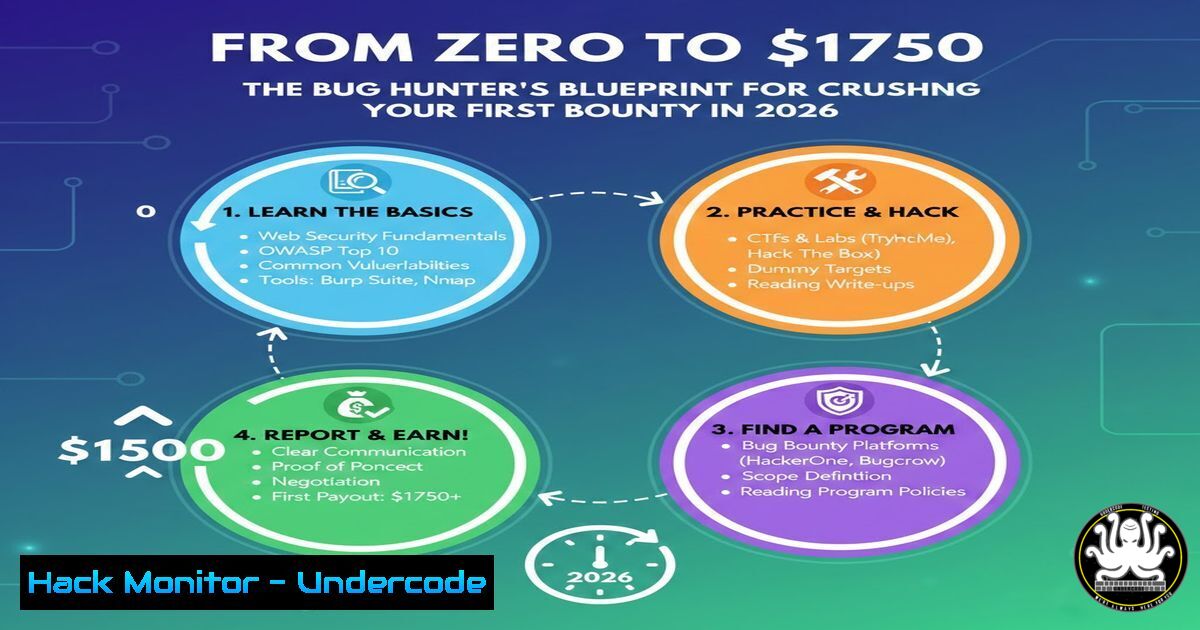
Introduction:
The landscape of cybersecurity defense is increasingly being crowdsourced, with platforms like Bugcrowd offering lucrative bounties for ethical hackers who uncover vulnerabilities before malicious actors can exploit them. Govind Jha’s recent success, netting a $1750 bounty and crossing 1000 platform points, exemplifies a tangible and rewarding career path in modern security. This article deconstructs the methodology behind a successful bug bounty hunt, providing a technical blueprint for aspiring hunters to transform their skills into verified income and professional credibility.
Learning Objectives:
- Understand the structured, phase-based approach to professional bug hunting, from reconnaissance to proof-of-concept.
- Master the essential command-line tools and techniques for effective information gathering and vulnerability discovery.
- Learn how to craft a high-quality, actionable vulnerability report that ensures swift validation and bounty payment.
You Should Know:
- The Reconnaissance Foundation: Passive & Active Intel Gathering
Before launching any tests, comprehensive reconnaissance is non-negotiable. This phase maps the target’s digital footprint, identifying hidden subdomains, APIs, and forgotten assets that often harbor critical flaws.
Step‑by‑step guide:
- Passive Enumeration: Use tools to collect data without directly touching the target.
Subdomain Discovery: Use `amass` or `subfinder`.
amass enum -passive -d target.com -o subdomains.txt
subfinder -d target.com -o subdomains_sf.txt
Asset History: Leverage the Wayback Machine via `waybackurls` to find old, often vulnerable endpoints.
echo "target.com" | waybackurls > urls_archive.txt
2. Active Enumeration: Probe the live target to discover running services and technologies.
Port Scanning: Use `nmap` to identify open ports and services.
nmap -sV -sC -T4 -oA nmap_scan target.com
Content Discovery: Use `ffuf` to brute-force directories and filenames.
ffuf -w /path/to/wordlist.txt -u https://target.com/FUZZ -fc 403
2. Vulnerability Discovery: Targeting Common & Critical Flaws
With a target list prepared, systematically test for common vulnerability classes. Focus on OWASP Top 10 issues like Broken Access Control and Injection flaws.
Step‑by‑step guide for testing IDOR (Insecure Direct Object Reference):
1. Identify API endpoints or URLs that reference objects by ID (e.g., /api/user/123, ?invoice_id=456).
2. Using an authenticated session, attempt to access another user’s object by modifying the ID.
Linux (with curl):
 Attempt to access a different user's profile
curl -H "Authorization: Bearer YOUR_TOKEN" https://target.com/api/profile/124
Use Burp Suite: Capture a legitimate request in the Proxy, send it to Repeater, and increment/decrement the object ID parameter.
3. If data belonging to another user is returned, you have a verified IDOR. Document all request/response pairs.
3. Server-Side Testing: Command Injection & SSRF
Test endpoints that process user input for server-side execution or requests.
Step‑by‑step guide for basic Command Injection testing:
- Find parameters that might be executed on the server (e.g.,
ip=,hostname=, `file=` in network tools or file managers). - Inject payloads using operators like
;,|,&&, or$().
Payload Example: `ip=8.8.8.8; whoami`
3. Use time-based payloads to detect blind injection.
Linux/Unix: `ip=8.8.8.8 && sleep 5`
Windows: `ip=8.8.8.8 & ping -n 5 127.0.0.1`
- If a `sleep` command causes a delayed response, the injection is likely successful. Important: Only proceed on targets you are explicitly authorized to test. Use a blind payload that outputs to a DNS or HTTP log you control (e.g., via Burp Collaborator) for safe, out-of-band confirmation.
4. Cloud & API Misconfiguration: The Low-Hanging Fruit
Modern apps often leak data through misconfigured cloud storage (S3 buckets, Azure blobs) or overly verbose APIs.
Step‑by‑step guide for checking S3 bucket permissions:
- Discover bucket names from source code, JS files, or subdomains (e.g.,
assets-target-com.s3.amazonaws.com).
2. Check for public `LIST` permissions.
aws s3 ls s3://bucket-name --no-sign-request --region us-east-1
3. Check for public `WRITE` permissions (a critical finding).
 Attempt to upload a harmless file
echo "test" > test.txt
aws s3 cp test.txt s3://bucket-name/ --no-sign-request
4. If either command succeeds, document it as a misconfiguration. For API testing, tools like `Postman` or `Burp Suite` are essential for inspecting GraphQL or REST API endpoints for information disclosure, excessive data exposure, or missing rate limiting.
- Crafting the Killer Report: From Finding to Bounty
A well-written report is what turns a finding into a paid bounty. It must be clear, concise, and actionable for the triage team.
Step‑by‑step guide:
- Use a clear, severity-based summary (e.g., “IDOR in `/api/v1/orders` leads to full account takeover”).
- Summary: Briefly describe the vulnerability, its component, and the impact in business terms.
- Steps to Reproduce: Provide a numbered, foolproof list. Include every click, input, and observed output. Use exact URLs and parameters.
- Proof of Concept (PoC): Attach screenshots, videos (GIFs are excellent), or curated request/response logs from Burp. Annotate key parts.
- Impact: Detail the worst-case scenario (e.g., data breach, financial loss, system compromise).
- Remediation: Suggest a specific fix (e.g., “Implement proper authorization checks using user session context, not user-supplied IDs”).
What Undercode Say:
- Methodology Over Luck: Consistent bounty earnings are not accidental; they are the product of a disciplined, repeatable process of recon, systematic testing, and continuous learning from disclosed reports.
- Quality Trumps Quantity: Submitting one well-documented, critical severity report with a clear PoC is infinitely more valuable than ten poorly written, duplicate, or speculative submissions. Platform points and reputation are built on trust and clarity.
The journey from novice to ranked hunter is a marathon of skill acquisition. It requires patience to learn tools, creativity to chain information, and rigor in documentation. Jha’s milestone underscores that the barrier to entry is not a lack of vulnerabilities, but a gap in structured approach. By mastering reconnaissance fundamentals, focusing on high-impact bug classes, and honing the art of communication through reports, aspiring hunters can systematically build their score and their career.
Prediction:
The bug bounty economy will continue its rapid expansion in 2026, driven by increasing regulatory pressures and the relentless scale of software deployment. We predict a significant rise in bounties for vulnerabilities in AI/ML pipelines (e.g., data poisoning, model theft) and critical infrastructure APIs, with platforms developing more granular skill-based scoring to match hunters with suitable programs. The professionalization of hunting will accelerate, with formalized training paths and certifications becoming standard, turning what was once a hobbyist pursuit into a mainstream cybersecurity specialization.
▶️ Related Video (78% Match):
🎯Let’s Practice For Free:
IT/Security Reporter URL:
Reported By: Govind Jha – Hackers Feeds
Extra Hub: Undercode MoN
Basic Verification: Pass ✅


