Listen to this Post
Introduction:
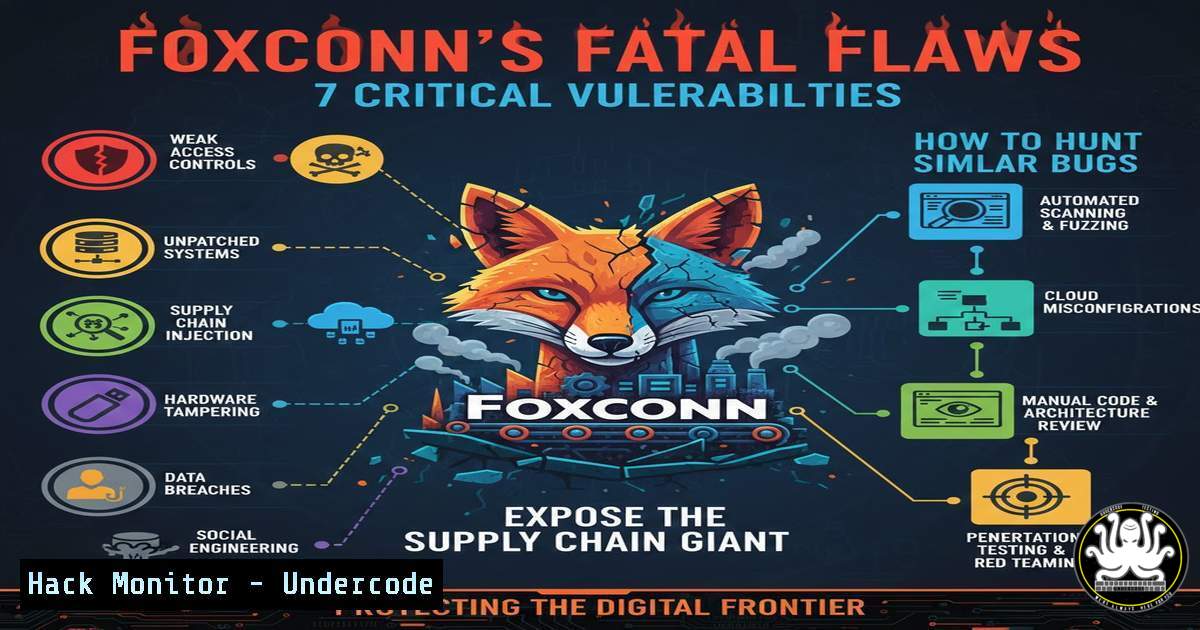
A recent independent security audit of Foxconn, the world’s largest electronics manufacturer, has uncovered seven critical vulnerabilities, now submitted for CVE assignment. These flaws, with CVSS scores up to 9.1, predominantly involve Broken Access Control and Insecure Direct Object References, painting a stark picture of systemic authorization failures in critical infrastructure. This incident underscores the relentless threat posed by seemingly basic web application security misconfigurations at an industrial scale.
Learning Objectives:
- Understand the practical exploitation of Broken Access Control (BAC) and Insecure Direct Object Reference (IDOR) vulnerabilities.
- Learn to replicate testing methodologies for common CWEs like Missing Authorization (CWE-862) and Improper Authentication (CWE-287).
- Develop skills to use command-line tools and proxies for vulnerability discovery and validation.
You Should Know:
1. Exploiting Broken Access Control (CWE-862 & CWE-285)
Broken Access Control occurs when restrictions on what authenticated users are allowed to do are not properly enforced. Attackers can exploit this to access unauthorized functionality or data, such as viewing other users’ accounts, modifying sensitive data, or escalating privileges.
Step‑by‑step guide:
- Reconnaissance: Map the application’s role-based structure. Identify endpoints like
/api/user/profile,/admin/dashboard,/api/orders/{id}. - Token Manipulation: Capture a legitimate request using a proxy like Burp Suite or browser developer tools.
- Testing Vertical Privilege Escalation: If you have a low-privilege user JWT or session cookie, try accessing a high-privilege endpoint.
Linux/cURL Example: Attempt to access an admin panel.Using a captured low-privilege session cookie or token curl -H "Cookie: session=low_priv_user_session_cookie" https://target.com/admin/exportUsers
Observe the Response: A 200 OK or successful data return indicates a critical BAC flaw.
- Testing Horizontal Privilege Escalation: Test if you can access another user’s resources by manipulating IDs.
Attempt to view another user's order by changing the orderId parameter
curl -H "Authorization: Bearer your_token" https://target.com/api/order/12345
Change 12345 to 12346, 12347, etc.
2. Hunting and Validating IDOR Vulnerabilities (CWE-639)
IDOR is a subtype of BAC where user-controlled input (like an ID in a URL or POST body) directly accesses a database object without an authorization check. It’s often found in APIs.
Step‑by‑step guide:
- Identify Direct Object References: Look for parameters like
user_id,account_id,order_number,uuid, `filename` in requests. - Fuzz with Incremental Values: Use tools to brute-force ID values.
Using `ffuf` (Linux):
ffuf -w /usr/share/wordlists/seclists/Discovery/Web-Content/numbers-1-10000.txt -u 'https://target.com/api/v1/user/FUZZ/profile' -H 'Authorization: Bearer YOUR_TOKEN' -mc 200
3. Test with Global Identifiers: Sometimes systems use UUIDs. Test if you can guess or predict them.
Simple Python Script to Test UUIDs:
import requests
import uuid

base_url = "https://target.com/api/document/"
headers = {"Authorization": "Bearer YOUR_TOKEN"}

Generate a random UUIDv4 to test predictability/acceptance
test_uuid = str(uuid.uuid4())
resp = requests.get(base_url + test_uuid, headers=headers)
print(f"Testing {test_uuid}: Status {resp.status_code}, Length {len(resp.text)}")
- Testing for Hard-coded and Client-Side Authentication (CWE-798 & CWE-603)
Hard-coded credentials (backdoors, API keys in source code) and client-side authentication checks are catastrophic flaws.
Step‑by‑step guide:
- Source Code Analysis: For mobile apps or client-side code, decompile (e.g., using `apktool` for Android) or examine JavaScript files.
Search JS files for keywords
grep -r "apiKey|password|secret|token" /path/to/downloaded/website/ --include=".js"
- Intercept Client-Side Flows: Use Burp Suite to intercept login or API calls. Observe if authentication decisions (like
isAdmin=true) are made in client-side JSON responses or JavaScript variables that can be manipulated before being sent to the server. - Network Traffic Analysis: Look for static API keys or tokens in mobile app traffic.
Usingmitmproxy: Set up a proxy, route app traffic through it, and search for `key=` or `password=` in all flows. -
Mitigating CSRF (CWE-352) and Interaction Frequency Flaws (CWE-799)
Cross-Site Request Forgery tricks a victim’s browser into executing unwanted actions. Improper control of interaction frequency enables brute-force attacks.
Step‑by‑step guide for CSRF Mitigation (Developer Focus):
- Implement Anti-CSRF Tokens: Generate a unique, unpredictable token for each user session, embedded in forms or headers.
Example in a Node.js/Express app:
const csrf = require('csurf');
const cookieParser = require('cookie-parser');
app.use(cookieParser());
app.use(csrf({ cookie: true }));

// Render form with token
app.get('/form', (req, res) => {
res.render('form', { csrfToken: req.csrfToken() });
});

// Validate token on POST
app.post('/process', (req, res) => {
// CSRF token is automatically validated by csurf middleware
// Proceed with action...
});
2. Use SameSite Cookies: Set the `SameSite=Strict` or `Lax` attribute on session cookies.
Step‑by‑step guide for Rate Limiting (CWE-799 Mitigation):
- Implement at the Application or Gateway Level: Use a middleware or module to track request counts from IPs/user IDs.
Basic Express Rate Limiter:
const rateLimit = require("express-rate-limit");
const authLimiter = rateLimit({
windowMs: 15  60  1000, // 15 minutes
max: 5, // Limit each IP to 5 login requests per window
message: "Too many attempts, please try again later."
});
app.use("/login", authLimiter);
- Proactive Discovery: Building a Simple Vulnerability Scanner for BAC/IDOR
Automate initial checks for common misconfigurations.
Step‑by‑step guide:
- Script to Test Endpoint Accessibility: A Python script using the `requests` library can test a list of endpoints with a stolen token.
import requests</li>
</ol>

TARGET = "https://target.com"
TOKEN = "YOUR_STOLEN_LOW_PRIV_TOKEN"
ENDPOINTS = ["/admin", "/api/admin/users", "/server-status", "/config.yml"]

headers = {'Authorization': f'Bearer {TOKEN}'}
for endpoint in ENDPOINTS:
url = TARGET + endpoint
resp = requests.get(url, headers=headers)
if resp.status_code == 200:
print(f"[!] Potential BAC: {url} accessible.")
print(f" Response snippet: {resp.text[:200]}...")
2. Integrate with `ffuf` for Directory/Parameter Bruteforcing: Automate the discovery of hidden administrative endpoints.
What Undercode Say:
- The Mundane is Critical: The highest-scoring flaws were not exotic zero-days but fundamental authorization failures. Security programs must prioritize robust, consistent authentication and authorization frameworks over chasing only complex vulnerabilities.
- Vendor Responsiveness is a Risk Factor: The 1.5-month delay without acknowledgment from a vendor of Foxconn’s scale highlights a severe supply chain risk. Organizations must factor vendor patching SLAs and transparency into their risk assessments and have contingency plans for when critical vulnerabilities go unaddressed.
Prediction:
This Foxconn case is a precursor to a wave of similar disclosures targeting major manufacturing and industrial control system vendors. As bug bounty hunting professionalizes, researchers will increasingly pivot from consumer software to the less-scrutinized but far more critical Operational Technology and supply chain software ecosystem. We predict a 50% increase in CVEs related to BAC and IDOR in industrial web interfaces over the next 18 months, forcing a long-overdue convergence of IT security practices with production floor operational integrity. Regulatory bodies will likely respond with stricter cybersecurity compliance mandates for all government contractors and critical infrastructure suppliers.
▶️ Related Video (74% Match):
🎯Let’s Practice For Free:
IT/Security Reporter URL:
Reported By: Hackhuang Vulnerability – Hackers Feeds
Extra Hub: Undercode MoN
Basic Verification: Pass ✅🔐JOIN OUR CYBER WORLD [ CVE News • HackMonitor • UndercodeNews ]
📢 Follow UndercodeTesting & Stay Tuned:


