Listen to this Post
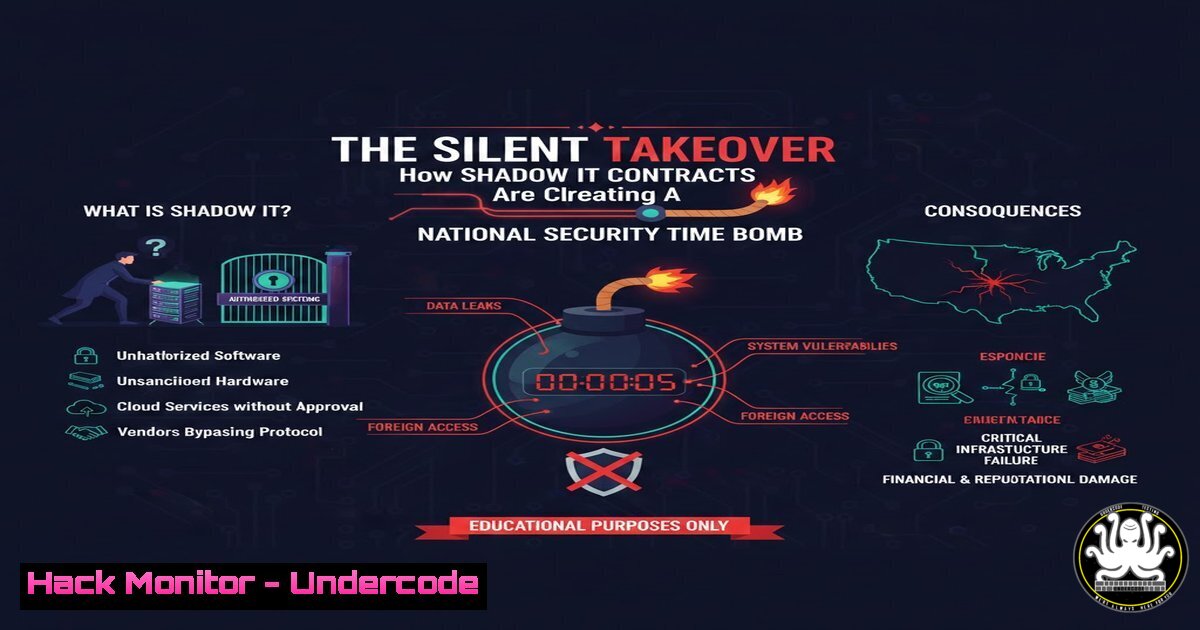
Introduction:
The quiet outsourcing of critical national infrastructure to foreign vendors isn’t just a procurement failure—it’s a catastrophic cybersecurity governance failure. When sensitive data, from health records to defense secrets, is managed by platforms with opaque architectures and extraterritorial jurisdiction, the UK’s digital sovereignty evaporates. This analysis dissects the technical and security implications of this dependency, moving beyond policy debates to the concrete vulnerabilities being engineered into the state’s core systems.
Learning Objectives:
- Understand the technical risks of vendor lock-in in critical national infrastructure (CNI).
- Learn key architectural and audit principles for sovereign, resilient systems.
- Identify command-level and governance actions to mitigate supply chain security threats.
You Should Know:
- Supply Chain Security: The Attack Surface You Didn’t Code
When a foreign vendor embeds its proprietary platforms into NHS or defense systems, the entire supply chain becomes an attack vector. The risk isn’t just the vendor’s code; it’s their update mechanisms, administrative backdoors, and the privileged access of their offshore personnel.
Step‑by‑step guide explaining what this does and how to use it.
Step 1: Map the Dependency. Document every system, API, and data flow touching the vendor’s platform. Use network mapping tools.
Linux Command: `nmap -sV –script vuln -oA vendor_scan
Windows PowerShell: `Get-NetTCPConnection | Where-Object {$_.State -eq “Established”} | Select-Object LocalAddress, RemoteAddress, OwningProcess | ft -AutoSize` to list active connections to identify external data flows.
Step 2: Demand SBOMs. A Software Bill of Materials (SBOM) is non-negotiable. It lists all open-source and third-party components, enabling vulnerability tracking (e.g., Log4j-style crises).
Step 3: Contract for Continuous Audit. Ensure contracts mandate real-time security log feeds to a domestic Security Information and Event Management (SIEM) system under UK jurisdiction.
- Architecture Review: Building in “Exit” as a Security Feature
A system you cannot leave is a system you cannot secure. Brittle, monolithic platforms are the antithesis of resilience. Sovereign capability requires modular, API-driven architectures.
Step‑by‑step guide explaining what this does and how to use it.
Step 1: Enforce API-First, Standards-Based Design. Mandate the use of open standards (e.g., HL7 FHIR for health, NAF for defense) over proprietary APIs. This allows component swapping.
Step 2: Implement a Data Mesh. Decouple data ownership from the platform. Use a data mesh architecture where government departments own and expose their data via internal, standardized APIs, which any approved vendor (domestic or foreign) can consume.
Tutorial Concept: Set up a proof-of-concept using Open Policy Agent (OPA) for fine-grained data access control across domains, ensuring the platform vendor is just another consumer, not the owner.
3. Data Sovereignty & Cryptographic Control
If data is stored or processed outside UK legal jurisdiction, UK law cannot protect it. Encryption is key, but who holds the keys?
Step‑by‑step guide explaining what this does and how to use it.
Step 1: Mandate Customer-Managed Keys (CMK). Insist all data-at-rest and data-in-transit encryption uses keys generated and held by the UK government, never by the vendor.
Azure Command: `New-AzKeyVaultKey -VaultName “UKGov-KV” -Name “NHS-Data-Key” -Destination “HSM”` creates a key in a UK-hyperscale region Key Vault with the key material in a Hardware Security Module (HSM).
AWS CLI: `aws kms create-key –key-usage ENCRYPT_DECRYPT –origin AWS_CLOUDHSM –bypass-policy-lockout-safety-check` (to be used within a UK Sovereign region).
Step 2: Implement Hardware Security Modules (HSMs). Store root keys in FIPS 140-2 Level 3 validated HSMs on UK soil, with strict access policies.
- Continuous Audit & Threat Hunting in Black Box Environments
“You cannot defend what you cannot see.” Opaque platforms are a threat hunter’s nightmare. Contracts must mandate unprecedented transparency.
Step‑by‑step guide explaining what this does and how to use it.
Step 1: Demand Full Audit Log Streaming. All platform activity—administrative, data access, system changes—must be streamed in real-time (e.g., via CEF or Syslog) to a government-controlled SIEM.
Step 2: Deploy Anomaly Detection. Use the ingested logs to build behavioral baselines.
Splunk SPL Query Example: `index=vendor_logs sourcetype=platform:admin | stats count by user, action | where count > 10` to flag excessive administrative actions.
Elasticsearch Detection Rule (KQL): `event.action: “DATA_EXPORT” and not geoip.country_iso_code: “GB”` to alert on data exports outside the UK.
5. The “Golden Copy” and Immutable Exit Strategy
An exit strategy is a technical requirement, not a legal formality. The ability to migrate data and functionality must be proven before a crisis.
Step‑by‑step guide explaining what this does and how to use it.
Step 1: Maintain a Verified “Golden Copy”. All data ingested by the vendor platform must be simultaneously written to a sovereign, government-owned data lake in an open, standard format (e.g., Parquet, JSON).
Conceptual Architecture: Implement a change-data-capture (CDC) pipeline from the source systems, branching one stream to the vendor and one to the sovereign store.
Step 2: Annual “Exit” Drills. Contractually require an annual exercise where a domestic vendor uses the documented APIs and the “golden copy” to spin up a minimal viable replacement for a core module, proving the exit path works.
What Undercode Say:
- Key Takeaway 1: The greatest national security risk is not a single vulnerability, but a systemic architectural weakness. Dependency on a foreign-controlled, opaque platform for CNI creates a single point of failure that is both a lucrative target and a potent weapon for geopolitical coercion.
- Key Takeaway 2: True digital sovereignty is enforced at the technical layer—through cryptographic key control, data replication mandates, and standardized APIs—not just at the legal or policy layer. Governance without technical enforcement is meaningless.
The conversation must shift from procurement policy to technical governance. The questions are not merely “who audits?” but “how do we get real-time, cryptographically verified audit streams?”. Not “what is the exit strategy?” but “how do we technically enforce a live, tested exit capability?”. The brittleness being built into the UK’s digital spine will not manifest as a slow decline, but as a sudden, catastrophic systemic failure when geopolitical, commercial, or technical fault lines finally slip.
Prediction:
Within the next 3-5 years, a major incident—a catastrophic data breach, a geopolitical sanction disrupting service, or a vendor’s unilateral change in terms—will force a frantic, expensive, and high-risk migration of a critical system. The cost will be orders of magnitude higher than competitive procurement, and the operational disruption will be severe. This event will become the canonical case study for “how not to manage digital sovereignty,” forcing a global reckoning on the technical governance of state infrastructure. Nations that have architecturally enforced sovereignty and resilience will survive intact; those mired in vendor dependency will face a decade-long crisis of confidence and capability.
🎯Let’s Practice For Free:
IT/Security Reporter URL:
Reported By: Psyfr Palantir – Hackers Feeds
Extra Hub: Undercode MoN
Basic Verification: Pass ✅


