Listen to this Post
Introduction:
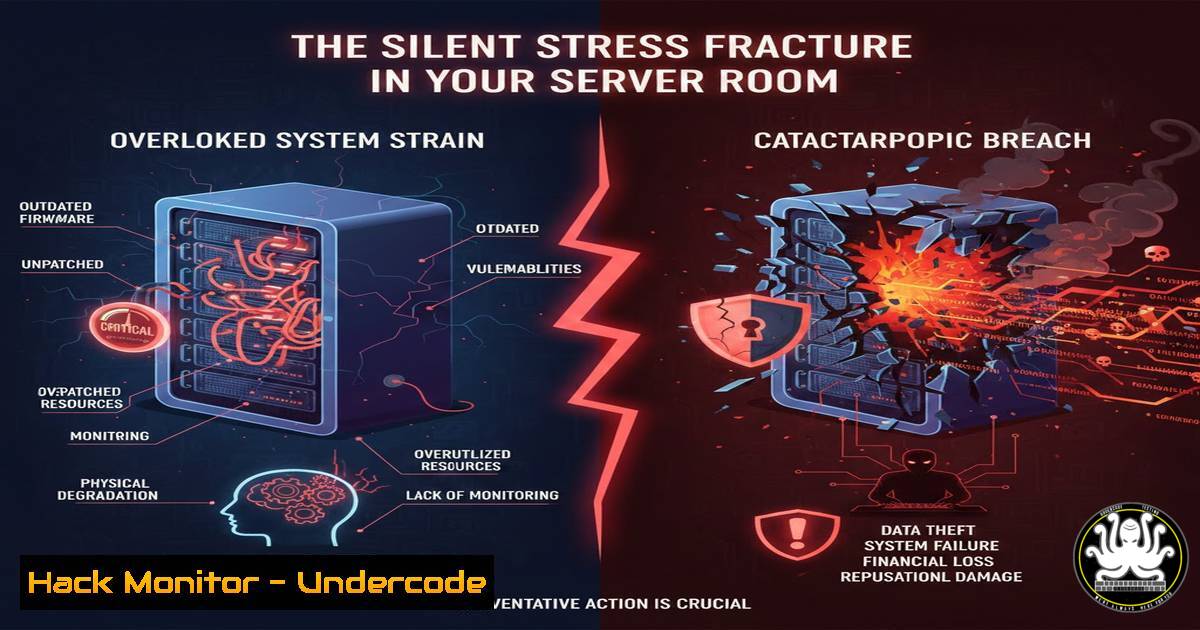
Just as persistent foot pain from irregular bones and improper support can lead to debilitating stress fractures, constant low-grade system strain from misconfigurations and unmonitored performance bottlenecks can create critical, hidden vulnerabilities in your IT infrastructure. These “digital stress fractures” often go unnoticed until a major event—like a traffic surge or a targeted attack—causes a total failure or a devastating breach. This article translates a physical wellness PSA into a crucial cybersecurity and systems management protocol, providing the technical “orthopedic exam” for your enterprise environment.
Learning Objectives:
- Learn to identify and diagnose systemic “stress fractures” in servers, networks, and cloud instances using performance monitoring and log analysis.
- Implement hardening and compensatory controls to mitigate risk from inherent system “irregularities” or legacy technical debt.
- Establish a proactive monitoring and maintenance regimen to prevent minor strains from evolving into catastrophic outages or security incidents.
You Should Know:
- Diagnosing Your Infrastructure’s “Gait Analysis”: Identifying Hidden Strain
The first step is a comprehensive diagnostic, moving beyond basic uptime checks. Continuous strain often manifests in system logs and performance metrics long before an outage occurs.
Step‑by‑step guide:
On Linux, use a combination of vmstat, iostat, and `dmesg` to check for memory pressure, I/O wait times, and kernel-level errors that indicate hardware or driver stress.
 Check for memory and swap pressure
vmstat 1 5
 Analyze disk I/O bottlenecks
iostat -dx 2 5
 Review kernel ring buffer for critical errors
dmesg -T | tail -50 | grep -E "error|fail|timeout"
On Windows, leverage Performance Monitor (perfmon.msc) to create a Data Collector Set tracking key counters: \Processor(_Total)\% Processor Time, \Memory\Available MBytes, \PhysicalDisk()\Avg. Disk Queue Length, and \Network Interface()\Packets Received Errors.
For Cloud (AWS Example), configure detailed CloudWatch alarms for EC2 instances on CPUUtilization, DiskReadOps, NetworkPacketsIn, and the crucial `StatusCheckFailed_Instance` metric. Use AWS Config to audit for non-compliant, “irregular” resource configurations.
- The “Orthopedic Scan”: Proactive Vulnerability and Configuration Audits
Irregular configurations are like irregular bones. Automated, regular audits are your MRI scan, revealing weaknesses before they fracture.
Step‑by‑step guide:
Run weekly vulnerability scans using tools like `Nessus` or OpenVAS, targeting not just the OS but middleware and open ports.
Implement Infrastructure as Code (IaC) scanning with `Checkov` or `Terraform Scan` to catch security misconfigurations in your templates before deployment.
 Scan Terraform plans with Checkov
checkov -d /path/to/terraform/code
Enforce configuration baselines. Use `CIS-CAT` benchmarks to assess systems against hardened standards. On Linux, audit SSH configurations (PermitRootLogin no, Protocol 2) and unused services (systemctl list-unit-files --state=enabled).
- Applying the “Compression Technology”: Hardening and Containment Strategies
Just as specialized shoes manage biomechanical stress, strategic hardening contains system strain. This involves segmentation, least-privilege access, and resource controls.
Step‑by‑step guide:
Network Segmentation: Isolate critical systems using VLANs or VPCs. Implement firewall rules (via iptables/nftables or AWS Security Groups) that deny all by default.
 Example iptables rule to restrict a service to a management subnet
iptables -A INPUT -p tcp --dport 22 -s 10.0.1.0/24 -j ACCEPT
iptables -A INPUT -p tcp --dport 22 -j DROP
Resource Limiting: Use `cgroups` on Linux or Windows Job Objects to prevent any single process from consuming excessive CPU, memory, or I/O.
 Create a cgroup for a service
sudo cgcreate -g cpu,memory:/my_service
sudo cgset -r cpu.cfs_quota_us=50000 my_service  Limit to 50% of a CPU core
sudo cgexec -g cpu,memory:/my_service /usr/bin/my_daemon
Application Hardening: Utilize SELinux/AppArmor on Linux to enforce mandatory access control policies, confining processes even if compromised.
4. Continuous “Physical Therapy”: Automated Monitoring and Remediation
Healing and prevention require continuous effort. Implement automated monitoring that triggers remediation playbooks for early warning signs.
Step‑by‑step guide:
Deploy a centralized logging stack (ELK or Grafana Loki) to aggregate syslogs, application logs, and security events. Create alerts for specific error patterns.
Use an automated remediation tool like `Ansible` or `AWS Systems Manager Automation` to respond to common issues. For example, an alert on high memory usage could trigger a playbook to restart a known leaky service and snapshot logs for analysis.
 Example Ansible playbook snippet for remediation
- name: Remediate high memory process
hosts: webservers
tasks:
- name: Find and restart leaking service
systemd:
name: "{{ item }}"
state: restarted
loop:
- "apache2"
- "my_app_service"
when: ansible_memory_mb.real.used > 90
- Preparing for “Event Season”: Stress Testing and Incident Runbooks
Before high-traffic events (product launches, sales cycles), conduct controlled stress tests and ensure incident response plans are drilled.
Step‑by‑step guide:
Conduct load testing using `Apache JMeter` or `k6` to simulate peak traffic and identify breaking points.
Develop and test Incident Response (IR) runbooks. These should include clear steps for communication, escalation, containment (e.g., isolating a compromised instance), and eradication.
Cloud-Specific: Implement AWS Auto Scaling or Kubernetes Horizontal Pod Autoscaling (HPA) policies to automatically add capacity during load, and ensure your IR playbooks include cloud-specific steps like snapshotting an instance before termination for forensics.
What Undercode Say:
- Key Takeaway 1: The most dangerous vulnerabilities are often not the publicized zero-days, but the chronic, accepted strains within your own environment—misconfigured permissions, unpatched legacy systems, and unmonitored performance degradation. These create the predictable “stress fractures” attackers exploit.
- Key Takeaway 2: Proactive, automated hygiene—configuration auditing, resource monitoring, and contained deployments—is the “Hoka shoe” for your infrastructure. It’s not always the most glamorous investment, but it is the foundational support that prevents career- and business-limiting incidents, allowing you to operate through demanding periods without catastrophic failure.
The underlying analysis draws a direct parallel between personal physical neglect and organizational technical debt. Both are tolerated until a tipping point causes immobility. The post’s core message—”don’t chalk it up as ‘normal'”—is the critical mindset shift for IT and security leaders. The technical commands and frameworks provided are the equivalent of the doctor’s treatment plan: actionable, specific, and designed to address the root cause, not just the symptom. Embracing this “dad shoe” philosophy of prioritizing robust, supportive fundamentals over superficially sleek configurations is what separates resilient organizations from those that are one event season away from a breach.
Prediction:
Ignoring the “wear and tear” of daily system operation will lead to an increasing number of breaches originating not from sophisticated external attacks, but from the catastrophic failure of over-stressed, under-maintained components. As AI-driven operations and complex microservices architectures increase system interdependency, the concept of “digital orthopedic health” will become a formal discipline within SRE (Site Reliability Engineering) and DevSecOps. Organizations that institutionalize continuous strain diagnosis and hardening will see significantly lower downtime and incident severity, turning operational resilience into a major competitive advantage during times of widespread digital disruption.
▶️ Related Video (76% Match):
🎯Let’s Practice For Free:
IT/Security Reporter URL:
Reported By: Scottwindonluton Sharing – Hackers Feeds
Extra Hub: Undercode MoN
Basic Verification: Pass ✅


