Listen to this Post
Introduction:
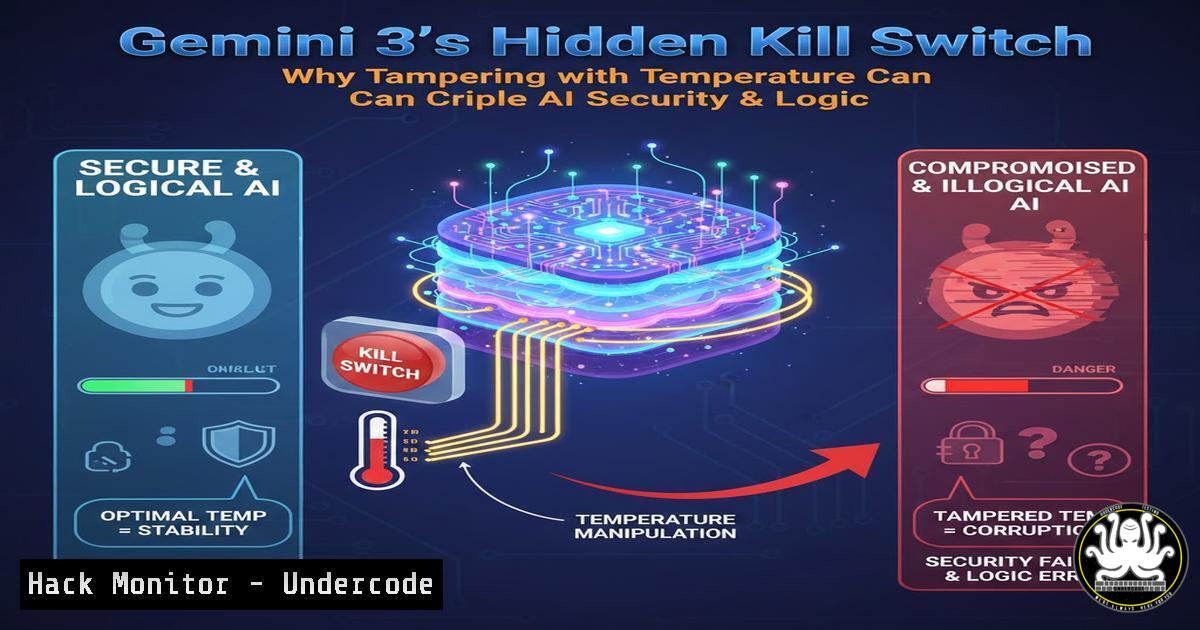
In the race to deploy advanced AI agents, a critical configuration parameter is being overlooked, posing significant risks to system stability and security. Google DeepMind’s recent advisory on Gemini 3’s temperature setting reveals a fundamental vulnerability: deviating from default configurations can induce logical degradation and infinite loops, transforming a powerful reasoning engine into an unpredictable and potentially dangerous asset. This insight is not merely a developer tip but a cornerstone for secure, reliable AI operations in enterprise environments.
Learning Objectives:
- Understand the critical role of the “temperature” parameter in LLM reasoning integrity and how its misuse introduces systemic risk.
- Learn to implement secure, monitoring-first configurations for the Gemini API to prevent agent failure and exploitation.
- Develop a troubleshooting and hardening protocol for AI endpoints to ensure operational resilience against logic-based attacks.
You Should Know:
1. The Temperature Parameter: Your AI’s Stability Core
The temperature parameter (typically ranging from 0.0 to 1.0) controls the randomness of an LLM’s outputs. A lower temperature makes the model more deterministic and focused, while a higher value encourages creativity and variability. According to DeepMind’s engineers, Gemini 3’s complex reasoning capabilities are intricately tuned to its default temperature. Altering it disrupts the model’s internal feedback mechanisms, potentially leading to degraded logic, nonsensical outputs, or a “reasoning loop” where the model gets stuck in a computational dead end, consuming resources indefinitely.
Step-by-step guide:
Do Not Adjust in Production: For any Gemini 3 series model (gemini-3-flash-preview, gemini-3-pro-preview), explicitly set `temperature=0.0` in your API call only if you require deterministic, structured output (e.g., JSON). For general reasoning tasks, omit the parameter to use the safe default.
Secure API Call Example (Python):
import google.generativeai as genai

genai.configure(api_key="YOUR_API_KEY")
model = genai.GenerativeModel('gemini-3-flash-preview')
 For reasoning: use default settings
response = model.generate_content("Analyze this security log for anomalies...")
 For structured extraction: explicitly set low temp
response = model.generate_content(
"Extract IPs and CVEs from this text as JSON.",
generation_config=genai.GenerationConfig(temperature=0.0)
)
2. Mitigating Infinite Loops and Resource Exhaustion Attacks
An AI agent stuck in an infinite loop is a denial-of-service (DoS) vector. It can exhaust API quotas, spike cloud costs, and cripple dependent services. This can be triggered maliciously via adversarial prompts or accidentally through misconfiguration.
Step-by-step guide:
Implement Hard Stops: Always enforce strict `max_output_tokens` and `max_timeout` limits in your client code and API gateway.
Infrastructure Command (Linux): Use monitoring tools to detect runaway processes.
 Monitor for high, consistent CPU from your AI client process
top -p $(pgrep -f "your_ai_agent_script.py")
 Set up a cron job to kill processes exceeding a runtime limit
/5     timeout 300 your_ai_agent_script.py || pkill -f "your_ai_agent_script.py"
API Gateway Rule (Example): Configure your gateway (e.g., Kong, Apigee) to reject requests that specify non-standard temperature values for Gemini 3 models.
3. Secure Configuration Management for AI Models
Treat AI model parameters like critical security configurations. Unauthorized or ad-hoc changes are a configuration drift vulnerability.
Step-by-step guide:
Use Version-Controlled Config Files: Store generation parameters in encrypted, version-controlled configs (e.g., HashiCorp Vault, AWS Secrets Manager).
 config/gemini_prod.yaml
models:
gemini-3-flash-preview:
generation_config:
 temperature: [OMITTED - USING DEFAULT]
max_output_tokens: 8192
top_p: 0.95
Infrastructure as Code (IaC): Deploy configurations using Terraform or Ansible to ensure parity across dev, staging, and prod.
4. Monitoring and Alerting on Model Degradation
You cannot secure what you cannot see. Implement observability specifically for AI model behavior.
Step-by-step guide:
Log All Inputs/Outputs: Sanitize and log prompts and responses to detect logic failures. Use a structured logging framework.
Create Dedicated Metrics:
`ai_model_error_rate` (tagged by `error_type=”reasoning_loop”`)
`ai_request_duration_seconds` (alert if > 30s)
Prometheus Alert Rule Example:
groups:
- name: ai_alerts
rules:
- alert: GeminiHighErrorRate
expr: rate(ai_model_error_rate{model=~"gemini-3."}[bash]) > 0.05
for: 2m
5. Troubleshooting Common Gemini API Errors
The LinkedIn post comments reveal common issues like “Deadline Exceeded.” This is often a symptom, not the root cause.
Step-by-step guide:
Error: “Deadline Exceeded” (or 504 Timeout):
- First Check: Verify your `temperature` parameter. Revert to default.
- Second Check: Analyze the prompt for complexity or ambiguity that could trigger long reasoning chains. Implement prompt validation.
- Client-Side Fix: Implement exponential backoff and retry logic in your code.
from tenacity import retry, stop_after_attempt, wait_exponential</li>
</ol>

@retry(stop=stop_after_attempt(3), wait=wait_exponential(multiplier=1, min=4, max=10))
def safe_generate_content(prompt):
return model.generate_content(prompt)
What Undercode Say:
- Key Takeaway 1: Defaults are Defaults for a Reason. In cutting-edge AI, especially with compound reasoning models like Gemini 3, default parameters are often the product of extensive safety and performance optimization. Arbitrarily changing them, a common practice from earlier AI generations, is now an operational hazard.
- Key Takeaway 2: AI Reliability is a Cybersecurity Pillar. An unstable, looping AI model is a vulnerable endpoint. It can be leveraged for financial damage (resource exhaustion), data leakage (through corrupted outputs), or as a failure point in a larger automated security chain. Hardening these systems is as crucial as patching a server.
This advisory from DeepMind is a canary in the coal mine. It highlights the evolving and opaque nature of complex AI systems where traditional “tuning” becomes a threat. The industry is moving from models as simple tools to models as autonomous systems. The security paradigm must shift accordingly, treating internal model parameters as critical infrastructure controls, subject to rigorous change management, continuous monitoring for behavioral integrity, and threat modeling that considers novel failure states like logical loops. The future of AI security lies not just at the network boundary, but within the configuration of the model’s very cognition.
▶️ Related Video (78% Match):
🎯Let’s Practice For Free:
IT/Security Reporter URL:
Reported By: Patrick L%C3%B6ber – Hackers Feeds
Extra Hub: Undercode MoN
Basic Verification: Pass ✅🔐JOIN OUR CYBER WORLD [ CVE News • HackMonitor • UndercodeNews ]
📢 Follow UndercodeTesting & Stay Tuned:


