Listen to this Post
Introduction:
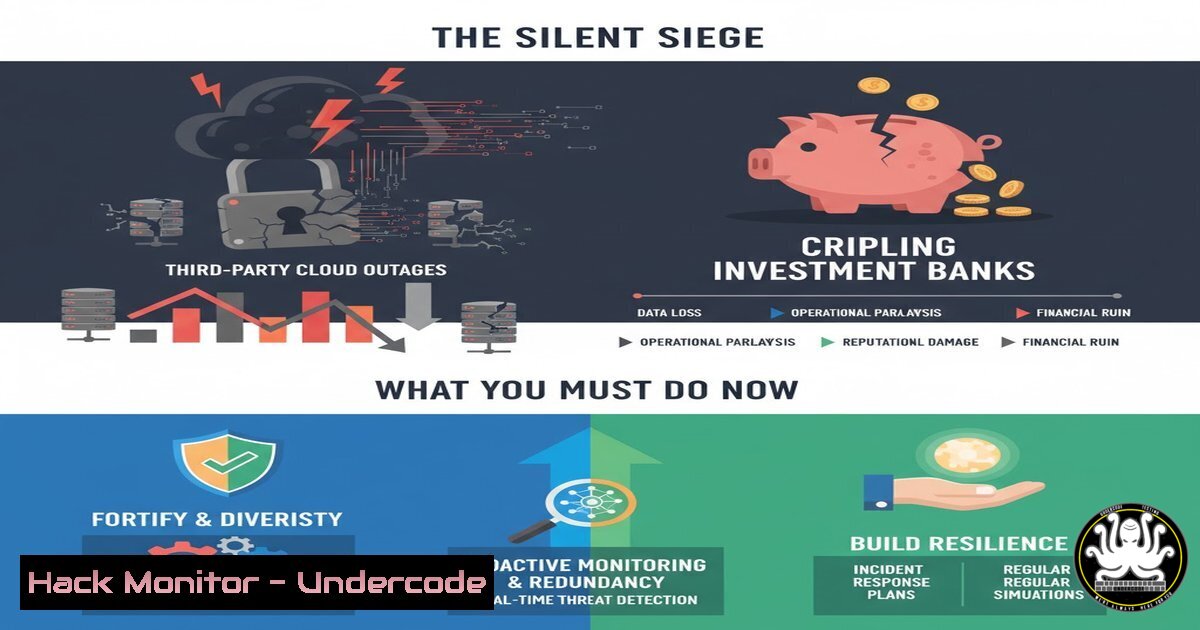
The financial sector’s massive migration to the cloud has introduced a catastrophic single point of failure. When a major cloud provider like Amazon Web Services (AWS) experiences an outage, it doesn’t just disrupt a single service; it can freeze the entire operations of investment banks, at a staggering cost of £600,000 per hour. This article delves into the critical vulnerability of over-reliance on unregulated third-party tech giants and provides a technical blueprint for building resilience.
Learning Objectives:
- Understand the technical root causes of third-party cloud outages and their impact on financial services infrastructure.
- Implement proactive monitoring, failover, and incident response strategies to mitigate cloud dependency risks.
- Learn the regulatory landscape shifts and how to prepare your organization for increased oversight of cloud supply chains.
You Should Know:
1. The Anatomy of a Modern Banking Outage
The complexity of a bank’s IT estate, often a hybrid of legacy on-premises systems and modern cloud microservices, creates a fragile ecosystem. Outages are rarely a single event but a cascade. A simple human error in a cloud configuration (e.g., an errant network ACL change) or a failure in a legacy system’s API gateway to the cloud can trigger a full-scale service disruption. The core issue is concentration risk; the banking sector’s collective dependence on a handful of cloud providers means a single provider’s regional failure becomes a systemic event.
Step‑by‑step guide explaining what this does and how to use it.
Scenario: An AWS us-east-1 region experiences a network partitioning event.
Impact: Your bank’s trading application, which relies on EC2 instances in that region and a DynamoDB table for real-time data, becomes unresponsive.
Initial Diagnosis (Using AWS CLI):
 Check the status of your EC2 instances in the affected region
aws ec2 describe-instance-status --region us-east-1 --instance-ids i-1234567890abcdef0

Attempt to describe your DynamoDB table (may time out or error)
aws dynamodb describe-table --region us-east-1 --table-name LiveTrades
The commands may return errors like `Request limit exceeded` or InternalServerError, indicating platform-level issues, not just your own misconfiguration.
2. Proactive Cloud Infrastructure Hardening
Resilience is not reactive; it’s engineered from the ground up. This involves architecting for failure by designing systems that can withstand the loss of an entire availability zone or region. The principle is to avoid having all critical components share a common failure mode.
Step‑by‑step guide explaining what this does and how to use it.
Step 1: Multi-Region Deployment for Critical Services. Use Infrastructure-as-Code (IaC) tools like Terraform to deploy identical stacks in a secondary region (e.g., eu-west-1).
 Example Terraform module call for a multi-region EC2 setup
module "primary_region" {
source = "./app-module"
region = "us-east-1"
ami = "ami-0c02fb55956c7d316"
}

module "failover_region" {
source = "./app-module"
region = "eu-west-1"
ami = "ami-0a0e7b81a6a17b7b8"
}
Step 2: Implement Database Replication. For a database like Amazon RDS (PostgreSQL), configure cross-region read replicas that can be promoted to a primary database during a disaster.
-- In the primary RDS instance (us-east-1), this is often configured in the AWS Console or CLI.
-- Command to create a cross-region read replica
aws rds create-db-instance-read-replica \
--db-instance-identifier my-db-replica \
--source-db-instance-identifier arn:aws:rds:us-east-1:123456789012:db:my-db \
--region eu-west-1
3. Mastering Continuous Monitoring and Alerting
You cannot mitigate what you cannot see. Proactive monitoring of your cloud provider’s health, combined with your own application’s key metrics, is essential. This allows you to often detect issues before they become full-blown outages.
Step‑by‑step guide explaining what this does and how to use it.
Step 1: Monitor Cloud Provider Status. Don’t just rely on the AWS Status Dashboard. Use its RSS feed or a tool like `curl` in a cron job to programmatically check status.
 Simple script to check for 'us-east-1' in the AWS status RSS feed
curl -s https://status.aws.amazon.com/rss/all.rss | grep -A 5 -i "us-east-1"
Step 2: Set Up Advanced CloudWatch Alarms. Go beyond basic CPU checks. Monitor for increased Error rates and Latency.
 Using AWS CLI to put a custom alarm for API Gateway 5xx errors
aws cloudwatch put-metric-alarm \
--alarm-name "API-Gateway-High-5xx-Errors" \
--alarm-description "Alarm when 5xx errors exceed 10% of total requests" \
--metric-name "5XXError" \
--namespace "AWS/ApiGateway" \
--statistic Sum \
--period 300 \
--threshold 100 \
--comparison-operator GreaterThanThreshold \
--evaluation-periods 2 \
--alarm-actions arn:aws:sns:us-east-1:123456789012:my-sns-topic
4. Architecting a Robust Failover and DNS Strategy
Detection is only half the battle. You need an automated or semi-automated process to redirect traffic away from the failing region. This is most commonly achieved using DNS failover services like Amazon Route 53.
Step‑by‑step guide explaining what this does and how to use it.
Step 1: Configure Route 53 Health Checks. Create health checks that monitor an endpoint in your primary region (e.g., /health).
Step 2: Set Up a Failover Routing Policy. Create a primary and secondary record set. The secondary record set in the failover region is activated only if the health check for the primary record fails.
 Create a health check for the primary endpoint
aws route53 create-health-check \
--caller-reference $(date +%s) \
--health-check-config '{
"Type": "HTTPS",
"ResourcePath": "/health",
"FullyQualifiedDomainName": "app.yourbank.com",
"Port": 443,
"RequestInterval": 30,
"FailureThreshold": 2
}'
The associated Route 53 record set would then be configured to route traffic to `eu-west-1.elb.amazonaws.com` if the health check for the US endpoint fails.
5. Preparing for Regulatory Scrutiny and Compliance
The UK’s Financial Conduct Authority (FCA) is moving to designate firms like AWS and Microsoft as critical third parties. This means banks will need to demonstrate rigorous oversight of their cloud supply chain.
Step‑by‑step guide explaining what this does and how to use it.
Step 1: Conduct a Dependency Map. Use tools like AWS Config or custom scripts to inventory all critical services and their dependencies.
 Use AWS Config to discover resources (ensure it's enabled in all regions)
aws configservice describe-discovered-resources --resource-type AWS::EC2::Instance --region us-east-1
Step 2: Enhance Contractual and Security Reviews. Ensure your contracts with cloud providers include clear SLAs, data sovereignty clauses, and right-to-audit clauses. Implement a formal Third-Party Risk Management (TPRM) program that subjects your cloud providers to the same scrutiny as any other critical vendor.
What Undercode Say:
- The Real Cost is Systemic, Not Just Financial. While £600k/hour is a shocking figure, the long-term damage to customer trust, brand reputation, and regulatory standing is immeasurable and potentially existential.
- Resilience is a Feature, Not an Afterthought. Architecting for high availability and disaster recovery can no longer be a “Phase 2” project. It must be a non-negotiable requirement baked into the initial design of every critical financial system, driven by IaC and automated pipelines.
The conversation has shifted from if a major cloud outage will affect a bank to when. The concentration of critical financial infrastructure in a small number of cloud platforms has created a systemic risk that regulators can no longer ignore. While the push for oversight from bodies like the FCA is a necessary step, it is a slow-moving, top-down solution. The onus is therefore on individual financial institutions to act now with bottom-up technical measures. Building a resilient, multi-cloud or hybrid architecture is no longer a luxury for the most advanced firms; it is a fundamental operational imperative for survival in the digital age. The banks that invest in and master these technical strategies today will be the ones that remain operational—and trusted—tomorrow.
Prediction:
The regulatory dam is about to break. Within the next 18-24 months, cloud providers like AWS, Microsoft Azure, and Google Cloud Platform will be formally designated as critical national infrastructure for the financial sector in multiple jurisdictions, starting with the UK and EU. This will mandate stringent, legally-binding resilience testing (e.g., mandatory chaos engineering drills), transparent incident reporting, and potentially even requirements for data and processing localization. Banks that have not already built and documented verifiable failover processes will face severe regulatory action, massive fines, and may be forced to partially repatriate workloads, incurring significant cost and complexity. The era of the cloud as an unregulated wild west for critical services is coming to an abrupt end.
🎯Let’s Practice For Free:
IT/Security Reporter URL:
Reported By: Karlflinders Uk – Hackers Feeds
Extra Hub: Undercode MoN
Basic Verification: Pass ✅


