Listen to this Post
Introduction:
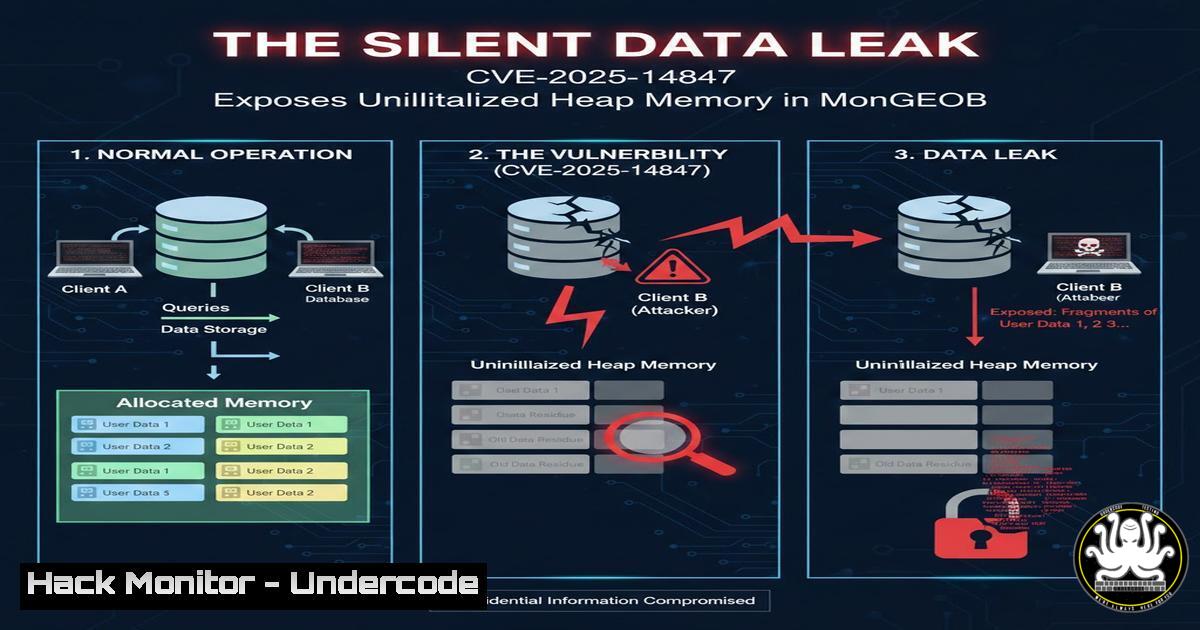
A critical security flaw designated CVE-2025-14847 has been disclosed, affecting MongoDB databases. This vulnerability allows an unauthenticated attacker to remotely extract uninitialized heap memory from the server. Such memory disclosure can lead to the exposure of sensitive information, including session tokens, database credentials, or fragments of user data, posing a severe risk to data confidentiality and system integrity.
Learning Objectives:
- Understand the mechanism and critical impact of uninitialized heap memory disclosure vulnerabilities.
- Learn methods to identify and test for similar information leakage flaws in database systems.
- Implement immediate mitigation and hardening strategies for MongoDB and similar NoSQL databases.
You Should Know:
1. Anatomy of a Heap Memory Disclosure Vulnerability
A heap memory disclosure occurs when an application inadvertently sends portions of its dynamic memory (heap) that were not explicitly initialized or sanitized back to a user. Unlike buffer overflows that write data, this flaw reads memory. The extracted data is often a “slice” of whatever was previously stored or processed in that memory location—potentially containing passwords, keys, or other application data. This happens due to programming errors where a function returns a buffer without ensuring its entire allocated size is filled with intended data.
Step‑by‑step guide explaining what this does and how to use it.
To understand the risk, you can simulate probing for information leakage. The following command uses `curl` to make a request and checks if the response contains non-printable or high-entropy data suggestive of a memory dump.
 Linux/macOS: Make a request and inspect raw response content.
curl -i -s "http://<TARGET_IP>:27017/" | od -c | head -50
 This uses od (octal dump) to display all characters, which might reveal raw memory bytes if the server is vulnerable.
Mitigation Step: The primary defense is in code. Developers must ensure all output buffers are explicitly initialized (e.g., using `memset` in C/C++) or, better, use safe, high-level libraries that manage memory safely.
2. Unauthenticated Exploit Path and Impact Assessment
The “unauthenticated” aspect of CVE-2025-14847 is particularly severe. It means an attacker needs no credentials, API keys, or prior access to interact with the MongoDB service and trigger the memory leak. This significantly lowers the barrier for exploitation and increases the attack surface, as the vulnerable port (default 27017) might be exposed to the internet.
Step‑by‑step guide explaining what this does and how to use it.
To assess exposure, first determine if your MongoDB port is accidentally open to the world. Use `nmap` from an external perspective or check your cloud security groups.
 Scan for open MongoDB ports on a target network segment
nmap -p 27017 --open <NETWORK_RANGE>
 Example: nmap -p 27017 --open 192.168.1.0/24
Immediate Action: If MongoDB does not need to be publicly accessible, enforce firewall rules (AWS Security Groups, Azure NSGs, iptables) to block inbound traffic to port 27017 from untrusted networks. For example, on a Linux server:
 Block incoming traffic on port 27017 using iptables
sudo iptables -A INPUT -p tcp --dport 27017 -j DROP
3. Hardening MongoDB Configuration
Proper configuration is a critical layer of defense. MongoDB offers several settings to reduce its attack surface, which should be applied regardless of this specific CVE.
Step‑by‑step guide explaining what this does and how to use it.
1. Enable Authentication: Edit the MongoDB configuration file (typically /etc/mongod.conf).
security:
authorization: enabled
2. Bind to Localhost: If only local applications need access.
net:
bindIp: 127.0.0.1
3. Encrypt Traffic: Enable TLS/SSL for connections.
net:
ssl:
mode: requireSSL
PEMKeyFile: /etc/ssl/mongodb.pem
4. Apply Changes: Restart the MongoDB service.
sudo systemctl restart mongod
4. Vulnerability Scanning and Patching Strategy
Proactive scanning is essential. While specific exploit code for CVE-2025-14847 may not be public, vulnerability scanners can detect vulnerable versions and misconfigurations.
Step‑by‑step guide explaining what this does and how to use it.
Using Nmap NSE Scripts: Nmap has scripts to check MongoDB.
nmap -p 27017 --script mongodb-info <TARGET_IP>
Official Patching: The most critical step is to apply official patches from MongoDB. Consult the MongoDB security advisory and upgrade to the fixed version.
 For Ubuntu/Debian systems
sudo apt update
sudo apt upgrade mongodb-org
 Verify version
mongod --version
5. API and Cloud Security Posture Implications
Modern applications often use MongoDB behind an API layer (e.g., Node.js, Python apps). This vulnerability reminds us that the security of the data layer is paramount, even if the API itself is secure.
Step‑by‑step guide explaining what this does and how to use it.
Principle of Least Privilege: Ensure the database user account used by your application has only the minimum necessary permissions (e.g., `readWrite` on a specific database, not root).
Cloud Hardening: In environments like AWS, use IAM roles for EC2 instances accessing DocumentDB (AWS’s managed MongoDB-compatible service) instead of storing password credentials. For Azure Cosmos DB, leverage managed identities.
6. Forensic Detection of Memory Scraping Attempts
Detecting an exploitation attempt can be challenging, as it may not leave traditional logs. You must look for anomalies.
Step‑by‑step guide explaining what this does and how to use it.
Monitor Logs: Check MongoDB logs (/var/log/mongodb/mongod.log) for unusual connections or errors.
sudo tail -f /var/log/mongodb/mongod.log | grep -E "(conn|error)"
Network Monitoring: Use tools like `tcpdump` to capture traffic on the MongoDB port and look for unusual request patterns or sizes.
sudo tcpdump -i any port 27017 -w mongo_traffic.pcap
7. Building a Long-Term Defense-in-Depth Strategy
A single patch is not enough. Adopt a defense-in-depth strategy.
Step‑by‑step guide explaining what this does and how to use it.
1. Regular Patching: Subscribe to MongoDB security alerts.
- Network Segmentation: Place databases in a private subnet, separate from web servers.
- Intrusion Detection: Deploy a Host-Based IDS (HIDS) like OSSEC or Wazuh to monitor critical database files and processes for changes.
- Regular Audits: Conduct periodic penetration tests and security audits focusing on data storage layers.
What Undercode Say:
- The Underlying Threat is Memory Management: The root cause of CVE-2025-14847 is improper memory handling. This flaw highlights a persistent class of vulnerabilities that exist beneath the application logic, in the foundational code of widely used software. It serves as a critical reminder that security must extend into how systems manage their most basic resources.
- The “Unauthenticated” Vector is a Game-Changer: The ability to extract data without any form of authentication turns what might be a limited flaw into a critical one. It effectively removes the first and often most significant barrier for an attacker, making any instance exposed to the internet an immediate and high-value target. This shifts the priority from complex exploit chains to simple, reliable data exfiltration.
Prediction:
The disclosure of CVE-2025-14847 will likely catalyze two major trends. First, we anticipate increased scrutiny and automated scanning for similar memory disclosure flaws across other NoSQL and database systems, potentially leading to a short-term spike in related CVEs as researchers audit codebases. Second, and more significantly, this vulnerability will accelerate the enterprise shift towards stricter zero-trust network architectures for databases. Reliance on perimeter security (firewalls) alone will be deemed insufficient. The future norm will involve mandatory internal authentication, encrypted communication for all database traffic, and the widespread adoption of confidential computing technologies that encrypt data in memory itself, rendering such heap extraction attacks futile. This event underscores that in modern infrastructure, the database can no longer be a trusted “black box” within the network.
▶️ Related Video (84% Match):
🎯Let’s Practice For Free:
IT/Security Reporter URL:
Reported By: The Singh – Hackers Feeds
Extra Hub: Undercode MoN
Basic Verification: Pass ✅


