Listen to this Post
Introduction:
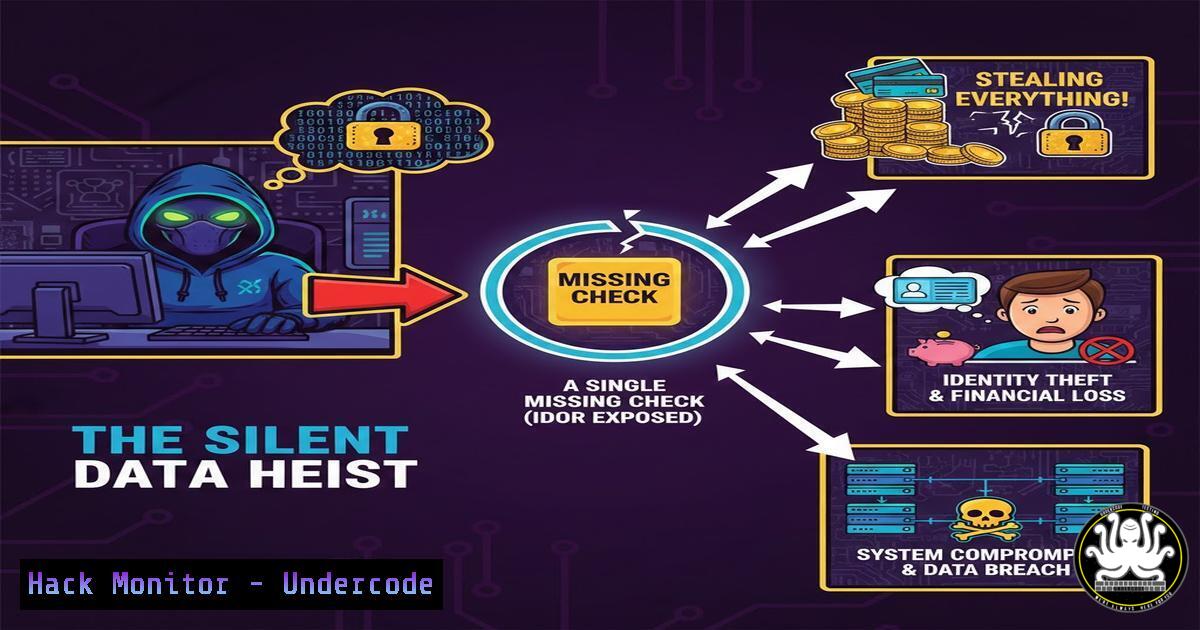
In the intricate world of web application security, a deceptively simple flaw can open the floodgates to massive data breaches. An Insecure Direct Object Reference (IDOR) vulnerability, recently highlighted by a security researcher’s responsible disclosure, underscores a critical truth: verifying a user’s identity (authentication) is meaningless without rigorously checking their permissions (authorization). This article dissects IDOR vulnerabilities, providing a technical deep dive into how they are exploited, detected, and eradicated from modern applications.
Learning Objectives:
- Understand the fundamental mechanics and business impact of IDOR vulnerabilities.
- Learn practical, hands-on methods for hunting IDOR flaws in web applications and APIs.
- Implement robust coding practices and security controls to prevent IDOR in development.
You Should Know:
- IDOR Demystified: It’s Not a Bug, It’s a Broken Access Control
At its core, an IDOR occurs when an application exposes a reference to an internal implementation object (like a database key, a filename, or a UUID) without proper authorization checks. An attacker can manipulate these references—often simple sequential IDs in URLs or API parameters—to access data belonging to other users.
Extended Explanation & Technical Context:
The disclosed scenario describes an endpoint like /api/v1/client/{client_id}/invoices. The application correctly authenticated users but failed to verify if the authenticated user was authorized to view invoices for the specific `client_id` submitted. By changing `client_id` from, say, `123` (their own) to 124, they accessed another client’s data. This is a classic vertical IDOR (privilege escalation). Horizontal IDOR involves accessing similar objects at the same privilege level (e.g., user A accessing user B’s profile).
- The Hunter’s Toolkit: Manual and Automated IDOR Detection
Manual testing remains crucial for finding complex IDORs. Start by mapping all application endpoints that take object identifiers. Use proxy tools like Burp Suite or OWASP ZAP to intercept requests and systematically tamper with parameters.
Step‑by‑step guide:
- Map Parameters: Log in as a test user (
user_a). Browse the application, capturing all traffic in Burp Suite. Identify parameters likeid,uid,file,account,number. - Tamper and Compare: For each parameter, change its value and replay the request. For example, if you see
GET /api/user/1024/profile, change it toGET /api/user/1025/profile. - Use BApp Extensions: In Burp, install the “Autorize” extension. It automates testing by replaying requests from a high-privilege user (like an admin) while using a low-privilege session, flagging unauthorized successful accesses.
- Test with Non-Sequential IDs: Don’t assume sequential numbers. Test with UUIDs, hashes, or usernames. If you see
file=document.pdf, try `file=../../etc/passwd` (Path Traversal, a cousin of IDOR). - API Testing: For modern APIs (GraphQL, REST), tools like `curl` or `httpx` are essential.
Linux/Mac (Bash):
 Test a numeric ID range
for id in {1000..1005}; do
curl -H "Authorization: Bearer $USER_A_TOKEN" "https://api.target.com/v1/data/$id" | jq .
done
Windows (PowerShell):
 Test with a list of GUIDs
$token = "your_token_here"
$guids = @("guid-1", "guid-2", "guid-3")
foreach ($guid in $guids) {
Invoke-RestMethod -Uri "https://api.target.com/v1/doc/$guid" -Headers @{"Authorization"="Bearer $token"}
}
- Beyond the Obvious: Testing for Indirect Object References
Sometimes, the reference is not direct. An application might use a “key” or “token” that maps to an internal object. Your goal is to find if these references are predictable or can be enumerated.
Step‑by‑step guide:
- Create Two Objects: As
user_a, create an invoice. Note the generated access link or key (e.g., `https://app.com/share?key=abc123`). - Access as Another User: Log out, log in as
user_b. Try to access the same resource usingkey=abc123. If successful, it’s an IDOR. - Analyze Key Entropy: Is the key short, numeric, or based on a timestamp? Attempt to brute-force or predict other keys using tools like
ffuf.ffuf -w /usr/share/wordlists/seclists/Fuzzing/6-digits-000000-999999.txt -u 'https://app.com/api/FUZZ' -H 'Cookie: session=USER_B_SESSION' -mr "success"
-
The Developer’s Arsenal: Mitigating IDOR with Secure Code Patterns
Prevention must be baked into the software development lifecycle. Rely on the framework’s built-in authorization mechanisms.
Step‑by‑step guide (Implementation):
- Use Indirect Reference Maps: Don’t expose database keys. Use a per-user map.
Vulnerable Code (Python/Flask):
@app.route('/order/<int:order_id>')
def get_order(order_id):
order = Order.query.get(order_id)  Direct use of PK!
return render_template('order.html', order=order)
Secure Code (Using a map):
from itsdangerous import URLSafeTimedSerializer
serializer = URLSafeTimedSerializer(secret_key)
 When generating a link for user
token = serializer.dumps({'user_id': current_user.id, 'order_pk': order.id})
 When processing a request
try:
data = serializer.loads(token, max_age=3600)
if data['user_id'] != current_user.id:
abort(403)
order = Order.query.get(data['order_pk'])
except:
abort(403)
2. Mandatory Access Control Checks: Every data access must include an authorization statement.
Secure Code Pattern (Pseudocode):
function getDocument(documentId) {
document = db.documents.find(documentId);
// CRITICAL CHECK
if (document.ownerId != currentUser.id && !currentUser.isAdmin) {
throw new AuthorizationException();
}
return document;
}
3. Use UUIDs: While not a security control, using random, non-sequential UUIDs (e.g., c9a9d3e1-1b7a-4a3d-bf8a-5e124b3a9c1d) makes mass enumeration impractical.
- The Architectural Shield: Implementing API Gateways and WAFs
For legacy systems or defense-in-depth, layer external controls.
Step‑by‑step guide (Conceptual):
- API Gateway Policies: Configure your API gateway (Kong, Apigee) to validate JWT claims against request parameters. A policy could assert that the `user_id` in the JWT token matches the `user_id` in the request path for specific endpoints.
- Web Application Firewall (WAF) Rules: Deploy custom WAF rules to flag sequences of rapid, numeric parameter changes that indicate IDOR probing, and block the source IP after a threshold.
What Undercode Say:
- Authorization is a Process, Not a State: Authentication confirms “who you are.” Authorization must continuously answer “is this who allowed to do this to that?” This check must happen on every request, at the business logic layer.
- Ethical Discovery is a Force Multiplier: The researcher’s path—identify, validate, disclose responsibly—is the gold standard. It transforms a potential weapon into a tool for collective defense, strengthening the entire digital ecosystem.
Analysis:
The disclosed IDOR is a stark reminder that modern application stacks, while robust in authentication (OAuth 2.0, SSO), often leave authorization as an afterthought for developers to implement ad-hoc. This creates a patchwork of inconsistent checks. The shift towards microservices and APIs exacerbates the risk, as a single missing check in one service can compromise the data integrity of the entire platform. The remediation is not about buying a silver-bullet tool but about fostering a security-first mindset in development teams, enforcing code reviews focused on access control, and integrating authorization testing into CI/CD pipelines.
Prediction:
As applications become more data-centric and interconnected (APIs, GraphQL, real-time streams), IDOR vulnerabilities will evolve into “Insecure Direct Relationship References.” Attackers will focus on manipulating complex graph queries or exploiting implicit trust between microservices to chain low-risk IDORs into catastrophic data leaks. The future of access control lies in standardized, declarative authorization frameworks (like OpenFGA, Google Zanzibar) that centralize policy management, making consistent enforcement easier to audit and maintain, ultimately moving us from “hoping the check is there” to “knowing the policy is enforced.”
▶️ Related Video (78% Match):
🎯Let’s Practice For Free:
IT/Security Reporter URL:
Reported By: Shantanu Gorad – Hackers Feeds
Extra Hub: Undercode MoN
Basic Verification: Pass ✅


