Listen to this Post
Introduction:
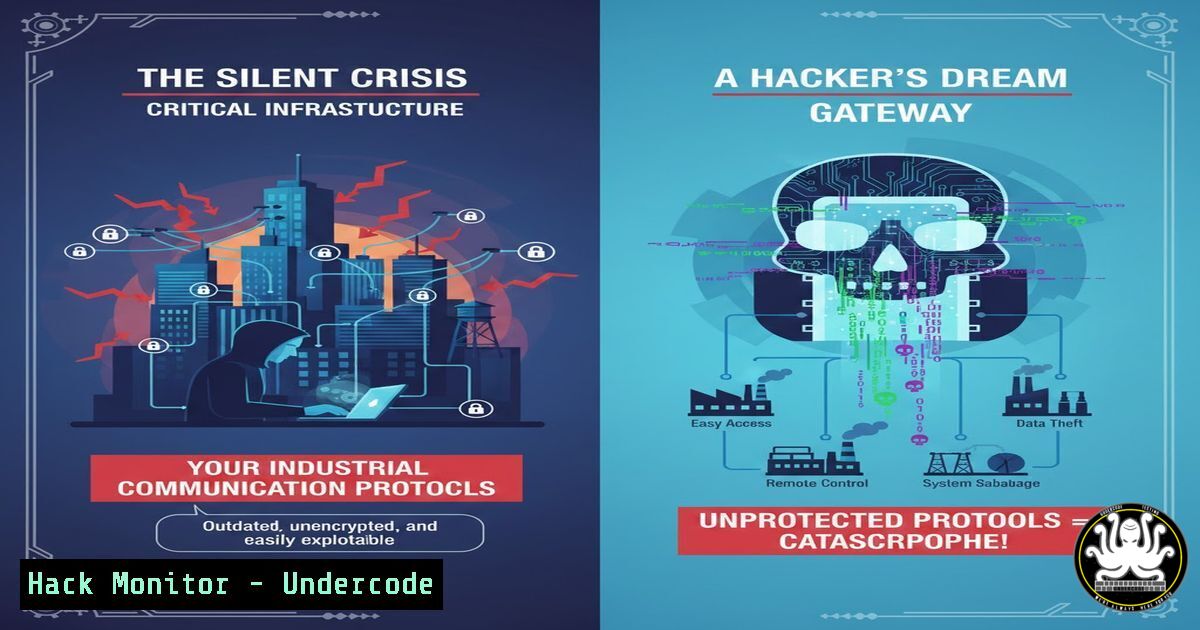
Industrial Control Systems (ICS) and Operational Technology (OT) form the backbone of critical infrastructure, from power grids to water treatment plants. Historically, the communication protocols that act as the “neural network” for these systems—such as Modbus, PROFINET, and DNP3—were engineered for reliability and real-time performance in isolated environments, not for security in interconnected, modern networks. This foundational design flaw has created a pervasive vulnerability landscape where threats to data integrity and system availability are not just probable but expected, as underscored by standards like ISA/IEC 62443.
Learning Objectives:
- Understand the inherent security weaknesses in common industrial communication protocols.
- Learn how to map and analyze OT network traffic to identify vulnerable protocols.
- Apply hardening and monitoring techniques to meet standards like ISA/IEC 62443 SR 3.1 for communication integrity.
You Should Know:
1. The Inherent Insecurity of “Reliable” Protocols
Industrial protocols like Modbus TCP, PROFINET, and DNP3 lack basic security mechanisms considered standard in IT, such as authentication, encryption, and message integrity checks. An attacker on the network can easily perform reconnaissance, eavesdrop, and inject malicious commands.
Step-by-Step Guide: Passive Protocol Identification with Wireshark
- Capture Traffic: Connect a monitoring port (SPAN) to your OT network segment. Use Wireshark to capture packets.
- Filter for OT Protocols: Apply display filters for common OT protocol ports:
`tcp.port == 502` (Modbus TCP)
`tcp.port == 20000` (DNP3)
`udp.port == 34964` (PROFINET)
- Analyze: Right-click a packet → `Decode As…` → Select the relevant protocol (e.g., Modbus) to view function codes (e.g.,
06 Write Single Register). This reveals readable, unencrypted commands that can be manipulated.
2. Exploiting Modbus TCP for Unauthorized Control
Modbus TCP is notoriously simple. It uses Function Codes to read or write to holding registers and coils, which directly map to physical process values and control commands.
Step-by-Step Guide: Simulating a Modbus Write Attack
- Set Up a Test Environment: Use a Python script with the `pymodbus` library to simulate a malicious client.
malicious_modbus_write.py
from pymodbus.client import ModbusTcpClient</li>
</ol>

client = ModbusTcpClient('192.168.1.10', port=502)  Target PLC IP
client.connect()
 Write value 1000 to holding register 40001 (often critical set-points)
client.write_register(address=0, value=1000, unit=1)  Modbus addressing often starts at 0
client.close()
2. Execute: Running this script against a vulnerable PLC could change a critical set-point (e.g., pressure or temperature), demonstrating a direct integrity and availability attack.
3. Hardening Communications with ISA/IEC 62443 SR 3.1
System Requirement 3.1, “Communication Integrity,” mandates the use of cryptographic mechanisms to protect the authenticity and integrity of communicated information. This is a direct response to the protocols’ native weaknesses.
Step-by-Step Guide: Implementing TLS for DNP3 (DNP3-SA)
- Assess Capability: Verify your DNP3 outstation and master devices support DNP3 Secure Authentication (DNP3-SA) or transport over TLS.
- Generate Certificates: Use OpenSSL to create a PKI for your OT environment.
Generate a CA key and certificate
openssl req -x509 -newkey rsa:2048 -keyout ca.key -out ca.crt -days 365 -nodes
Generate a server certificate for your DNP3 master
openssl req -newkey rsa:2048 -keyout master.key -out master.csr -nodes
openssl x509 -req -in master.csr -CA ca.crt -CAkey ca.key -CAcreateserial -out master.crt -days 365
- Configure Devices: Install the
ca.crt,master.crt, and `master.key` on your DNP3 master. Configure the outstation to trust the CA certificate. Enable “Secure Authentication” or TLS transport in the device configuration software.
4. Network Segmentation as a Primary Defense
Isolating OT protocol traffic from general IT networks is the most critical architectural control to limit attack surface.
Step-by-Step Guide: Configuring a Industrial Demilitarized Zone (IDMZ) Firewall Rule
1. Design Topology: Plan an IDMZ with a firewall between the corporate IT network and the OT control network.
2. Implement Restrictive Rules (Example for pfSense/OPNsense): Create a rule on the OT-side firewall interface:Action: `Block`
Protocol: `TCP/UDP`
Source: `IT_NETWORK` (e.g., 10.0.0.0/24)
Destination: `OT_NETWORK` (e.g., 192.168.1.0/24)
Destination Port: `502, 20000, 44818, 34964` (Common OT ports)
3. Create Allow Exceptions: Only allow specific, necessary traffic from IT to IDMZ (e.g., historian data pulls) and from OT to IDMZ, never direct IT-to-OT connections.5. Active Monitoring for Anomalous Protocol Behavior
Continuous monitoring can detect malicious activity that bypasses perimeter defenses.
Step-by-Step Guide: Setting a Sigma Rule for Detecting Unusual Modbus Write
1. Tool Selection: Deploy a security monitoring tool like Wazuh or Elastic SIEM that supports Sigma rules.
2. Create a Detection Rule: Write a Sigma rule (modbus_unusual_write.yml) to alert on rare Modbus write functions outside of maintenance windows.title: Unauthorized Modbus Write Request status: experimental logsource: product: zeek category: modbus detection: selection: modbus.function: - 'Write Single Coil' - 'Write Single Register' - 'Write Multiple Registers' filter: modbus.src: - 'authorized_engineering_station_1' Whitelist known good sources timeframe: 'maintenance_window' Filter known good times condition: selection and not filter
3. Deploy & Tune: Load the rule into your SIEM, tune the whitelists (
filter), and configure alerting for high-priority events.What Undercode Say:
- Legacy is Not an Excuse: The argument that systems are “air-gapped” or “too legacy” is obsolete. Convergence and remote access demands have bridged the gap, making protocol-level security non-negotiable.
- Defense-in-Depth is Mandatory: No single control can secure OT. It requires a layered strategy combining network segmentation (architectural), protocol encryption (technical), and behavioral monitoring (operational) to achieve compliance with standards like 62443 and truly mitigate risk.
The core analysis is that the ICS security community has moved beyond merely acknowledging the problem. The focus is now on pragmatic, incremental implementation of controls. Starting with visibility (traffic capture) and segmentation provides immediate risk reduction, while the longer-term journey involves upgrading to secure protocol variants and robust key management. The shared resource from ISA-TR84.00.09 is pivotal, as it provides the mapped security capabilities that inform where to apply cryptographic controls first.
Prediction:
In the next 3-5 years, we will witness a surge in targeted ransomware and state-sponsored attacks that specifically exploit these unauthenticated industrial protocols to cause physical disruption, not just data theft. This will accelerate the mandated adoption of secure protocol standards (like OPC UA PubSub over TSN with encryption) and drive the integration of IT-style threat detection directly into PLCs and RTUs. Compliance frameworks will evolve from recommending to requiring cryptographic integrity for all cross-zone communications, fundamentally changing how new industrial equipment is designed and certified.
▶️ Related Video (76% Match):
🎯Let’s Practice For Free:
IT/Security Reporter URL:
Reported By: Tahseen Saber – Hackers Feeds
Extra Hub: Undercode MoN
Basic Verification: Pass ✅🔐JOIN OUR CYBER WORLD [ CVE News • HackMonitor • UndercodeNews ]
📢 Follow UndercodeTesting & Stay Tuned:


