
Listen to this Post
Introduction:
In the relentless pursuit of expanding an organization’s attack surface, bug hunters and penetration testers are constantly refining their reconnaissance techniques. A recent bug bounty disclosure highlights a powerful, yet often overlooked, Shodan search methodology that bypasses traditional domain-based enumeration. By strategically manipulating search filters, security researchers can uncover hidden IP addresses and misconfigured assets directly exposed to the internet, turning low-severity findings into high-impact vulnerabilities.
Learning Objectives:
- Understand and replicate the Shodan “TLD stripping” technique for advanced reconnaissance.
- Learn how to craft precise Shodan search queries and integrate them into a professional workflow.
- Translate reconnaissance data into demonstrable security impact for effective bug bounty reporting.
You Should Know:
- The Core Technique: Stripping Top-Level Domains for Raw IP Discovery
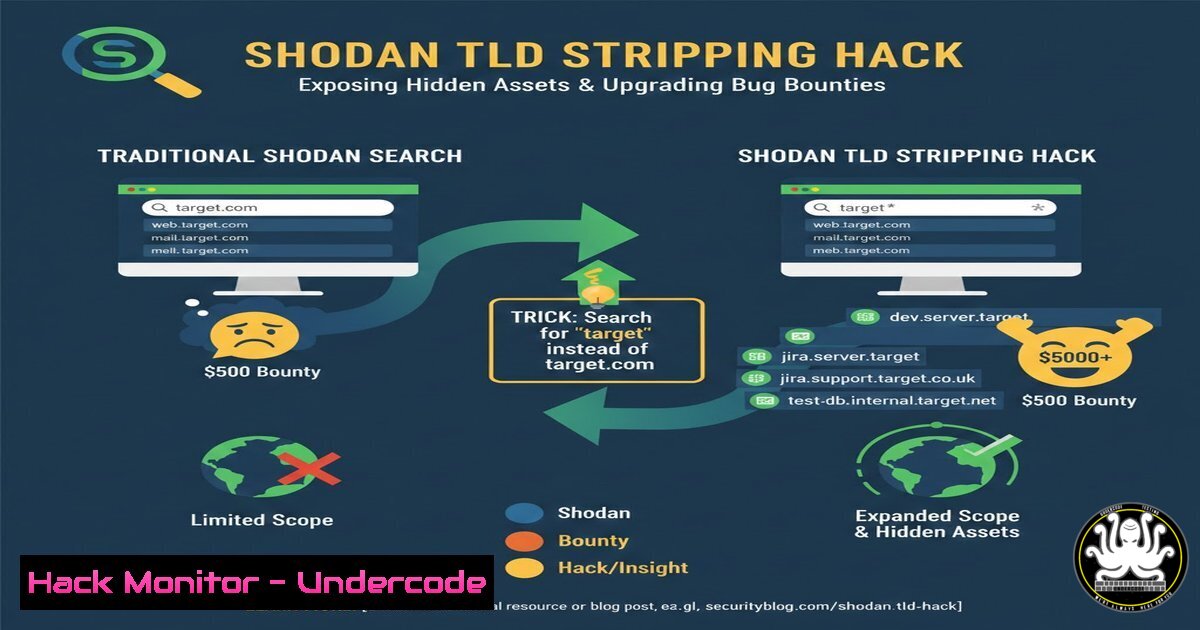
The fundamental insight is that many organizations use SSL certificates or serve HTTP content that references the core brand name without the top-level domain (TLD). Searching for these “naked” names can reveal IPs and servers that subdomain enumeration might miss.
Step-by-Step Guide:
- Concept: Instead of searching for
ssl:"target.com", you search forssl:"target". This query looks for SSL certificates where the Common Name (CN) or Subject Alternative Name (SAN) contains the root word.
2. Basic Query: `ssl:”google” http.status:200`
What it does: This Shodan query returns all IP addresses with a valid (200 OK) HTTP service and an SSL certificate issued for any entity containing the string “google” (e.g., google.com, googleapis.com, a-googledemo.test).
3. Refinement: Combine with other filters. For example, `ssl:”stripe” port:443 -hostname:stripe.com` might find development or third-party servers using Stripe certificates.
4. Command-Line Integration (Using Shodan CLI):
 Install the Shodan CLI
pip install shodan
 Initialize with your API key
shodan init YOUR_API_KEY
 Run the TLD-stripped query
shodan search 'ssl:"targetbrand" http.title:"dashboard"'
What it does: The Shodan command-line tool allows you to programmatically run these searches, filter results, and pipe data into other tools for further analysis.
2. Validating Findings and Assessing Impact
Discovering an IP is only the first step. The critical phase is connecting it to an asset owned by the target program and demonstrating a security flaw.
Step-by-Step Guide:
- Reverse DNS & WHOIS: For each discovered IP, perform validation.
Linux
host <IP_ADDRESS>
dig -x <IP_ADDRESS>
Windows
nslookup <IP_ADDRESS>
- HTTP Header Inspection: Server headers often leak internal hostnames.
curl -I http://<IP_ADDRESS>
Look for headers like 'Host', 'Server', 'X-Backend-Server'
- Virtual Host Brute-Forcing: If the IP hosts multiple sites, discover them.
Using ffuf
ffuf -w /path/to/wordlist.txt -u http://<IP_ADDRESS> -H "Host: FUZZ.target.com" -mc 200
- Impact Argumentation: As seen in the report, an asset initially deemed peripheral (P4) was upgraded (P3) after the researcher proved it handled sensitive data or was part of a critical workflow. Document this chain of evidence: IP -> Valid Target Asset -> Vulnerability -> Proof of Concept -> Business Impact.
3. Expanding the Methodology: Beyond `ssl:` Filters
This principle applies to other Shodan search facets. Creative query building is key.
Step-by-Step Guide:
- HTTP & HTML Content: `http.title:”Target Brand”` or
http.html:"Target Brand".
2. Specific Technologies: `product:”nginx” org:”Target Corp”` or `http.favicon.hash:-`.
3. Port-Centric Discovery: Find non-standard management interfaces.
port:8443 ssl:"internal"
port:9000 http.component:"React"
4. Automation Script Example (Python):
import shodan
API_KEY = "YOUR_API_KEY"
api = shodan.Shodan(API_KEY)
targets = ["brand1", "brand2", "internal"]
for target in targets:
try:
query = f'ssl:"{target}" country:"US"'
results = api.search(query)
for result in results['matches']:
print(f"{result['ip_str']}:{result['port']} - {result.get('org', 'N/A')}")
except shodan.APIError as e:
print(f"Error for {target}: {e}")
4. Integrating with Vulnerability Assessment
Once assets are mapped, pivot to active vulnerability scanning on the newly discovered scope.
Step-by-Step Guide:
1. Port Scanning with Nmap: Categorize services.
nmap -sV -sC -oA discovered_asset <IP_ADDRESS>
2. Web Path Discovery: Use tools like `gobuster` or dirsearch.
gobuster dir -u https://<IP_ADDRESS> -w /usr/share/wordlists/dirb/common.txt
3. API Endpoint Discovery: For modern applications.
ffuf -w /path/to/api-wordlist.txt -u https://<IP_ADDRESS>/FUZZ -mc 200,401
5. Defender’s Perspective: Hardening Your External Attack Surface
Security teams must assume attackers use these techniques.
Step-by-Step Guide for Mitigation:
- Asset Inventory & Classification: Maintain a dynamic, authoritative inventory of all internet-facing assets. Use tools like AWS Config, Azure Resource Graph, or dedicated Cyber Asset Attack Surface Management (CAASM) platforms.
- Certificate Management: Ensure SSL/TLS certificates do not contain sensitive internal naming conventions (e.g.,
prod-internal-db). Use descriptive but non-revealing names. - Cloud Hardening (AWS Example): Implement strict security groups and NACLs.
Use AWS CLI to audit security groups for overly permissive rules
aws ec2 describe-security-groups --query "SecurityGroups[?IpPermissions[?FromPort==22 && IpRanges[?CidrIp=='0.0.0.0/0']]]" --output table
- Network Segmentation: Isolate development, staging, and management interfaces from direct internet access using VPNs or bastion hosts.
- Continuous Monitoring: Implement Shodan and Censys monitoring for your own digital footprint to get alerts when unknown assets appear.
What Undercode Say:
- Reconnaissance is Iterative and Creative: The most valuable assets are often found by manipulating common tools in uncommon ways. The “TLD stripping” trick is a perfect example of a simple logic leap that yields significant results.
- Impact is King in Bug Bounties: The upgrade from P4 to P3 underscores a critical lesson: a finding’s value is not just in the technical flaw, but in your ability to articulate its business context and real-world exploitability. Relentlessly connect the technical dot to a business risk.
Analysis:
This technique is not about exploiting a software bug, but a methodological gap in traditional asset discovery. It exploits the common practice of reusing brand names in certificate issuance and internal branding. Defenders often focus on known domains, while this approach reveals the “shadow infrastructure” linked by naming conventions rather than DNS records. It bridges the gap between passive subdomain enumeration and aggressive network scanning, offering a high-precision, low-noise method for attack surface expansion. For attackers, it’s a force multiplier; for defenders, it highlights the critical need for exhaustive, attribute-based asset management beyond DNS.
Prediction:
This reconnaissance methodology will rapidly become standardized in both red team and bug hunter playbooks, leading to a short-term surge in findings related to exposed internal systems. In response, organizations will accelerate adoption of certificate transparency log monitoring and machine-learning-driven anomaly detection for their external footprint. In the longer term, we will see the development of “offensive AI” agents that autonomously generate and test such heuristic search patterns across Shodan, Censys, and binary edge platforms, continuously probing for new asset discovery logic. This will force a paradigm shift in defensive posture from “protect what we know” to “continuously discover and validate what we own.”
▶️ Related Video (72% Match):
🎯Let’s Practice For Free:
IT/Security Reporter URL:
Reported By: Sahil Kumar – Hackers Feeds
Extra Hub: Undercode MoN
Basic Verification: Pass ✅


