Listen to this Post
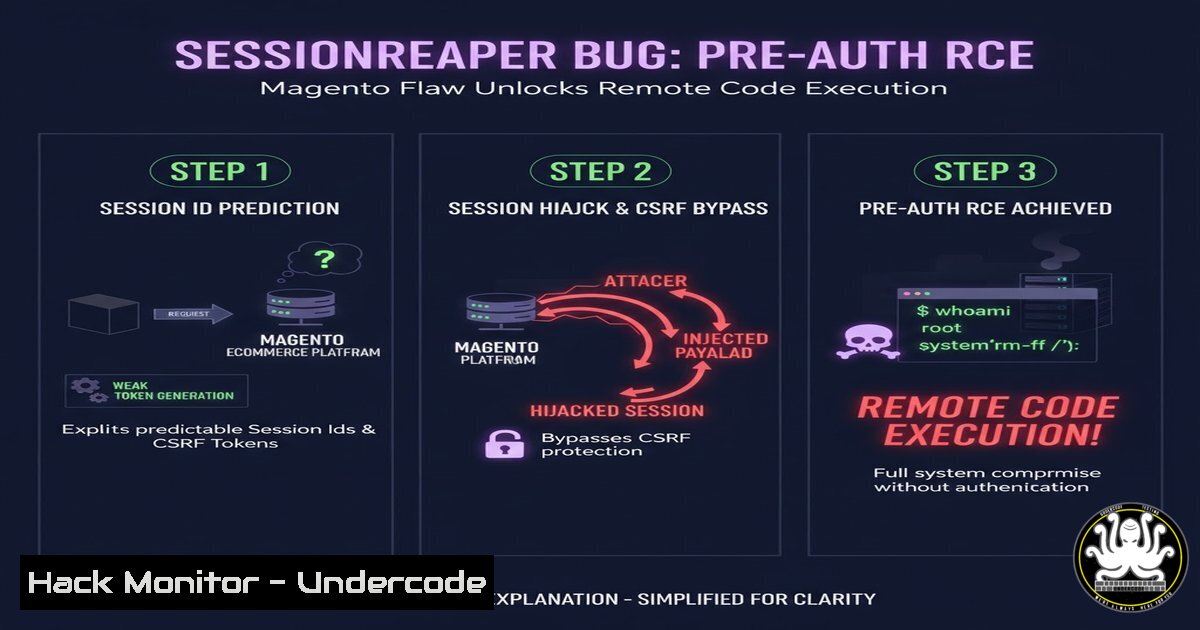
Introduction:
A critical vulnerability in Magento, CVE-2025-54236, was initially downplayed by Adobe as a simple account takeover issue. However, security researchers have revealed its true severity: a pre-authentication remote code execution (RCE) flaw, dubbed “SessionReaper,” stemming from unsafe nested deserialization within the Commerce REST API. This incident highlights the critical risks of deserialization vulnerabilities and the importance of independent community verification of vendor advisories.
Learning Objectives:
- Understand the mechanics of unsafe deserialization attacks and how they lead to RCE.
- Learn to identify and test for deserialization vulnerabilities in web APIs.
- Implement defensive strategies to harden systems against deserialization-based exploits.
You Should Know:
1. Identifying the Vulnerable Endpoint
The vulnerability was exploited through the Magento REST API endpoint /rest/V1/customers/me. A crafted request to this endpoint could trigger the deserialization chain.
cURL Command to Identify Accessible API Endpoints:
curl -k -s "https://<TARGET>/rest/V1/integration/admin/token" | jq .
Step-by-step guide explaining what this does and how to use it.
This command attempts to interact with a common Magento API endpoint to generate an admin token. The `-k` flag ignores SSL certificate errors, and the `-s` flag silences the progress meter. The output is piped to `jq` for pretty-printing. A successful response, even an error, indicates the API is accessible and can be probed for other endpoints like the vulnerable customer endpoint. This is the first step in reconnaissance.
2. Crafting the Malicious Deserialization Payload
The exploit involved sending a serialized PHP object that, when deserialized, would execute arbitrary code. PHPGGC (PHP Generic Gadget Chains) is a common tool for generating such payloads.
PHPGGC Command to Generate a Deserialization Payload:
phpggc -u Monolog/RCE8 'system' 'id' | base64 -w 0
Step-by-step guide explaining what this does and how to use it.
This command uses PHPGGC to generate a serialized payload for the Monolog RCE8 gadget chain. The `-u` flag URL-encodes the output. The arguments `’system’ ‘id’` specify that the `system` function should be called with the command id. The payload is then base64-encoded to prepare it for transmission over HTTP. This payload would be the core of the attack sent to the vulnerable endpoint.
3. Exploiting the SessionReaper Vulnerability via HTTP
With the generated payload, an attacker can craft a malicious HTTP POST request to the vulnerable endpoint without any authentication.
cURL Command for Pre-Auth RCE Exploitation:
curl -X POST "https://<TARGET>/rest/V1/customers/me" \
-H "Content-Type: application/json" \
-d '{"customer":{"id":"<MALICIOUS_BASE64_PAYLOAD>"}}'
Step-by-step guide explaining what this does and how to use it.
This command sends a POST request to the `customers/me` endpoint. The `-H` flag sets the Content-Type to JSON. The `-d` flag contains the JSON data payload. The key part is the `”id”` field, which is where the base64-encoded PHP object from PHPGGC is placed. When Magento processes this request, it deserializes the object, triggering the gadget chain and executing the embedded command (e.g., id).
4. Detecting Deserialization Attempts with Log Monitoring
Monitoring web server logs is crucial for detecting exploitation attempts. Unusual patterns in requests to specific API endpoints can be a key indicator.
Linux grep Command to Search for Suspicious API Activity:
grep -E "POST /rest/V1/customers" /var/log/nginx/access.log | grep -v " 200 "
Step-by-step guide explaining what this does and how to use it.
This command searches the Nginx access log for all POST requests to the customer endpoint. The `grep -v ” 200 “` part then filters out successful (200 status) requests, leaving only non-200 responses which could indicate failed exploitation attempts or errors triggered by malicious payloads. Regular monitoring of such logs can provide early warning of an attack.
5. Mitigating with WAF Rules to Block Deserialization
A Web Application Firewall (WAF) can be configured to block requests containing known serialization markers or patterns associated with gadget chains.
ModSecurity Rule Snippet to Block Java Deserialization (Conceptual):
SecRule REQUEST_BODY "@rx (rO0A|ACED|java.lang)" \
"id:1001,phase:2,deny,msg:'Java Object Deserialization Attempt'"
Step-by-step guide explaining what this does and how to use it.
This is a simplified example rule for the ModSecurity WAF. The `SecRule` directive defines a rule. `REQUEST_BODY` is the inspection target. The `@rx` operator performs a regular expression match for common Java serialization markers like `rO0A` or java.lang. If a match is found, the request is denied, and a log message is generated. While this example is for Java, similar logic can be applied to create rules for PHP serialization formats.
6. Patching and System Hardening
The primary mitigation is to apply the official Adobe security patch immediately. Furthermore, system hardening should be performed.
Linux Command to Verify File Integrity Post-Patch:
rpm -V --nomtime magento-package-name
Step-by-step guide explaining what this does and how to use it.
This command (on Red Hat-based systems) verifies the integrity of the installed Magento package files against the RPM database. The `-V` flag triggers verification, and `–nomtime` ignores file modification time changes, focusing on more critical changes like file size or MD5 checksum. Any unexpected changes in core files could indicate a incomplete patch or a backdoor.
7. Network-Level Containment
If immediate patching is not possible, network-level controls can be implemented to restrict access to the vulnerable endpoint as a temporary measure.
Windows Firewall Command to Block a Specific URL Path (Using Netsh):
netsh http add urlacl url=https://+:443/rest/V1/customers/me/ user="NT AUTHORITY\LOCAL SERVICE"
Step-by-step guide explaining what this does and how to use it.
This command uses the Windows `netsh` tool to add a URL reservation. While typically used for granting access, in this context, by reserving the URL and assigning it to a specific, restricted user, you can effectively block general access to the exact exploit path. This is a complex but potent temporary containment strategy that requires careful testing to avoid breaking legitimate functionality.
What Undercode Say:
- Vendor severity ratings should be the starting point for risk assessment, not the final word. Independent validation is non-negotiable.
- Nested deserialization remains a critical anti-pattern in application security, and legacy codebases are a breeding ground for such vulnerabilities.
The SessionReaper incident is a textbook case of a vulnerability’s perceived impact being dangerously misaligned with its technical reality. Adobe’s initial advisory focused on the symptom (account takeover) rather than the root cause (unsafe deserialization leading to RCE). This underscores a critical gap in the vulnerability disclosure ecosystem where vendors, often for reputational or commercial reasons, may minimize a flaw’s severity. The security community’s role as an independent verifier was paramount here. This event serves as a stark reminder that modern application security must aggressively hunt for and eradicate unsafe deserialization patterns, treating them with the same severity as SQL injection or buffer overflows. Legacy systems, particularly in e-commerce platforms handling vast amounts of sensitive data, are disproportionately vulnerable to these complex attack chains.
Prediction:
The successful exploitation and subsequent community analysis of CVE-2025-54236 will act as a blueprint for attackers targeting other applications with nested deserialization patterns in their APIs. We predict a short-term surge in automated scanning for similar endpoints in Magento instances and other e-commerce platforms (e.g., Shopify plugins, WooCommerce). In the longer term, this flaw will fuel the development of more sophisticated, polyglot deserialization gadget chains that can evade simple signature-based WAF rules, forcing a shift towards behavioral analysis and runtime application self-protection (RASP) technologies for effective defense.
🎯Let’s Practice For Free:
IT/Security Reporter URL:
Reported By: Shubhamshah Why – Hackers Feeds
Extra Hub: Undercode MoN
Basic Verification: Pass ✅


