Listen to this Post
Introduction:
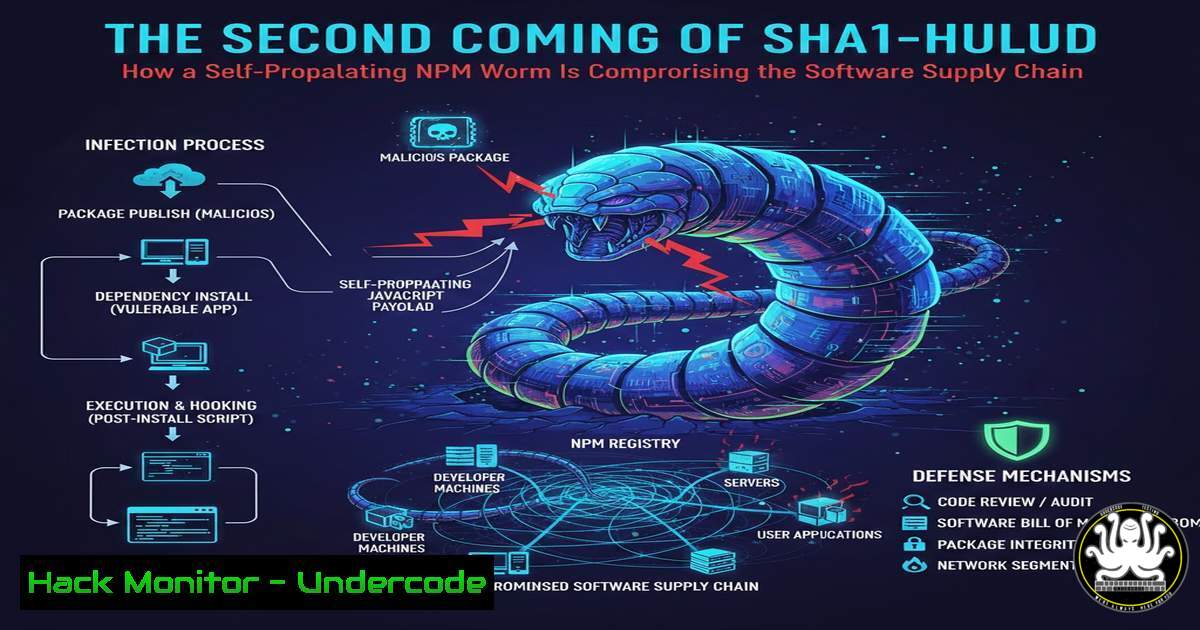
A massive, self-propagating worm dubbed “Sha1-Hulud: The Second Coming” is wreaking havoc across the NPM ecosystem. This sophisticated attack has compromised hundreds of packages from major organizations like Zapier, Postman, and PostHog, leading to over 26,000 breached accounts and the public exfiltration of secrets to GitHub. The worm leverages stolen NPM tokens to achieve critical mass, creating a self-sustaining cycle of infection that poses a severe threat to the global software supply chain.
Learning Objectives:
- Understand the infection vector and propagation mechanism of the Sha1-Hulud worm.
- Learn how to identify and eradicate the malware from your development environment and infrastructure.
- Implement proactive measures to harden your organization against similar supply chain attacks.
You Should Know:
1. Understanding the Attack Vector and Malware Payload
The initial compromise is believed to have originated from a breached account at Zapier, which was used to seed the malicious code into their NPM packages. The primary payload is a file named setup_bun.js. When a compromised package is installed or updated, this script executes, performing a multi-stage attack. It first establishes persistence on the victim’s machine, then conducts a comprehensive scan of the local environment for secrets, including environment variables, configuration files, and CI/CD credentials. Any discovered secrets, especially NPM developer tokens, are Base64-encoded and exfiltrated to a newly created public GitHub repository with the description “Sha1-Hulud: The Second Coming”. If an NPM token is found, the worm uses it to automatically compromise all packages accessible by that token, creating a self-propagating cycle.
2. Immediate Detection and Forensic Analysis
The first step in containment is detecting the presence of the worm. The attack leaves clear forensic artifacts.
Step-by-step guide:
Check for Malicious Files: Scan your project directories and global `node_modules` for the malicious file.
Linux/macOS Command:
find . -name "setup_bun.js" -type f
Windows Command (PowerShell):
Get-ChildItem -Path . -Filter "setup_bun.js" -Recurse -File
Audit GitHub Repositories: Immediately check your organization’s GitHub account for any unauthorized repositories. The description “Sha1-Hulud: The Second Coming” is a primary indicator of compromise.
Scan for Suspicious Network Calls: Monitor outbound traffic for connections to GitHub’s API endpoints related to repository creation. Tools like Wireshark or host-based firewalls can be configured to alert on this activity.
3. Containment and Eradication: Rotating Secrets
If any trace of the malware is found, assume all secrets in that environment are compromised. Immediate rotation is non-negotiable.
Step-by-step guide:
1. Revoke NPM Tokens:
Log into the NPM registry via the command line or website.
List all active tokens: `npm token list`
Delete every single token: `npm token delete [token-id]`
Generate new, securely generated tokens with minimal required permissions.
2. Rotate All Other Credentials: This includes, but is not limited to:
Cloud provider access keys (AWS, GCP, Azure)
Database passwords
API keys for external services (Stripe, SendGrid, etc.)
SSH keys
CI/CD pipeline secrets (GitHub Actions, GitLab CI, Jenkins credentials)
3. Purge Node Modules and Lockfiles: Completely remove `node_modules` and package lock files (package-lock.json, yarn.lock) to ensure a clean re-installation of dependencies.
4. Identifying and Purging Compromised Dependencies
Your project must be audited against the known list of compromised packages. Relying on a potentially infected `node_modules` cache for this audit is unreliable.
Step-by-step guide:
- Consult the Official List: The security team at Aikido Security is maintaining a real-time list of compromised packages: `https://www.aikido.dev/blog/shai-hulud-strikes-again-hitting-zapier-ensdomains`. Cross-reference your `package.json` against this list.
- Use NPM Audit: Run `npm audit` to check for known vulnerabilities. While this specific worm may be too new for the databases, it’s a critical best practice.
- Clean Re-install: After confirming your direct dependencies are safe, perform a clean installation.
rm -rf node_modules package-lock.json
npm install
5. Hardening Your Development and CI/CD Environment
Proactive hardening is essential to prevent future incidents.
Step-by-step guide:
- Implement Secret Scanning: Use pre-commit hooks and CI/CD pipeline integrations with tools like GitGuardian, TruffleHog, or GitHub’s built-in secret scanning to prevent secrets from being committed to code in the first place.
- Enforce Least Privilege for NPM Tokens: Never use automation tokens with publish rights for general installation. Use tokens with the minimum required scope (
--read-only). - Use Package Allow Lists: In enterprise environments, use a private registry like JFrog Artifactory or GitHub Packages with curated allow lists to prevent unauthorized packages from being installed.
- Immutable Infrastructure & Sandboxing: Run CI/CD jobs in ephemeral, sandboxed containers that are destroyed after each execution to limit the worm’s ability to persist and spread laterally.
What Undercode Say:
- The software supply chain has become the primary attack surface for modern cyber threats, and traditional perimeter security is no longer sufficient. This worm demonstrates that a single compromised credential can lead to a cascading failure across the entire ecosystem.
- The speed and scale of this attack underscore a critical failure in the “trust by default” model of open-source repositories. Organizations must shift to a “zero-trust” approach for their dependencies, actively verifying integrity rather than assuming safety.
The Sha1-Hulud incident is not just another vulnerability; it is a paradigm shift. It proves the feasibility of a fully automated, self-propagating cyber-attack within a critical software infrastructure. The worm’s ability to use exfiltrated secrets to fuel its own spread creates a positive feedback loop that is incredibly difficult to break. This event should serve as a wake-up call for all development organizations to invest heavily in software supply chain security, including mandatory secret management, strict dependency auditing, and robust, isolated build environments. The cost of inaction is no longer just a data breach; it’s becoming an unwitting participant in a global cyber-pandemic.
Prediction:
The success of the Sha1-Hulud worm will inevitably spawn a new generation of copycat attacks and more advanced variants. We predict a rise in AI-powered worms that can intelligently analyze stolen secrets to determine the most valuable next targets, potentially moving beyond NPM to infect PyPI, RubyGems, and Docker Hub. This will force a fundamental restructuring of how open-source registries operate, likely leading to mandatory two-factor authentication, stricter publishing controls, and the widespread adoption of software bill of materials (SBOMs) and cryptographic signing for all packages. The era of the “smart worm” has begun, and the software industry is now in an arms race it is not yet prepared to win.
🎯Let’s Practice For Free:
IT/Security Reporter URL:
Reported By: Advocatemack %F0%9D%97%AD%F0%9D%97%AE%F0%9D%97%BD%F0%9D%97%B6%F0%9D%97%B2%F0%9D%97%BF – Hackers Feeds
Extra Hub: Undercode MoN
Basic Verification: Pass ✅


