Listen to this Post
Introduction:
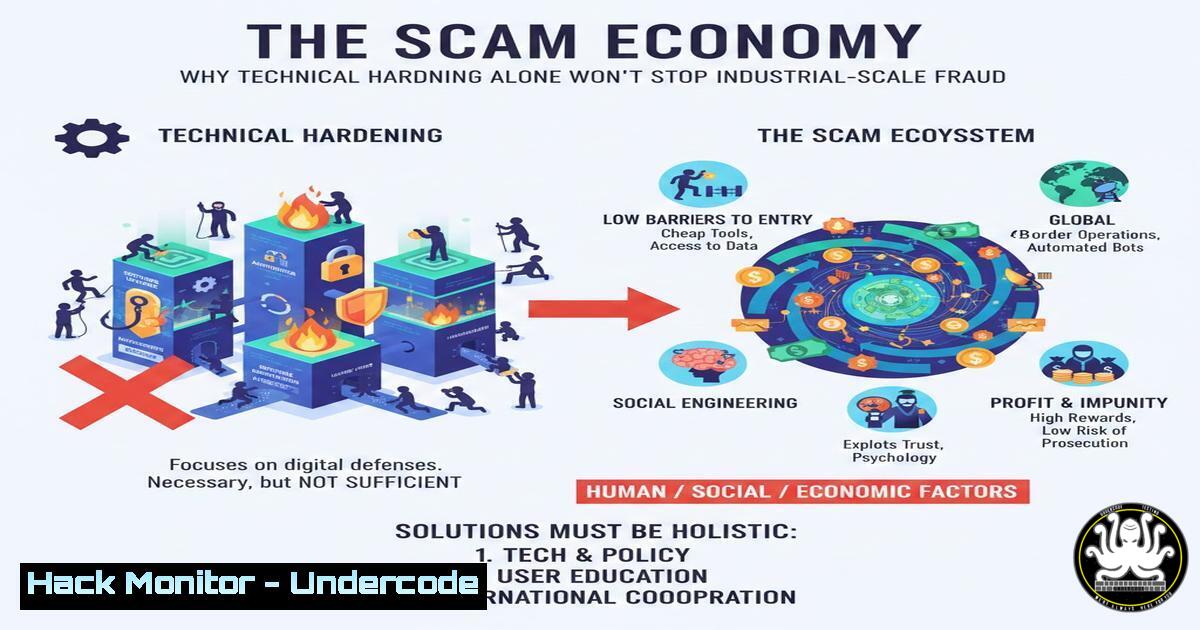
The digital landscape is besieged by a industrial-scale scam ecosystem that traditional security awareness and technical patches cannot dismantle alone. As industry experts highlight, the core issue is not a lack of user education but a deeply embedded profit motive that financially incentivizes carriers to tolerate illegal traffic. This article deconstructs the technical architecture enabling this fraud and outlines the multi-layered defenses, from network-level commands to policy enforcement, required to disrupt the scam economy’s business model.
Learning Objectives:
- Understand the technical pathways and network vulnerabilities exploited by industrial-scale scam messaging operations.
- Implement actionable command-level controls and traffic analysis techniques to identify and block fraudulent communications.
- Analyze the systemic economic incentives that must be reformed to complement technical security measures.
You Should Know:
- Deconstructing the Scam Messaging Ecosystem: The Technical Backbone
The global scam ecosystem relies on a complex network of interconnected systems, including vulnerable SIP trunks, unsecured PBXes, and SS7 signaling vulnerabilities. Fraudsters exploit these to generate massive volumes of scam SMS and voice calls, often using impersonation and social engineering. The traffic is typically routed through multiple carriers, some of whom may turn a blind eye due to the revenue generated, creating a “grey route” infrastructure that obscures the origin.
Step‑by‑step guide explaining what this does and how to use it.
Step 1: Identify Suspicious SIP Registration Attempts. On your SIP server, monitor for brute-force attacks attempting to register and use your trunk for unauthorized traffic.
Linux Command (using `asterisk -r` for Asterisk PBX):
sip show registry
 Look for unknown IPs or domains in the "Host" column.
sip set debug on
 Monitor the console for real-time SIP packet analysis, watching for REGISTER and INVITE requests from suspicious sources.
Step 2: Analyze Call Detail Records (CDRs) for Anomalies. Scam operations often show patterns like a high volume of short-duration calls to a specific range of numbers or a sudden, massive spike in outbound SMS traffic.
Bash Command to parse CDRs:
 Find top 10 source IPs for outbound calls in the last 24 hours
awk -F, '{print $3}' call_records.csv | sort | uniq -c | sort -nr | head -10

Check for SMS spikes (assuming SMS logs are in a separate file)
grep "SMS sent" sms_log.txt | cut -d' ' -f1 | uniq -c
 This groups SMS sends by hour, making spikes easily visible.
2. Implementing Network-Level SMS Firewalling and Filtering
A robust SMS firewall is critical for filtering scam messages based on content, origin, and destination. This involves deploying rules that block known malicious patterns, such as URLs associated with phishing sites or sender IDs used in impersonation scams.
Step‑by‑step guide explaining what this does and how to use it.
Step 1: Deploy Regex-Based Content Filtering. Create regular expressions to flag or block messages containing high-confidence scam keywords and URL patterns.
Example Rule (Pseudocode for an SMS Firewall like `Kannel` or proprietary solutions):
IF message_content MATCHES ".(urgent|bank\s+transfer|tax\s+refund|gift\s+card|click\s+this\s+link)." THEN
action = "BLOCK";
log_event("High-Confidence Scam Phrase Blocked", message_id);
END IF
Step 2: Integrate with Real-Time Blackhole Lists (RBLs). Configure your SMSC to query RBLs containing known fraudulent sender numbers or gateway IP addresses.
Linux Command to test an IP against a DNSBL (for email/SIP, conceptually similar for SMS):
host 192.0.2.55.zen.spamhaus.org
 If the query returns an address like 127.0.0.2, the IP is listed as spammy.
- Hardening SIP Trunks and Voice Infrastructure Against Fraud
Unsecured Session Initiation Protocol (SIP) trunks are a primary vector for telecom fraud, including toll fraud and scam call origination. Hardening these systems is non-negotiable.
Step‑by‑step guide explaining what this does and how to use it.
Step 1: Enforce Strong Authentication and IP Whitelisting. Do not rely on weak passwords. Restrict inbound SIP connections to known, trusted IP addresses.
Example Configuration Snippet (`/etc/asterisk/sip.conf`):
[bash]
context=public-incoming
allowguest=no ; Crucial: Disables unauthenticated calls

[trusted-peer]
type=peer
host=192.0.2.100 ; IP of your trusted carrier
secret=VeryStrongPassword123!
context=trunk-incoming
Step 2: Implement Call Rate Limiting. Prevent abuse by limiting the number of concurrent calls or calls per minute from a single endpoint.
Asterisk CLI Command:
pjsip set logger on
 Then, in extensions.conf, you can use the `GROUP` and `GOTOIF` functions to count calls and jump to a busy signal if a limit is exceeded.
4. Leveraging AI/ML for Anomalous Traffic Pattern Detection
Artificial Intelligence and Machine Learning can analyze vast quantities of traffic data to identify subtle, emerging patterns that rule-based systems might miss. This is key for detecting new scam campaigns early.
Step‑by‑step guide explaining what this does and how to use it.
Step 1: Data Collection and Feature Engineering. Aggregate CDRs, SIP logs, and SMS logs into a central data lake. Key features include call duration, frequency, destination prefixes, time-of-day patterns, and call success/failure rates.
Step 2: Develop a Baseline and Anomaly Scoring Model. Using a tool like Python’s Scikit-learn, create a model that flags deviations from normal behavior.
Simplified Python Snippet for Anomaly Detection:
from sklearn.ensemble import IsolationForest
import pandas as pd

Load CDR data
data = pd.read_csv('cdr_features.csv')
 Train model
model = IsolationForest(contamination=0.01)  Assume 1% anomaly
model.fit(data)
 Predict anomalies
data['anomaly_score'] = model.decision_function(data)
data['is_anomaly'] = model.predict(data)
 Print suspicious calls
print(data[data['is_anomaly'] == -1])
- The Policy and Economic Layer: Taking the Profit Out of Scams
Technical controls are a defensive measure, but the offensive strategy must involve dismantling the economic model. This requires regulatory and contractual pressure on carriers.
Step‑by‑step guide explaining what this does and how to use it.
Step 1: Contractual SLAs with Financial Penalties. Enterprises and aggregators must contract with carriers that include strict Service Level Agreements (SLAs) with severe financial penalties for carrying identified scam traffic.
Step 2: Advocate for Regulatory “Know Your Customer” (KYC) Rules. Lobby for regulations that require all entities entering the telecommunications chain to undergo rigorous KYC checks, making it harder for fraudulent operators to establish a foothold and holding them financially and legally accountable.
What Undercode Say:
- Technical Hardening is Necessary but Insufficient. While firewalls, AI, and secure configurations are critical for defense-in-depth, they are ultimately fighting the symptoms. The root cause is a financial ecosystem that rewards the carriage of malicious traffic.
- The Solution is a Public-Private-Technical Trifecta. Lasting change will only come from the convergence of robust technical security, stringent corporate policies that disincentivize fraud, and strong regulatory frameworks that enforce accountability across the entire communications supply chain.
The analysis from industry insiders like Eric Priezkalns reveals a critical truth: the scam problem is a market failure. Carriers profit from the volume of traffic, creating a perverse incentive to ignore its legitimacy. This aligns with classic security principles where a system’s weakness is often its economic model, not just its technical flaws. Focusing solely on user education or endpoint security is like mopping the floor while the tap is still running. The conversation must shift towards creating transparency and financial disincentives for bad actors and complicit intermediaries. This requires technical professionals to not only secure their own systems but also to advocate for and implement the economic and policy controls that will starve the scam economy of its fuel.
Prediction:
In the next 3-5 years, we will witness a significant regulatory crackdown on the telecommunications industry, mirroring aspects of financial sector anti-money laundering laws. “Carrier KYC” will become standard, and the liability for scam-related losses will increasingly be placed on the originating and intermediate carriers who fail their due diligence. This will be driven by a growing body of litigation from victims and class-action lawsuits. Technologically, we will see a rapid maturation of decentralized identity and blockchain-based caller ID systems to combat spoofing, forcing a fundamental redesign of trust in digital communications. The carriers that proactively invest in transparent, secure infrastructure and ethical traffic policies will emerge as the new trusted leaders, while those clinging to the grey market will face existential threats.
🎯Let’s Practice For Free:
IT/Security Reporter URL:
Reported By: Alexandrajbrooks Telcos – Hackers Feeds
Extra Hub: Undercode MoN
Basic Verification: Pass ✅


