Listen to this Post
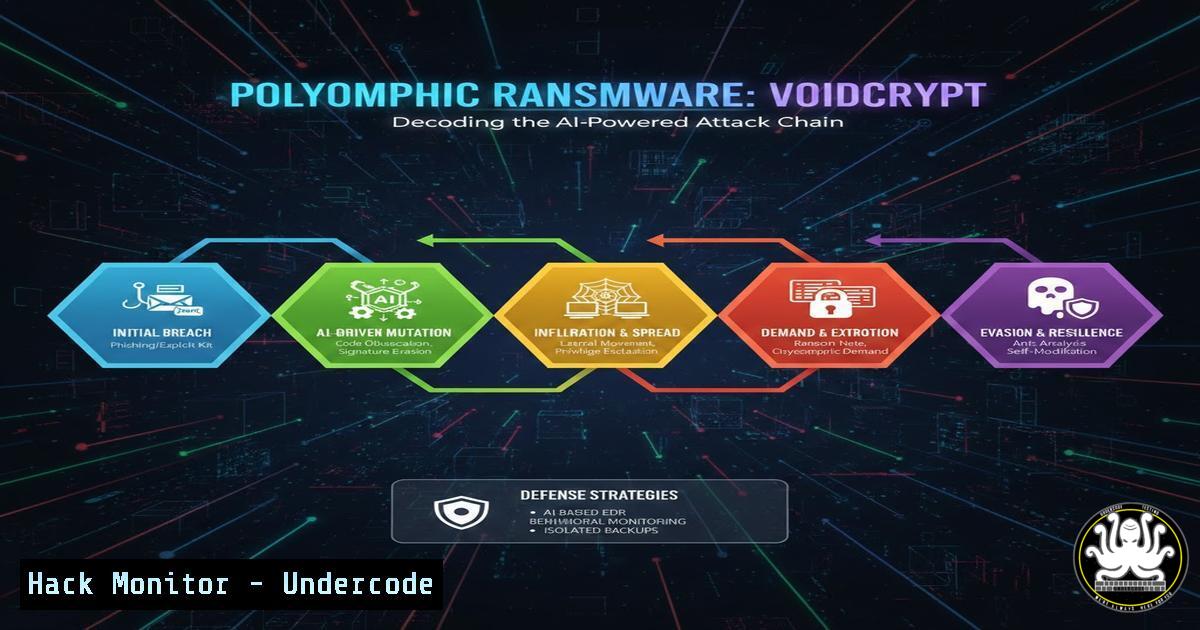
Introduction:
The cybersecurity landscape is witnessing a paradigm shift with the emergence of VoidCrypt, a next-generation ransomware strain that leverages artificial intelligence to create polymorphic code, rendering traditional signature-based detection obsolete. Unlike static malware, VoidCrypt mutates its codebase with every infection, utilizing machine learning algorithms to analyze target environments in real-time and evade sandboxes. This advanced persistent threat targets hybrid cloud infrastructures and endpoint devices simultaneously, exploiting zero-day vulnerabilities in API communications to maximize lateral movement.
Learning Objectives:
- Analyze the AI-driven obfuscation techniques used by VoidCrypt to bypass antivirus and EDR solutions.
- Identify indicators of compromise (IoCs) across Linux and Windows systems post-exploitation.
- Implement defensive strategies using command-line tools and security configurations to mitigate polymorphic ransomware attacks.
You Should Know:
1. Initial Infection Vector: The Stealth Dropper
The attack begins with a sophisticated phishing campaign distributing malicious Excel documents (XLM macros) or compromised MSI installers. Upon execution, the dropper initiates a PowerShell script designed to run completely in memory, leaving minimal forensic traces.
Step‑by‑step guide to analyzing the dropper behavior:
To understand how the dropper evades detection, security analysts can simulate the environment and monitor process creation.
On Windows (using PowerShell and Sysinternals):
 Monitor for suspicious process trees initiated by Office applications
Get-WmiObject Win32_Process | Where-Object { $_.ParentProcessId -eq (Get-Process -Name "EXCEL" | Select -ExpandProperty Id) } | Format-Table Name, ProcessId, CommandLine

Use Sysmon to log network connections from Office products
 Ensure Sysmon is configured with a rule to log Event ID 3 (Network connection)
Find all instances where Image contains 'EXCEL.exe' and DestinationPort is 443 or 80
On Linux (if targeting a vulnerable Samba server or web app):
 Check for suspicious cron jobs or systemd timers added by the dropper
sudo grep -r -i "wget|curl" /etc/cron /var/spool/cron/

Monitor file system changes in real-time during detonation
sudo inotifywait -m -r --format '%w%f' /tmp /var/tmp
2. AI-Powered Evasion and Sandbox Detection
Once executed, VoidCrypt queries the system to determine if it is running in a virtualized environment. It uses CPU instruction counts, disk size checks, and MAC address analysis. The AI model embedded within the malware adjusts its payload based on these findings.
Step‑by‑step guide to hardening environments against sandbox detection:
To prevent malware from identifying your analysis sandbox, implement the following configurations.
Windows Registry Modifications to Mimic a Physical Machine:
:: Modify registry to alter hardware IDs reported to processes
reg add "HKLM\HARDWARE\DESCRIPTION\System" /v "SystemBiosVersion" /t REG_SZ /d "Default System BIOS" /f
reg add "HKLM\SOFTWARE\Microsoft\Cryptography" /v "MachineGuid" /t REG_SZ /d "12345678-1234-1234-1234-123456789012" /f

:: Add more realistic user artifacts
reg add "HKCU\Software\Microsoft\Windows\CurrentVersion\Explorer\RecentDocs" /v "MRUListEx" /t REG_BINARY /d 01000000 /f
Linux Kernel Hardening (Hide from /proc checks):
 Hide kernel modules from unprivileged users
echo "kernel.modules_disabled = 1" >> /etc/sysctl.conf
sysctl -p

Use bind mounts to hide virtualization tools signatures
mount --bind /dev/null /usr/bin/lspci
3. Privilege Escalation via API Security Flaws
After establishing persistence, VoidCrypt exploits insecure API endpoints on the local network. It specifically targets REST APIs with broken object-level authorization (BOLA) to move from a workstation to a server.
Step‑by‑step guide to detecting and mitigating API-based lateral movement:
Understanding how the attacker enumerates and exploits APIs is crucial.
Detecting Suspicious API Calls (using Zeek or tcpdump):
 Capture traffic to internal APIs that deviate from normal user-agent strings
sudo tcpdump -i eth0 -A -s 0 'tcp port 8080 and (tcp[((tcp[12:1] & 0xf0) >> 2):4] = 0x504f5354)'

Look for internal IP addresses performing brute-force API authentication
sudo grep "401 Unauthorized" /var/log/nginx/api_access.log | awk '{print $1}' | sort | uniq -c | sort -nr
Cloud Hardening (AWS Example to prevent BOLA):
 Implement strict IAM policies to enforce API Gateway resource permissions
 Use AWS CLI to audit resource policies that are too permissive
aws apigateway get-rest-apis --query 'items[?contains(policy, "")]' --output table

Ensure Lambda authorizers are enabled for all API endpoints
aws apigateway get-authorizers --rest-api-id your_api_id
4. Data Exfiltration and Encryption
Before encrypting files, VoidCrypt exfiltrates sensitive data to an external server using fragmented DNS tunneling to bypass firewalls. It then uses a hybrid encryption scheme (ChaCha20 for files, RSA-4096 for the key).
Step‑by‑step guide to blocking data exfiltration:
Implementing network-level controls can stop the data leak before the ransomware activates the encryption.
Windows Firewall Rule to Block Outbound SMB and RDP (common exfiltration paths):
 Block all outbound SMB connections to prevent spreading and exfiltration to network shares
New-NetFirewallRule -DisplayName "Block SMB Outbound" -Direction Outbound -Protocol TCP -LocalPort 445 -Action Block

Limit DNS traffic to known resolvers only to stop DNS tunneling
New-NetFirewallRule -DisplayName "DNS Restrict" -Direction Outbound -Protocol UDP -RemotePort 53 -RemoteAddress 8.8.8.8 -Action Allow
Linux (iptables) to Detect and Block Suspicious Outbound Traffic:
 Log and drop connections to non-standard ports from internal servers
iptables -A OUTPUT -p tcp --dport 53 -m string --string "tunnel" --algo bm -j LOG --log-prefix "DNS_TUNNEL: "
iptables -A OUTPUT -p tcp --dport ! 53 -m state --state NEW -j DROP

Monitor for mass file access (pre-encryption activity) using auditd
auditctl -w /home -p war -k mass_file_access
ausearch -k mass_file_access | aureport -f -i
5. Post-Exploitation Analysis and Recovery
If the encryption payload detonates, immediate containment is required. The focus shifts to analyzing the ransom note and attempting to find cryptographic weaknesses if the AI model made a mistake in key generation.
Step‑by‑step guide to incident response:
On a compromised Linux server:
 Immediately isolate the host
iptables -P INPUT DROP
iptables -P OUTPUT DROP
iptables -P FORWARD DROP

Locate the ransomware process
ps aux | grep -i "void|crypt"
 Kill the process
kill -9 [bash]

Check for the encryption binary and reverse engineer its strings
strings /tmp/.cache/.systemd-private- | grep -i "rsa|chacha|aes"
Windows Recovery Attempt (Volume Shadow Copies):
:: Attempt to restore previous versions of files if the ransomware failed to delete shadows
vssadmin list shadows
:: If shadows exist, copy a file back
copy \?\GLOBALROOT\Device\HarddiskVolumeShadowCopy1\Users\Admin\Documents\important.docx C:\Users\Admin\Documents\

:: Check for decryption tools posted by security researchers (specific to this strain)
:: Use Sysinternals Strings to look for command-and-control IPs embedded in the binary
What Undercode Say:
- The Arms Race Has Escalated: VoidCrypt represents the first wave of malware where the evasion logic is not hardcoded but learned. Defenders must shift from static rule-writing to deploying behavioral AI models that can detect anomalies in process behavior rather than matching file hashes.
- API Security is the New Perimeter: The attack’s success hinged on exploiting internal APIs. Organizations often secure the external web application firewall but leave internal APIs wide open. Implementing strict mutual TLS (mTLS) and continuous API discovery is no longer optional.
Prediction:
Within the next 12 months, we will see the emergence of “Defensive AI” that fights back against polymorphic malware. This will lead to a digital cold war within networks, where AI-driven ransomware and AI-driven EDR systems engage in real-time computational battles for control over process threads. This will inevitably lead to higher false positives but will be necessary to contain threats that mutate faster than humans can patch.
🎯Let’s Practice For Free:
IT/Security Reporter URL:
Reported By: Brianelliottdavis Cobol – Hackers Feeds
Extra Hub: Undercode MoN
Basic Verification: Pass ✅


