
Listen to this Post
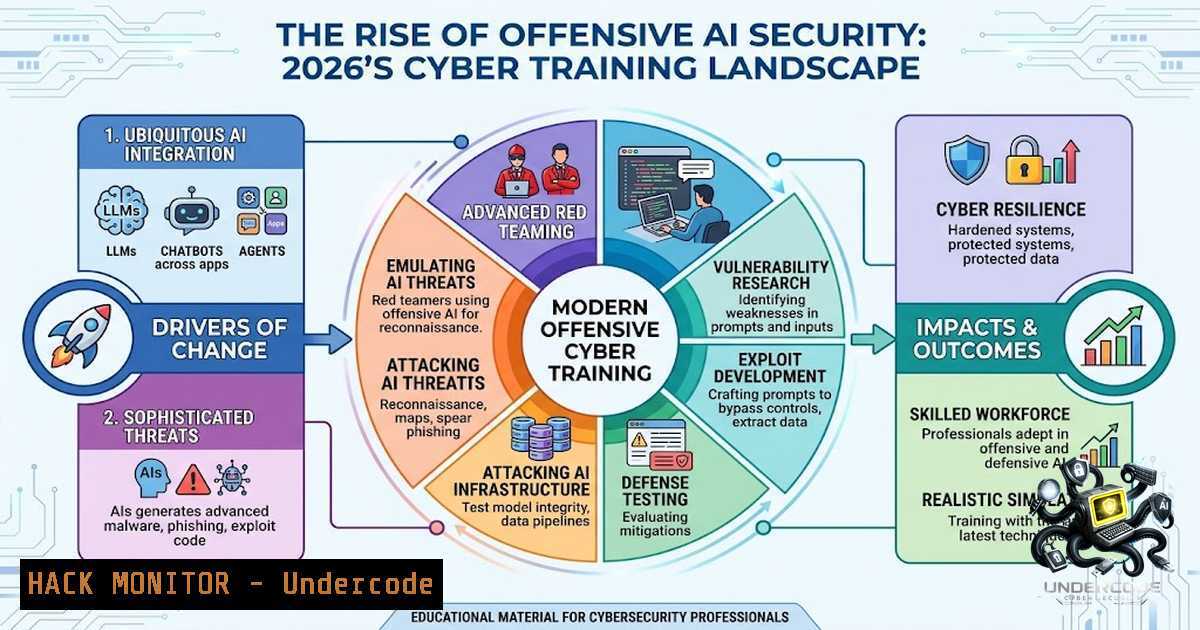
Introduction:
As organizations rapidly integrate generative AI, machine learning models, and autonomous agents into their production environments, the cybersecurity attack surface has expanded beyond traditional perimeters. Conventional penetration testing methodologies, designed for standard IT infrastructure, are increasingly insufficient for identifying logic flaws within Large Language Models (LLMs) and complex multi-agent orchestration frameworks. In response, 2026 has witnessed a surge in specialized training programs—from OffSec’s Advanced AI Red Teaming (OSAI) to ISC2’s AI Express Courses—aimed at equipping professionals with the adversarial mindset required to secure AI ecosystems.
Learning Objectives & Secrets:
- Objective 1 (The Adversarial Mindset): Develop the ability to think like an attacker targeting AI systems. This involves moving beyond standard vulnerability assessments to understand how real adversaries manipulate model behavior, exploit Retrieval-Augmented Generation (RAG) pipelines, and compromise the underlying infrastructure supporting AI deployments. Secret Tip: Focus on “human-in-the-loop” logic flaws—automated scanners often miss business logic errors in LLM interactions that can lead to data exfiltration.
- Objective 2 (Prompt Injection Mastery): Given that prompt injection accounts for 29% of AI-focused security challenges, mastering indirect and direct prompt injection is critical. Secret Tip: Practice using encoded payloads and context-switching techniques to break out of system prompts and access underlying vector databases or training data.
- Objective 3 (Securing the AI Supply Chain): Understand the vulnerabilities in the AI lifecycle, from model weight extraction to dependency confusion attacks in ML pipelines. Secret Tip: Audit your organization’s Hugging Face or private model registries for exposed API keys and backdoored pre-trained models; 24% of AI breaches involve model backdooring or supply-chain compromise.
You Should Know:
1. Attacking RAG Pipelines and Embedding Models
Retrieval-Augmented Generation (RAG) is a primary architecture for enterprise AI, but it introduces specific vulnerabilities. Attackers can poison the vector database or manipulate embeddings to force the LLM to return malicious or inaccurate data.
- Step-by-step guide to testing RAG security:
- Enumeration: Identify the data sources connected to the RAG pipeline (e.g., internal wikis, SharePoint, private GitHub repos).
- Data Poisoning: If you have write access (or can exploit a misconfigured vector database like Pinecone or Weaviate), inject malicious documents containing specific keywords that trigger a desired false output.
- Embedding Inversion: Attempt to reconstruct original training data from the embeddings. Use tools like `text-embeddings-inference` to analyze the vector space.
- Command (Linux – Vector DB Scan): Use `nmap -p 8000-9000
` to identify open vector database ports and attempt to connect via the native client (e.g., weaviate-cli).
2. Defending Against Model Backdoors and Weight Poisoning
Attackers are increasingly targeting the model supply chain, inserting backdoors that activate upon specific triggers. Defending against this requires strict integrity checks.
- Step-by-step guide to securing model weights:
- Hashing: Generate cryptographic hashes (SHA-256) for all model weight files upon download and store them in a secure, immutable ledger.
- Verification: Before loading a model into production, run a script to verify the hash matches the known good value.
3. Command (Linux – Hash Verification):
sha256sum /path/to/model_weights.bin
 Compare output against the known good hash
4. Command (Windows – PowerShell):
Get-FileHash -Path "C:\models\model_weights.bin" -Algorithm SHA256
5. Advanced: Implement Differential Privacy and Federated Learning techniques to ensure that even if a gradient is poisoned, the overall model integrity remains intact.
3. Cloud and API Security for AI Workloads
AI models often run on cloud infrastructure (AWS, Azure, GCP) with exposed APIs. Misconfigurations here can lead to complete model theft or denial-of-service attacks.
- Step-by-step guide to hardening AI APIs:
- Rate Limiting: Implement strict rate limiting on your inference endpoints to prevent model scraping and DoS attacks.
- Input Validation: Use strict schemas (e.g., JSON Schema) to validate all inputs to the LLM. Reject any input containing obfuscated code or unusual Unicode characters.
- Command (Linux – API Stress Test): Use `ab -1 1000 -c 100 -p payload.json -T application/json https://api.yourmodel.com/v1/completions` to test rate limits.
4. Configuration: Ensure that your cloud IAM roles follow the principle of least privilege. The model should not have access to the production database directly.4. Simulating Adversarial Attacks on Multi-Agent Systems
As organizations deploy multi-agent workflows where AI agents interact with each other and external tools, the attack surface expands exponentially.
– Step-by-step guide to testing multi-agent security:
1. Orchestration Mapping: Map out the communication flow between agents (e.g., Agent A queries database, Agent B executes code).
2. Indirect Prompt Injection: Send a malicious payload to Agent A that is designed to be propagated to Agent B, causing Agent B to execute a harmful command.
3. Exploitation: Use tools like OffSec’s AI-300 labs which simulate enterprise-style AI architectures including LLMs, vector databases, and orchestration frameworks.
4. Code Snippet (Python – Agent Logging): Implement logging to detect anomalous agent behavior.import logging logging.basicConfig(level=logging.INFO) Log all inputs/outputs to agents to detect injection attempts
5. Addressing the “Shadow AI” and Governance Gap
Over 80% of workers use unapproved AI tools, creating an invisible attack surface. Security teams must detect and govern these unsanctioned tools.
– Step-by-step guide to Shadow AI detection:
1. Network Monitoring: Use a proxy or firewall to monitor traffic to known AI API endpoints (e.g., OpenAI, Anthropic, Hugging Face).
2. Command (Linux – Network Monitoring): `tcpdump -i eth0 ‘host api.openai.com’` to see if internal IPs are sending data to external AI providers. - DLP Integration: Implement Data Loss Prevention (DLP) policies that flag when sensitive data (e.g., PII, source code) is sent to external AI models.
- Inventory: Build an AI asset inventory to classify and prioritize AI risk based on data sensitivity.
What Undercode Say:
- Key Takeaway 1: The “Human Differential” is the ultimate defense. While automation can handle standard tasks, the nuanced judgment to identify logic flaws and LLM limitations remains a uniquely human skill that must be cultivated through rigorous, hands-on training.
- Key Takeaway 2: The line between offensive and defensive security is blurring. The data shows that 77.53% of defensive professionals are pursuing offensive training, signaling a move towards a “purple team” model where understanding the attack is essential for effective defense. Organizations must prioritize continuous, hands-on simulation exercises over theoretical knowledge to close the AI security skills gap.
Prediction:
- +1: The proliferation of specialized certifications like OffSec’s OSAI and CompTIA SecAI+ will standardize AI security competencies, leading to a more resilient global cybersecurity workforce by 2027.
- -1: As AI agents become more autonomous, the risk of “Agentic AI Hijacking” (currently 12% of threats) will increase exponentially, potentially leading to automated, large-scale supply chain compromises that outpace human response capabilities.
- +1: The emphasis on structured learning programs (with a 64% completion rate) suggests that employer-led training initiatives will successfully bridge the AI skills gap, reducing reliance on external hiring for specialized AI security roles.
- -1: The rise of “Vibe Coding” and AI-assisted development will introduce unprecedented vulnerabilities in the software development lifecycle, requiring a complete re-evaluation of secure coding standards and governance frameworks.
▶️ Related Video (72% Match):
🎯Let’s Practice For Free:
🎓 Live Courses & Certifications:
Join Undercode Academy for Verified Certifications
🚀 Request a Custom Project:
Secure, high-velocity infrastructure and disruptive technological engineering. Contact our engineering team for high-tier development and proprietary systems:
[email protected]
💎 Smart Architecture | 🛡️ Secure by Design | ⭐ Trusted by Thousands
IT/Security Reporter URL:
Reported By: https://lnkd.in/p/eENbStew – Hackers Feeds
Extra Hub: Undercode MoN
Basic Verification: Pass ✅


