
Listen to this Post
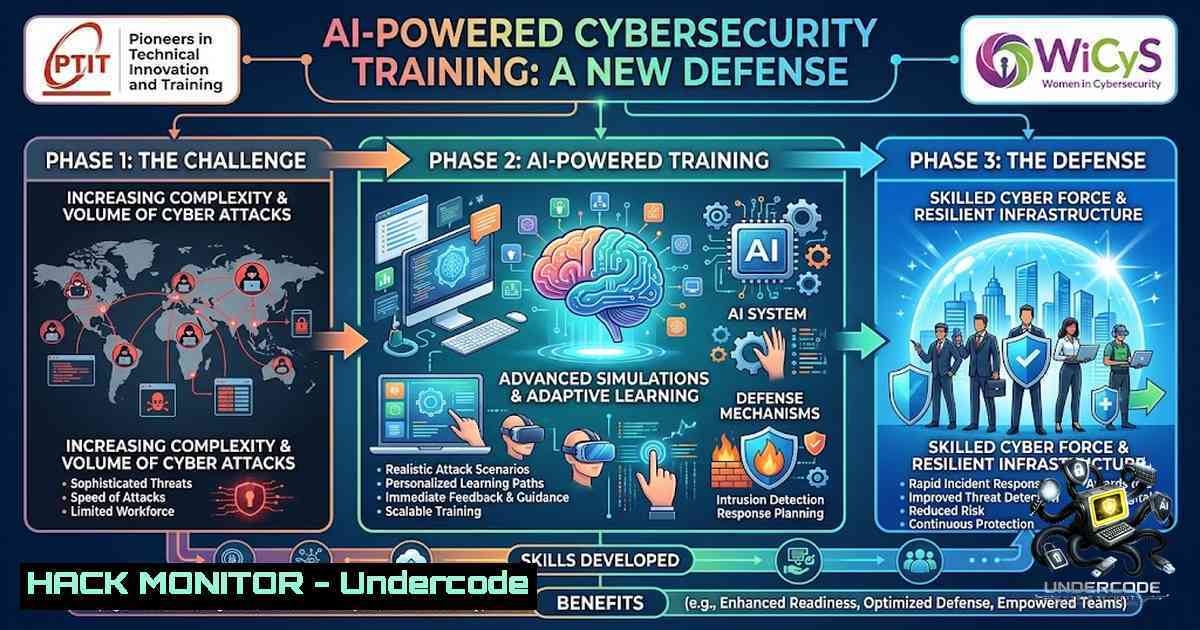
Introduction:
The cybersecurity landscape is undergoing a seismic shift as artificial intelligence (AI) and machine learning (ML) redefine both the sophistication of cyberattacks and the evolution of defense mechanisms. Recognizing this paradigm shift, leading institutions like the Posts and Telecommunications Institute of Technology (PTIT) in Vietnam and global organizations like Women in CyberSecurity (WiCyS) are launching specialized, hands-on training programs to equip the next generation of defenders with practical AI skills. These initiatives underscore a critical industry reality: the future of cybersecurity belongs to professionals who can effectively leverage intelligent technologies to protect digital systems.
Learning Objectives & Secrets:
- Objective 1: Master AI-Assisted Cyber Defense Operations. Learn to integrate AI tools like Anthropic’s Claude into blue team workflows, including detection engineering, incident response, and governance, risk, and compliance (GRC). Secret Tip: Focus on validating AI-generated outputs; human oversight remains paramount as AI recommendations must be critically assessed before action.
- Objective 2: Implement AI-Based Anomaly Detection and Threat Analysis. Gain proficiency in using ML for network threat detection, malware analysis, and incident response. Secret Tip: Prioritize hands-on lab work involving data collection, processing, and analysis to understand how ML models are trained on security datasets.
- Objective 3: Translate AI Risks into Actionable Security Requirements. Learn to identify and mitigate risks introduced by AI-assisted development practices, converting them into clear, testable security controls. Secret Tip: Map AI-specific threats to established security frameworks to ensure compliance and robust governance, addressing the dangers of “shadow AI”.
You Should Know:
- Bridging the Skills Gap with Practical, AI-Focused Curricula
The core of these new training programs is a response to a widening skills gap in the cybersecurity workforce. WiCyS, in partnership with cybersecurity analytics company Skillrex, assessed members across 60 core competencies, identifying specific areas where additional technical training is needed. This data-driven approach ensures that curricula are directly aligned with industry demands. Similarly, PTIT’s course, “Applied AI and Machine Learning for Network and Information Security,” is designed to address current technological advances and real-world industry requirements, combining lectures with project-based learning. These programs are not just about theory; they are about developing practical, job-ready skills.
2. Configuring Your Environment for AI-Assisted Cybersecurity Analysis
To begin practical work, setting up a secure and functional environment is crucial. This involves creating isolated virtual machines (VMs) for safe malware analysis and tool testing.
- Step 1: Set Up a Virtual Lab. Use virtualization software like VMware or VirtualBox. Create at least two VMs: one for analysis (e.g., a Windows or Linux machine with your tools) and one as a target/sandbox (e.g., a vulnerable Windows 7 or Linux machine).
- Step 2: Install Core Analysis Tools. On your analysis VM, install essential tools. For network analysis, consider Wireshark and tcpdump. For malware analysis, install a debugger like x64dbg and a disassembler like Ghidra or IDA Free.
- Step 3: Integrate AI Tooling. For AI-assisted operations, familiarize yourself with large language models (LLMs) like Anthropic’s Claude, which can be used for tasks like log analysis and detection engineering. Linux Command: Use `curl` to interact with an LLM’s API for basic log analysis. For example:
curl -X POST https://api.anthropic.com/v1/messages -H "x-api-key: YOUR_API_KEY" -H "content-type: application/json" -d '{"model":"claude-3-opus-20240229","max_tokens":1024,"messages":[{"role":"user","content":"Analyze this log for suspicious activity: [PASTE LOG HERE]"}]}'. Windows Command: Use `Invoke-RestMethod` in PowerShell for similar API interactions.
3. Implementing AI-Based Anomaly Detection
Anomaly detection is a key application of ML in cybersecurity. This involves using algorithms to identify patterns that deviate from normal network behavior, which could indicate a threat.
- Step 1: Data Collection. The first step is gathering network traffic data. Use `tcpdump` on Linux or `netsh trace` on Windows to capture network packets. Linux Command: `sudo tcpdump -i eth0 -w traffic_capture.pcap` captures packets on the `eth0` interface and saves them to a file. Windows Command: `netsh trace start capture=yes tracefile=C:\capture.etl` starts a network trace.
- Step 2: Feature Extraction. Convert raw data into numerical features that an ML model can understand. This might involve calculating statistics like packet size, number of connections per second, or protocol ratios. Python libraries like `scapy` and `pandas` are invaluable for this.
- Step 3: Model Training and Application. Use an unsupervised learning algorithm, such as an Isolation Forest or an Autoencoder, to train a model on “normal” traffic data. Once trained, the model can score new traffic data, flagging instances that are statistically anomalous. Tools like `scikit-learn` in Python provide implementations of these algorithms. For example:
from sklearn.ensemble import IsolationForest
model = IsolationForest(contamination=0.1)
model.fit(normal_traffic_data)
predictions = model.predict(new_traffic_data)  -1 for anomalies, 1 for normal
4. Cloud Security and AI Integration
As organizations move to the cloud, securing these environments becomes paramount. PTIT’s curriculum includes cloud security, highlighting its importance in the modern threat landscape. AI can enhance cloud security by automating threat detection and response.
- Step 1: Implement Cloud-1ative Security Tools. Leverage your cloud provider’s native security tools. For AWS, use GuardDuty for threat detection; for Azure, use Microsoft Defender for Cloud; for GCP, use Security Command Center. These tools use ML to identify unusual activity.
- Step 2: Integrate AI for Continuous Monitoring. Use serverless functions (e.g., AWS Lambda) to trigger automated responses based on AI-detected threats. For example, a Lambda function can be invoked when GuardDuty flags a high-severity finding, automatically isolating the affected instance by changing its security group.
- Step 3: Harden Cloud Configurations. Apply the principle of least privilege. Use Infrastructure as Code (IaC) tools like Terraform to enforce secure configurations. Command Example: `terraform plan` to review changes before applying them, ensuring no insecure configurations (like open S3 buckets) are introduced.
5. Addressing AI-Specific Security Risks
The rise of AI introduces new vulnerabilities, including attacks targeting AI systems themselves and risks from “shadow AI”. Understanding these threats is critical.
- Step 1: Identify AI Assets. Create an inventory of all AI-enabled systems within your organization to improve visibility.
- Step 2: Assess AI Risk. Classify and prioritize AI risk based on data sensitivity and business impact.
- Step 3: Implement AI Governance. Establish policies for the secure development and use of AI. This includes implementing data classification and governance procedures to ensure that sensitive data is not inadvertently exposed to public AI models.
- Step 4: Monitor for Adversarial Attacks. Be aware of techniques like prompt injection or data poisoning that can compromise AI models. Implement validation and monitoring to detect such anomalies.
- Developing a Capstone Project: Integrating AI into Cybersecurity
PTIT’s program culminates in a capstone project, allowing students to apply their knowledge to a real-world problem. This is a critical step in solidifying learning.
- Step 1: Define a Problem. Choose a specific cybersecurity challenge, such as phishing email detection, network intrusion detection, or automated malware classification.
- Step 2: Gather Data. Collect a relevant dataset. For phishing detection, you might use a dataset of email headers and bodies. Public datasets are available on platforms like Kaggle.
- Step 3: Build and Train a Model. Use a machine learning library (e.g.,
scikit-learn,TensorFlow) to build and train a model on your dataset. - Step 4: Deploy and Evaluate. Integrate your model into a simple application or script that can take new inputs and make predictions. Evaluate its performance using metrics like accuracy, precision, and recall.
What Undercode Say:
- Key Takeaway 1: The integration of AI into cybersecurity training is no longer optional but a necessity. Programs like those at PTIT and WiCyS are pioneering this integration, ensuring the workforce is prepared for an AI-driven threat landscape.
- Key Takeaway 2: The focus must be on practical, hands-on experience. Theory alone is insufficient; professionals need to work with real data, configure tools, and build models to truly understand AI’s application in security.
Analysis: The initiatives by PTIT and WiCyS represent a significant and necessary evolution in cybersecurity education. They move beyond traditional curricula to address the immediate and future needs of the industry. By focusing on applied AI and ML, these programs are not just teaching students how to use new tools but are fundamentally changing how security professionals think about defense. The emphasis on data-driven curriculum design, as seen with WiCyS’s partnership with Skillrex, ensures that training is relevant and addresses actual workforce gaps. Furthermore, the inclusion of topics like cloud security and AI-specific threats demonstrates a holistic understanding of the modern security landscape. These efforts are crucial for developing a resilient and capable cybersecurity workforce.
Prediction:
- +1 The proliferation of AI-focused training programs will lead to a more agile and effective cybersecurity workforce, capable of countering sophisticated, AI-powered attacks.
- +1 Hands-on, project-based learning models will become the standard for cybersecurity education, as they are proven to produce job-ready professionals.
- -1 A potential downside is the risk of over-reliance on AI tools, leading to a degradation of fundamental security skills if not balanced with rigorous foundational training.
- -1 The rapid evolution of AI may outpace curriculum development, creating a continuous challenge for educational institutions to keep their programs current.
▶️ Related Video (82% Match):
🎯Let’s Practice For Free:
🎓 Live Courses & Certifications:
Join Undercode Academy for Verified Certifications
🚀 Request a Custom Project:
Secure, high-velocity infrastructure and disruptive technological engineering. Contact our engineering team for high-tier development and proprietary systems:
[email protected]
💎 Smart Architecture | 🛡️ Secure by Design | ⭐ Trusted by Thousands
IT/Security Reporter URL:
Reported By: https://lnkd.in/p/eQNjNsCR – Hackers Feeds
Extra Hub: Undercode MoN
Basic Verification: Pass ✅


