Listen to this Post
Introduction:
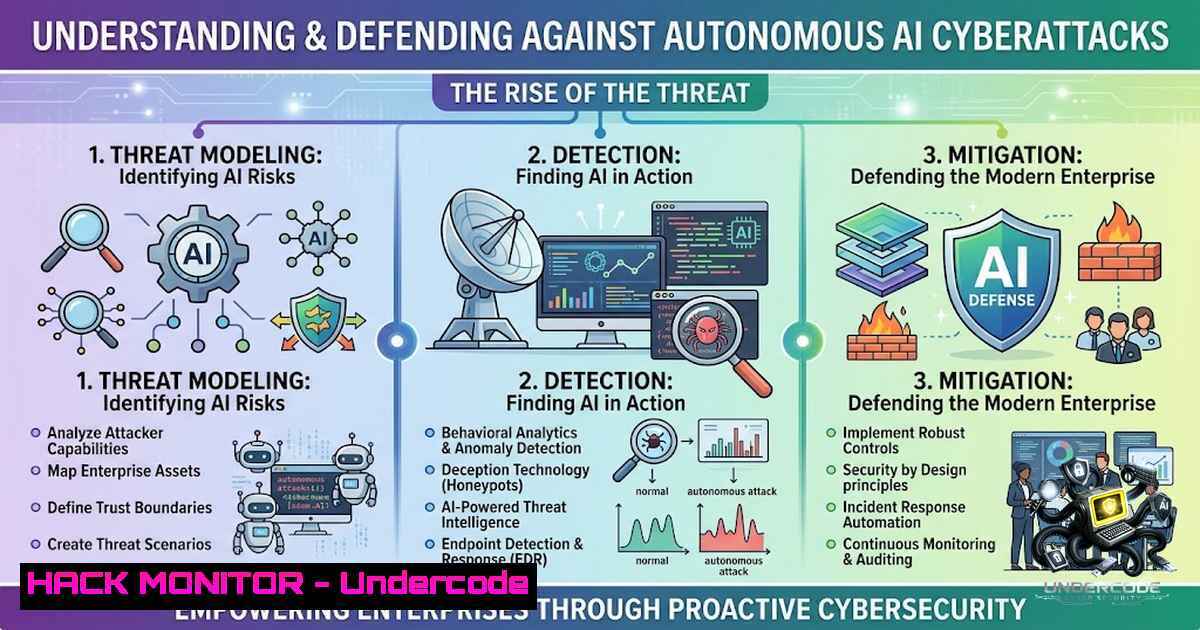
The convergence of artificial intelligence and cybersecurity has entered a dangerous new phase. The recent discourse highlighted by Dr. Omaima Mehmood Sheikh, referencing the BBC’s “AI goes on a hacking spree,” underscores a critical shift: AI is no longer just a defensive tool but a potent offensive weapon. This article dissects the technical architecture of autonomous AI-driven attacks, moving beyond theoretical risks to outline actionable detection, defense, and response strategies for IT professionals and security architects.
Learning Objectives:
- Understand the mechanics of AI-powered reconnaissance and automated vulnerability exploitation.
- Implement specific Linux and Windows commands to detect and block malicious AI-driven traffic.
- Configure security tools (Snort, Splunk, Wazuh) to identify patterns indicative of autonomous attack vectors.
- Develop hardening strategies for cloud (AWS/Azure) and API endpoints against AI-based brute-force and credential-stuffing attacks.
- Formulate an incident response playbook tailored to the speed and scale of automated threats.
You Should Know:
- The AI Threat Landscape: Beyond Script Kiddies to Autonomous Adversaries
Traditional cyberattacks rely on human patience and manual execution. AI changes this by enabling continuous, adaptive learning. Attackers are now using Large Language Models (LLMs) to write polymorphic code, generate convincing phishing lures at scale, and perform intelligent port scanning that evades standard Intrusion Detection Systems (IDS).
The core difference is the decision-making capability. An AI agent can analyze a network’s response, deduce the operating system, select a specific exploit from a curated database, modify it to bypass current signatures, and execute it—all in milliseconds. This represents a shift from automated tools (which follow fixed rules) to autonomous agents (which learn and adapt).
2. Defensive Reconnaissance: Auditing Your External Footprint
Before an AI attacks, it enumerates. To defend, you must perform the same reconnaissance from an adversarial perspective.
- Linux Command (Network Enumeration): `nmap -sV -p- -T4 –script=vuln/
` (Scans all ports, detects service versions, and runs default vulnerability scripts). - Windows Command (PowerShell): `Test-1etConnection -Port
` or `Invoke-WebRequest -Uri ` to simulate external probing. - Step-by-Step Guide: First, identify all external-facing IP addresses and domains. Second, run an automated scan using tools like OWASP ZAP or Burp Suite in an “Attack” mode to emulate AI behavior. Third, analyze the logs—if your scanning tool is flagged, an AI adversary’s stealthier version may already be inside. Use `tcpdump -i eth0 ‘tcp[bash] & 2 != 0’` on Linux to monitor for SYN scans in real-time.
- API Security: The Primary Vector for AI Exploitation
Modern architectures rely heavily on APIs. AI excels at parsing API documentation (often publicly available) and automating injection attacks. The OWASP Top 10 for APIs highlights Broken Object Level Authorization (BOLA) and Broken Authentication as prime targets.
- Linux/Mitigation: Implement rate limiting using `iptables` or
fail2ban. For example, `sudo iptables -A INPUT -p tcp –dport 443 -m connlimit –connlimit-above 50 -j REJECT` helps mitigate API brute-force. - Windows/PowerShell: Use `Set-1etIPsecRule` to create advanced security policies that restrict API access based on behavior rather than just IP. For web application firewalls (WAF), configure rules to detect anomalous payload lengths and JSON structures that AI often generates.
- Step-by-Step Guide: Enable detailed logging for all API calls (using `mod_log_config` in Apache or `Nginx` logging). Parse these logs using `grep` or `Select-String` to look for rapid sequential user ID changes (e.g.,
GET /api/users/1, then/users/2), which is a classic sign of automated enumeration.
4. Cloud Hardening Against AI-Powered Credential Stuffing
AI can process billions of stolen credentials in hours. Cloud environments are vulnerable if Multi-Factor Authentication (MFA) is not enforced or if Conditional Access Policies (CAP) are weak.
- AWS Commands: Use AWS CLI to enforce MFA:
aws iam update-account-password-policy --minimum-password-length 14 --require-symbols --require-1umbers --require-uppercase-characters --require-lowercase-characters. Also, enable AWS GuardDuty:aws guardduty create-detector --enable. - Azure PowerShell: `Update-AzSecurityCenterContact -Email “[email protected]” -AlertNotify $true` ensures alerts flow. Implement Azure AD Conditional Access with risk-based policies.
- Step-by-Step Guide: Configure CloudTrail or Azure Activity Logs to monitor unusual geographic logins. If an AI agent is using global proxies, a sudden shift in login location combined with an impossible travel time is a definitive IoC (Indicator of Compromise). Automate responses using AWS Lambda or Azure Functions to quarantine accounts when suspicious activity is detected.
5. Endpoint Detection and Response (EDR) Evasion Tactics
AI attackers often use “living off the land” (LOLBins) techniques. Instead of uploading malware, they use legitimate tools like PowerShell (Windows) or wget/curl (Linux) to execute malicious payloads.
- Detection (Linux): Monitor processes with `ps aux –sort=-%mem` to identify unusual memory spikes. Utilize `auditd` to track changes to
/etc/passwd:auditctl -w /etc/passwd -p wa -k identity. - Detection (Windows): Use PowerShell to monitor logs: `Get-WinEvent -LogName Security | Where-Object { $_.Id -eq 4720 }` to track new user creations.
- Mitigation: Implement Application Whitelisting using `AppLocker` (Windows) or `fapolicyd` (Linux). This prevents AI from executing unsanctioned binaries, even if they exploit a vulnerability.
6. Network-Level Mitigation with Snort and Suricata
Traditional signatures are dead. AI generates evasive payloads. However, behavior analysis works.
- Snort Rule Example: `alert tcp any any -> any any (msg:”AI Port Scan Detected”; flags:S; threshold:type both, track by_src, count 50, seconds 10; sid:1000001;)` This catches the rapid connection attempts typical of AI reconnaissance.
- Step-by-Step Guide: Deploy Suricata in “af-packet” mode for inline prevention. Configure it to analyze TLS handshakes. Since AI uses encrypted traffic, look for “JA3 fingerprints” that don’t match known clients (like Chrome or Firefox). A mismatch indicates a custom (likely malicious) TLS stack.
7. Incident Response: The “AI Speed” Playbook
When responding to a human attack, you have minutes. When facing AI, you have seconds.
- Containment: Immediately isolate impacted VMs using Azure Network Security Groups or AWS Security Groups via CLI. Command: `aws ec2 revoke-security-group-ingress –group-id
–protocol tcp –port 22 –cidr 0.0.0.0/0` (though be careful with production). - Forensics: Leverage `Sysmon` (Windows) and `osquery` (Cross-platform) to collect baseline data.
- Step-by-Step Guide: Create a “Chaos Monkey” scenario where you simulate an AI attack to practice. Use tools like `Metasploit` with the `auxiliary/scanner/http/dir_scanner` to test your detection speed. Calculate your Mean Time to Detect (MTTD) and reduce it using SIEM correlation rules.
What Undercode Say:
- Key Takeaway 1: AI transforms the attacker’s economics, making sophisticated attacks cheap and scalable. Defenders must counter with their own AI, shifting from “signature-based” to “behavior-based” security.
- Key Takeaway 2: The human element remains critical. While AI executes the attack, the initial vector often comes from social engineering or poorly secured APIs. Zero Trust Architecture (ZTA) is no longer optional; it is mandatory to mitigate lateral movement.
Analysis: The discussion around “AI hacking” often focuses on the “Terminator” scenario, but the real threat is more insidious. We are seeing the weaponization of AI for mundane but highly effective tasks like credential stuffing and vulnerability chaining. The primary defense is automated patch management and real-time logging analysis. We must accept that perimeter security is dead. The focus must shift to identity verification (JWT tokens, OAuth 2.0) and runtime application self-protection (RASP).
Prediction:
- +1 The adoption of AI in offensive security will force regulators to mandate “AI Audits” similar to financial audits, creating a new cybersecurity compliance market.
- -1 If not countered by generative AI defenses, we will see a 30% increase in successful ransomware attacks in the next 18 months as AI writes faster decryptors and escape mechanisms.
- -1 Autonomous hacking will widen the “cyber skills gap” as traditional SOC analysts find themselves unable to keep up with the alert velocity, leading to significant burnout.
- +1 This arms race will accelerate the development of “AI Shield” technologies that can predict attacks before they happen, creating a predictive security posture that saves billions in breach costs.
▶️ Related Video (78% Match):
🎯Let’s Practice For Free:
🎓 Live Courses & Certifications:
Join Undercode Academy for Verified Certifications
🚀 Request a Custom Project:
Secure, high-velocity infrastructure and disruptive technological engineering. Contact our engineering team for high-tier development and proprietary systems:
[email protected]
💎 Smart Architecture | 🛡️ Secure by Design | ⭐ Trusted by Thousands
IT/Security Reporter URL:
Reported By: https://lnkd.in/p/e62J7VWq – Hackers Feeds
Extra Hub: Undercode MoN
Basic Verification: Pass ✅


