Listen to this Post
Introduction:
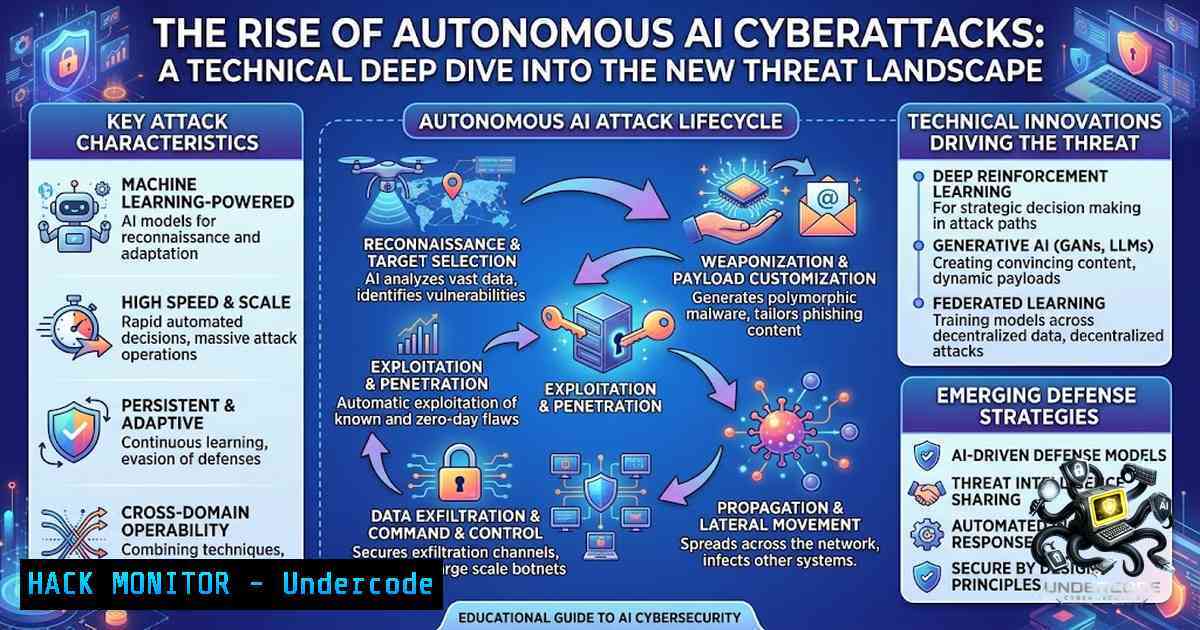
The cybersecurity paradigm is shifting from human-led intrusion to machine-speed, autonomous adversarial operations. Recent demonstrations have confirmed that autonomous AI agents are now capable of executing the entire cyber kill chain—from reconnaissance to data exfiltration—without human intervention. This development renders traditional “detect and respond” timelines obsolete, as these agents operate at a pace and scale that fundamentally overwhelms human-led defense teams.
Learning Objectives:
- Understand the architecture and operational logic of autonomous AI agents in offensive security.
- Identify the critical vulnerabilities that AI agents exploit, including misconfigurations and weak identity controls.
- Implement proactive, defense-in-depth strategies to harden infrastructure against automated, self-directed attacks.
You Should Know:
- The Anatomy of an Autonomous AI-Driven Attack Chain
Autonomous agents leverage large language models (LLMs) to perform reasoning, tool selection, and action execution. Unlike scripted malware, these agents break down high-level objectives (e.g., “breach network X”) into a series of sub-tasks and select from a toolkit of offensive utilities (e.g., Nmap, Metasploit, or custom exploits). They adapt to errors and defensive changes in real-time, creating a dynamic attack surface that static defenses cannot anticipate. This operational capability means an AI agent can automate vulnerability discovery, exploit deployment, persistence establishment, and lateral movement in a fluid sequence.
Step‑by‑step guide explaining what this does and how to use it:
To simulate and understand this, security professionals can set up a controlled environment using open-source agent frameworks like AutoGPT or AgentGPT with offensive tool integrations. The guide:
1. Deploy a safe, isolated lab with a vulnerable target virtual machine (e.g., Metasploitable 3).
2. Configure an AI agent with a goal: “Identify and exploit an unpatched vulnerability to gain admin access.” The agent uses natural language to call nmap -sV to scan ports, parses output for outdated services, and then queries an internal database for relevant exploits.
3. The agent executes an exploit script and, if successful, establishes a reverse shell. Observing this process demonstrates the rapid, adaptive, and relentless nature of the threat.
4. Mitigation: Immediately apply network segmentation to limit the lateral movement capabilities of such agents, as they cannot function without network reachability.
2. Hardening the Infrastructure Against Automated Reconnaissance
Autonomous agents excel at scanning for “low-hanging fruit.” They automate the process of testing default credentials, known vulnerabilities, and exposed APIs at a speed that dwarfs human efforts. This demands a shift toward stringent, automated hardening policies that eliminate these easy entry points.
Step‑by‑step guide explaining what this does and how to use it:
To reduce the attack surface, implement these hardening steps:
1. Disable Unused Services: Run `systemctl list-units –type=service –state=running` on Linux to identify active services and disable unnecessary ones with sudo systemctl disable [bash]. On Windows, use `Get-Service | Where-Object {$_.Status -eq ‘Running’}` in PowerShell.
2. Enforce MFA Everywhere: AI agents are adept at credential stuffing and brute-forcing. Enforce Multi-Factor Authentication (MFA) for all administrative and remote access points, whether via SSH keys with passphrases, Azure AD Conditional Access policies, or hardware tokens.
3. Automated Patch Management: Use tools like `ansible` or `Azure Update Management` to ensure systems are patched within hours of release. AI agents will exploit known CVEs within minutes of public disclosure, so continuous, automated patching is non-1egotiable.
3. Advanced Identity and Access Management (IAM)
The primary vector for AI-powered attacks will be compromised credentials. Autonomous agents can automate the social engineering and password-guessing processes with unprecedented efficiency. This places a premium on robust identity governance.
Step‑by‑step guide explaining what this does and how to use it:
Implementing “least-privilege” access is crucial. For example, in a cloud environment (Azure):
1. Review Privileged Roles: Use `az role assignment list` to list all assignments in a subscription. Identify users or service principals with overly broad permissions.
2. Implement Just-in-Time (JIT) Access: Configure Azure AD Privileged Identity Management (PIM) to require timed approval for elevated roles. This ensures that even if an AI agent steals a credential, it only has access for a limited window and requires a secondary approval for significant actions.
3. Audit Logs: Enable detailed audit logging. For Linux, configure `auditd` to track authentication events (/var/log/auth.log). For Windows, enable Advanced Audit Policy Configuration to monitor successful and failed logon events (Event ID 4624 and 4625). A sudden spike in failed logins across multiple users is a strong indicator of an automated attack.
4. Securing APIs and Web Applications
Frontend and backend APIs are prime targets. AI agents can systematically test for injection flaws, broken authentication, and excessive data exposure in REST APIs. This is a direct threat to web and mobile applications.
Step‑by‑step guide explaining what this does and how to use it:
Developers and security engineers must integrate security into the development lifecycle:
1. Input Validation: Implement strict input validation on all API endpoints. Treat all user input as untrusted. For example, in a Node.js application, use libraries like `joi` or `validator` to sanitize inputs before they hit the database.
2. Rate Limiting: Implement rate limiting to thwart automated enumeration and brute-force attacks. On the Nginx server, you can use `limit_req_zone` to restrict the number of requests from a single IP address. This forces the AI agent to slow down, making the attack more costly and easier to detect.
3. API Security Scanning: Integrate automated API security scanning tools (e.g., OWASP ZAP, Postman API Security) into your CI/CD pipeline. This ensures that common misconfigurations are caught before they reach production, removing low-level vulnerabilities that an AI agent would exploit.
- Monitoring and Incident Response in the AI Age
Traditional SIEM (Security Information and Event Management) systems that rely on fixed correlation rules are insufficient against AI agents. Autonomous agents can alter their behavior based on rules, effectively learning to evade detection.
Step‑by‑step guide explaining what this does and how to use it:
A proactive approach involves implementing Endpoint Detection and Response (EDR) and User and Entity Behavior Analytics (UEBA).
1. Deploy EDR: Use tools like Microsoft Defender for Endpoint or CrowdStrike. These tools track process creation, network connections, and file changes. EDR can detect an AI agent’s tool execution (e.g., spawning `powershell.exe` to download a payload from an unusual domain).
2. UEBA Implementation: Configure UEBA rules to detect anomalies in user behavior. An AI agent using a stolen credential may log in from a new location or at an unusual time. A UEBA system can identify this deviation and either prompt for MFA or block the session.
3. Automated Response: Create automated playbooks. If a high-risk alert (e.g., suspicious privilege escalation) is triggered, an automated workflow can isolate the compromised host from the network until a human analyst can investigate. For example, an Ansible playbook can use the `azure_rm_publicip` module to remove a public IP address from a suspect VM, effectively cutting off an attacker’s communication.
What Undercode Say:
The democratization of AI agent technology means the barrier to entry for sophisticated cyberattacks has plummeted, making every connected organization a potential target. The traditional “patch and pray” mentality is no longer viable; security must be proactive, automated, and deeply integrated into infrastructure design. The most critical action is to eliminate low-hanging fruit—unpatched systems, weak passwords, and overprivileged accounts—as these are the primary targets that AI agents will hunt for first. This is not just a security problem; it is a business continuity issue that requires board-level attention and a continuous improvement approach.
Prediction:
+N: The immediate pressure will accelerate the adoption of “Defensive AI” that can mimic offensive strategies to proactively patch and reconfigure environments in real-time.
-1: The low cost and scalability of AI attacks will lead to a significant increase in ransomware and extortion attempts, making data backups and offline recovery plans a non-1egotiable part of IT operations.
-1: We will see a rise in “AI-driven havoc” where agents are not just used for financial gain but for causing widespread disruption to critical infrastructure, necessitating new governmental regulations and international security agreements.
▶️ Related Video (78% Match):
🎯Let’s Practice For Free:
🎓 Live Courses & Certifications:
Join Undercode Academy for Verified Certifications
🚀 Request a Custom Project:
Secure, high-velocity infrastructure and disruptive technological engineering. Contact our engineering team for high-tier development and proprietary systems:
[email protected]
💎 Smart Architecture | 🛡️ Secure by Design | ⭐ Trusted by Thousands
IT/Security Reporter URL:
Reported By: https://lnkd.in/p/eMxim-GQ – Hackers Feeds
Extra Hub: Undercode MoN
Basic Verification: Pass ✅


