Listen to this Post
Introduction:
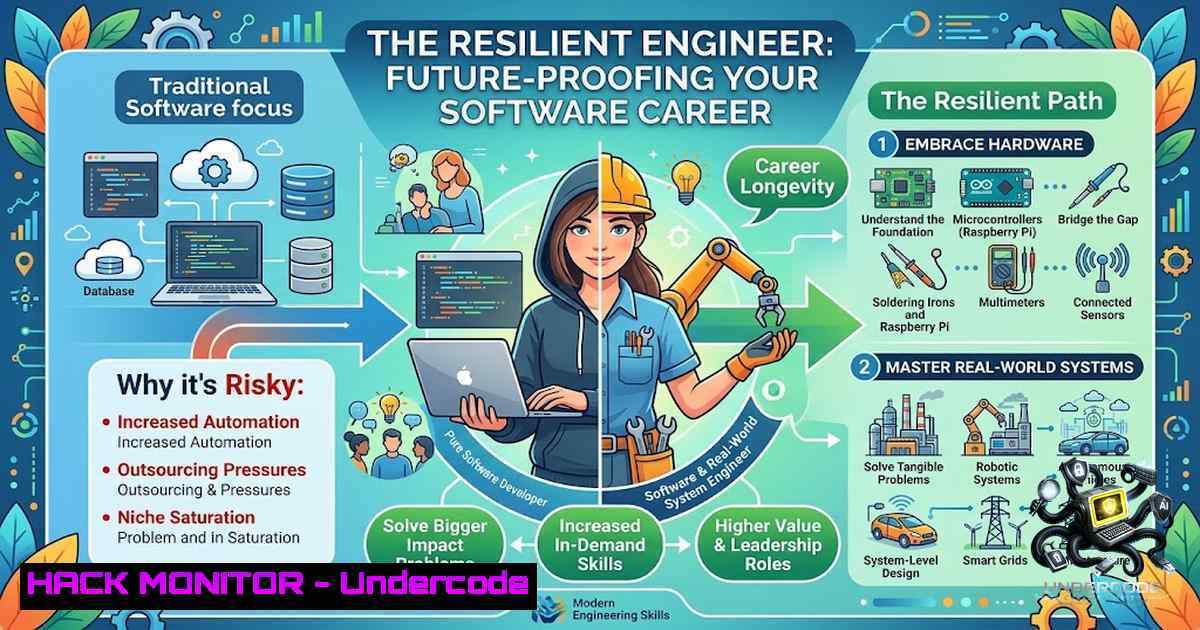
The rapid advancement of AI in software development has sparked a critical debate about the future of engineering roles. While AI excels at generating code and automating routine tasks, it remains fundamentally incapable of physically interacting with the tangible world—solving problems that require dexterity, electrical intuition, and a deep understanding of physics. This shift suggests that the most secure career paths for software engineers may involve diversifying into hardware, solar systems, automotive electronics, and other hands-on engineering domains to build resilience against automation and economic downturns.
Learning Objectives:
- Understand the strategic value of cross-disciplinary skills in mitigating career risk from AI and market volatility.
- Identify key areas where hardware and physical systems engineering offer irreplaceable value.
- Acquire practical knowledge for integrating hardware troubleshooting, energy systems, and financial acumen into a software-centric career.
- Differentiate between high-value clients and time-wasting opportunities in technical sales and consulting.
You Should Know:
- The Physical Security and Resilience of Hardware Systems
In cybersecurity, we often discuss the “air gap”—a physical separation from unsecured networks—as the ultimate defense. While software can be patched and firewalls updated, a physical hardware failure or a compromised electrical system presents a different class of threat. For engineers venturing into hardware, understanding the fundamentals of circuit protection, surge suppression, and redundant power supplies is essential.
Step‑by‑Step Guide: Building a Hardware Security Baseline
- Assess Physical Vulnerabilities: Walk through your facility and identify all entry points for power and data cables. Ensure that critical infrastructure (servers, networking gear) is protected by a UPS (Uninterruptible Power Supply).
- Implement Surge Protection: Use whole-house or rack-mounted surge protectors that include a status indicator light to confirm they are still functional.
- Grounding Verification: Use a multimeter to check that all outlets in your server room are properly grounded to prevent electrostatic discharge (ESD) damage.
- Environmental Monitoring: Deploy sensors for temperature and humidity; many can be integrated with a Raspberry Pi to send alerts via API.
- Review Firmware: Regularly check and update the firmware on network switches, routers, and storage devices to mitigate known physical-layer vulnerabilities.
2. Automotive Hacking and CAN Bus Exploitation
Modern vehicles are essentially networks of computers on wheels. The Controller Area Network (CAN) bus allows microcontrollers and devices to communicate with each other without a host computer. For the security-minded engineer, understanding CAN bus is crucial for both securing smart vehicles and performing legitimate diagnostics or penetration testing.
Step‑by‑Step Guide: Interfacing with a Vehicle’s CAN Bus
- Hardware Setup: Acquire a USB-to-CAN adapter (e.g., PeakCAN or a cheap MCP2515 module) and connect it to your laptop.
- Linux Command: Install the necessary tools:
sudo apt-get install can-utils. - Interface Configuration: Set up the virtual CAN interface: `sudo ip link set can0 type can bitrate 500000` followed by
sudo ifconfig can0 up. - Listen to Traffic: Use `candump can0` to see raw CAN IDs and data flowing across the network. Note the flood of messages for critical functions (engine RPM, wheel speed).
- Send a Signal (Simulation): To test, broadcast a simple message:
cansend can0 123DEADBEEF. In a real environment, you would decode the specific frames required for fuel injection or door locking (using a database like OpenDBC). - Windows Alternative: Use tools like PCAN-View for a GUI-based approach to monitor and send CAN messages.
3. Solar System Engineering for Energy Independence
Integrating solar power is not just about saving money; it’s about creating resilient infrastructure that can operate independently of the grid—critical for data centers and off-site security operations. Engineers can design and wire systems that power their home labs or office backup equipment, ensuring continuous operation during blackouts.
Step‑by‑Step Guide: Sizing and Wiring a Small Solar Setup
1. Calculate Load: Determine the wattage of the equipment you want to power (e.g., a router, a small server, and a monitor). Calculate total daily Watt-hours.
2. Component Selection: Choose photovoltaic (PV) panels, a charge controller (MPPT for efficiency), a deep-cycle battery (Lithium or AGM), and an inverter (Pure Sine Wave for sensitive electronics).
3. Series vs. Parallel Wiring: If using 12V panels, wire them in parallel to increase current (amps) while maintaining voltage, or in series to increase voltage.
4. Connection Sequence: Connect the battery to the charge controller first (to allow the controller to detect the battery voltage), then the solar panels, and finally the inverter. This sequence prevents damage to the controller.
5. Safety Checks: Always use a multimeter to test voltage before and after connections. Install a DC-rated circuit breaker between the panels and controller.
6. Software Monitoring: Use a Raspberry Pi to read data from the charge controller (via Modbus) to visualize energy production and consumption.
4. Financial Engineering and Client Filtering
The original post highlights a brutal truth about sales: 95% of prospects are a waste of time. For independent security consultants and software vendors, this is a crucial lesson. “Speculative buyers” often request extensive proposals and meetings but lack the budget or authority to commit. Engineers must adopt a “qualification-first” approach.
Step‑by‑Step Guide: Firing Non-Serious Clients
- Establish Minimum Viable Terms: Clearly define your payment structure (retainer, upfront fees) before any deep discovery calls.
- The “Lawyer” Test: If a prospect defaults to “I will talk to my lawyer,” ask them to provide a signed Memorandum of Understanding (MOU) or a small deposit to proceed. Serious buyers have ready capital and fast-moving legal teams.
- Asset Verification: For large contracts, request a credit reference or proof of insurance. Genuine buyers provide this; speculative buyers delay.
- Automate Filtering: Use CRM rules: If a lead doesn’t fill out a specific budget field (e.g., “Project budget > $25k”), they are routed to a “cold” list that receives only generic newsletters.
- The 15-Minute Rule: Limit initial discovery calls to 15 minutes and explicitly state the cost of full consultation. If they ask for free work, politely decline and move on.
5. Japanese vs. American Engineering Philosophy (Systems Thinking)
The post contrasts the reliability of Japanese cars (e.g., Toyota) with American models (e.g., Ford Explorer), attributing longevity to design philosophy. In cybersecurity, this mirrors the debate between “robust” systems (error-tolerant, modular, easy to maintain) and “brittle” systems (complex, proprietary, hard to fix). Engineers should favor architectures that are easily repairable—open-source firmware, standardized connectors, and modular components—over integrated, single-vendor lock-ins.
Step‑by‑Step Guide: Adopting a Repairable Architecture in IT
- Standardize Hardware: Avoid vendor-specific proprietary cables. Stick to USB-C, Ethernet, and common screw types.
- Document Everything: Create a Hardware Bill of Materials (BOM) for your server racks, noting part numbers for PSUs and fans.
- Open-Source Firmware: Where possible, flash OpenWrt on routers to free yourself from vendor limitations and backdoors.
- Disaster Recovery Plan: If a primary switch fails, ensure you have an identical, pre-configured backup switch ready to hot-swap. This reduces Mean Time to Repair (MTTR).
- Apply the “50,000-Mile” Logic: Schedule regular PM (Preventive Maintenance) for your cooling and power systems, just as you would a timing belt on a car.
What Undercode Say:
- The Hybrid Engineer is the Future: Software skills are a commodity due to AI, but the ability to diagnose a faulty electrical relay or physically wire a network is a premium skill. Diversifying into hardware creates a “hard boundary” that AI cannot cross, ensuring long-term relevance.
- Brutal Pragmatism in Business: Efficiency extends beyond code into client acquisition. Eliminating time-wasters is essential for profitability. Undercode’s advice mirrors the Pareto principle: 80% of revenue often comes from 20% of clients. Engineers must stop romanticizing “everyone” as a potential customer and focus on those with capital and decisiveness.
- Beyond the Screen: The post implies a holistic lifestyle where self-reliance in energy and repair leads to both psychological and financial security. In an unstable economic climate, these skills provide a safety net that pure backend code cannot.
Prediction:
- +1: The trend of “Software-Defined Everything” will plateau as engineers realize the physical limitations of networking and power. We will see a resurgence of “System Resilience Architects” who blend DevOps with electrical engineering.
- +1: AI tools will increasingly be used to simulate and design solar arrays, but the physical installation and troubleshooting will require human hands, creating a lucrative niche for hybrid engineers.
- -1: The current generation of software engineers graduating without any hardware knowledge will face severe competition from AI and outsourcing, forcing a mid-career pivot that many will find difficult without foundational physics knowledge.
- +1: The principles of “repairability” in hardware will bleed back into software, pushing against the “black box” cloud services in favor of open, modular microservices that can be easily swapped out, much like replacing a starter motor in a Japanese sedan.
- -1: Economic pressures may lead to a short-term exodus from software into trades, causing a surplus of entry-level hardware technicians before the market matures and demands high-level specialization.
▶️ Related Video (76% Match):
🎯Let’s Practice For Free:
🎓 Live Courses & Certifications:
Join Undercode Academy for Verified Certifications
🚀 Request a Custom Project:
Secure, high-velocity infrastructure and disruptive technological engineering. Contact our engineering team for high-tier development and proprietary systems:
[email protected]
💎 Smart Architecture | 🛡️ Secure by Design | ⭐ Trusted by Thousands
IT/Security Reporter URL:
Reported By: https://lnkd.in/p/e5j8jAGp – Hackers Feeds
Extra Hub: Undercode MoN
Basic Verification: Pass ✅


