Listen to this Post
Introduction:
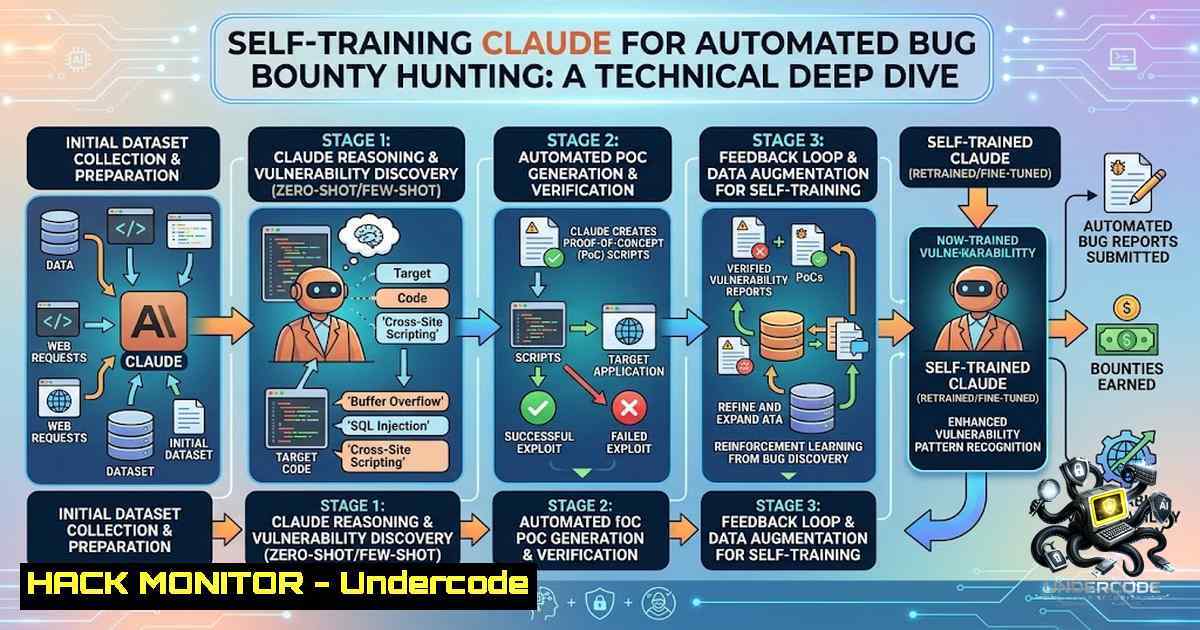
The integration of large language models into offensive security workflows has transitioned from theoretical discussion to practical implementation. Security researchers are now leveraging Anthropic’s Claude AI as an autonomous bug-hunting partner, feeding it disclosed vulnerability reports, training it on capture-the-flag (CTF) environments, and deploying it against corporate targets. This approach, popularized by researchers like Akash Suman, represents a paradigm shift where AI doesn’t just assist—it actively hunts. However, this capability comes with significant cost implications, technical complexity, and ethical considerations that security professionals must navigate carefully.
Learning Objectives:
- Understand the architecture and tooling required to deploy Claude for automated bug bounty hunting, including MCP servers, skill bundles, and integration frameworks.
- Master the workflow of feeding disclosed reports and training Claude on vulnerable labs to build contextual hunting capabilities.
- Learn practical implementation steps across Linux and Windows environments, including command-line configurations and API cost optimization strategies.
You Should Know:
1. The Architecture of AI-Powered Bug Hunting
The foundation of self-training Claude for bug bounty lies in the Model Context Protocol (MCP), an open-source standard released by Anthropic that enables seamless integration between AI models and external security tools. When a user submits a natural-language prompt—such as “Port scan target.com and check for common web vulnerabilities”—Claude determines which security tools are required, sends structured requests to an MCP server, executes commands, interprets results, and iterates autonomously.
Kali Linux MCP Integration Setup:
The Kali Linux development team officially introduced native AI-assisted penetration testing workflows in early 2026. The architecture consists of three layers:
- UI Layer: Claude Desktop (macOS/Windows) as the natural language interface
- Execution Layer: A Kali Linux box running
mcp-kali-server, an API bridge exposing security tools - Intelligence Layer: Anthropic’s Claude model (Sonnet 4.5 or Opus 4.7) processing prompts and orchestrating tool calls
Setup Commands (Kali Linux):
 Install MCP Kali Server
sudo apt update
sudo apt install mcp-kali-server

Verify installation
systemctl status mcp-kali-server

Configure Claude Desktop MCP client
 Edit ~/.config/Claude/claude_desktop_config.json
{
"mcpServers": {
"kali": {
"command": "ssh",
"args": ["-i", "/path/to/ed25519-key", "user@kali-host", "mcp-kali-server"]
}
}
}
For Windows users, the setup requires SSH key-based authentication to a remote or WSL2-hosted Kali instance, using ed25519 keys for passwordless access. The `mcp-kali-server` runs a Flask-based API on localhost:5000, serving as the command execution bridge.
Alternative: PentestMCP Server (Dockerized)
For researchers preferring containerized environments, PentestMCP Server offers 88 security tools inside a Kali Linux Docker container:
 Clone and build
git clone https://github.com/chfle/Pentest-MCP-Server
cd Pentest-MCP-Server
docker build -t pentest-mcp .

Run with scope enforcement
docker run -p 5000:5000 pentest-mcp
This approach enforces non-root execution, input validation, and scope allowlisting to prevent accidental out-of-scope scanning.
- Training Claude with Disclosed Reports and Skill Bundles
The core of “self-training” involves feeding Claude curated knowledge from disclosed bug bounty reports. Several open-source skill bundles have emerged that package this intelligence into structured, auto-loadable formats.
Claude-BugHunter: 51 Skills from 574+ Reports
The `claude-bughunter` bundle, built by Sachin Sharma, contains 51 skills, 15 slash commands, and patterns curated from 574+ disclosed HackerOne reports across 24 vulnerability classes. It transforms Claude from a general-purpose chatbot into a senior bug-hunting researcher.
Installation:
 Clone the skill bundle
git clone https://github.com/xiaolai/Claude-BugHunter.git ~/.claude/skills/claude-bughunter

Verify skills are loaded
claude --list-skills
Key Skill Layers:
- Methodology Layer: `bug-bounty` + `bb-methodology` + `redteam-mindset` — teaches Claude how to think, including 5-phase non-linear hunting workflows and developer-psychology heuristics
- Vulnerability Layer: `24hunt-` skills — per-class detection patterns, payloads, and bypass tables
- Enterprise Layer: Attack chains for M365 Entra, Okta, VMware vCenter, and cloud IAM with 2024-2026 CVE chains
- Validation Layer: 7-Question Gate, VRT category mapping, and Bugcrowd report templates
Claude CyberSecurity Skills: End-to-End Workflow
The 0xGhostCAT repository provides 30 production-grade skills following a structured workflow:
Recon → Hunt → Validate → Report
When you tell Claude “hunt this new H1 program at target.com,” it chains:
program-selection → scope-analysis → subdomain-enum → asset-discovery → fingerprinting → suggested vuln vectors → ready-to-fire commands
Training on Public Platforms:
The skill bundles are calibrated against public training platforms including DVWA, OWASP Juice Shop, Hacker101, and testphp.vulnweb.com. To train Claude on these:
 Launch Claude Code in a project directory
cd ~/labs/dvwa
claude

Claude will auto-load relevant skills based on context
 Describe what you're testing in plain English

<blockquote>
  "I'm testing DVWA for SQL injection vulnerabilities. Walk me through the methodology."
3. Tool Integration and Command Execution
Claude’s MCP integration supports essential penetration testing tools, enabling autonomous execution:
| Tool | Purpose |
|||
| Nmap | Network and port scanning |
| Gobuster / Dirb | Directory and web path enumeration |
| Nikto | Web server vulnerability scanning |
| Hydra / John the Ripper | Credential brute-forcing |
| Metasploit Framework | Exploitation and post-exploitation |
| SQLMap / WPScan | Database injection and WordPress auditing |
| Enum4linux-1g | SMB/Windows enumeration |
Example: Autonomous Port Scan
During testing documented by the Kali team, a prompt asking for a port scan of `scanme.nmap.org` triggered Claude to:
1. Verify tool availability
2. Execute `nmap -sV scanme.nmap.org`
3. Parse open ports on 80/TCP and 443/TCP
4. Report findings without any manual commands
Transilience AI Community Tools
The Transilience AI suite offers 26 skills covering 100% OWASP Top 10 coverage plus OWASP LLM Top 10. Their autonomous pentesting agent scored 100% (104/104) on a published CTF benchmark suite.
Docker Setup (Recommended):
 Clone the repository
git clone https://github.com/transilienceai/communitytools
cd communitytools

Run the Kali container setup
bash scripts/kali-claude-setup.sh projects/pentest

This builds a Docker image with Kali Rolling + Node.js + Claude Code + Playwright + Chromium
The skills transfer across models: Claude Sonnet 4.6 reaches 96.2% and Claude Haiku 4.5 reaches 62.5% on the same benchmark.
4. Cost Management and API Credit Optimization
A critical consideration when self-training Claude for bug bounty is API cost. Claude Code is a free command-line tool, but API usage requires credits. Researchers have reported significant cost overruns due to various issues.
Common Cost Issues:
- Uncontrolled recursive agent spawning — one session burned over $600 in API credits
- Model switch ignored — a requested switch to Haiku remained on Sonnet 4-6, consuming ~$9 in a single session
- Credit consumption rate increased 3-5x after January 2026
- Cache bugs can silently 10-20x API costs
Cost Optimization Strategies:
 Use prompt caching to reduce costs
 ClaudeStrike offers cost-optimized mode with prompt caching
curl -sSL https://raw.githubusercontent.com/ChrisBurkett/ClaudeStrike/main/install.sh | bash
 Then run with cost-optimized mode
cstrike --mode cost-optimized
Best Practices:
- Set explicit session limits in Claude Code configuration
- Monitor usage via Anthropic Console dashboards
- Use separate API keys for different environments (dev/staging/prod)
- Rotate API keys quarterly
- Never hardcode API keys — use environment variables and `.env` files
 Environment variable setup
export ANTHROPIC_API_KEY="your-key-here"
 Or use .env file
echo "ANTHROPIC_API_KEY=your-key-here" > .env
 Add .env to .gitignore
echo ".env" >> .gitignore
5. Security Risks and Operational Safeguards
While AI-powered bug hunting offers significant advantages, it introduces new attack surfaces that security teams must address.
Identified Risks:
- Prompt Injection: Malicious prompts can manipulate Claude’s behavior
- Over-permissioned Tool Access: Excessive permissions can lead to unintended actions
- Insufficient Audit Logging: Without proper logging, malicious activities go undetected
- Dangerous Flag Usage: The `–dangerously-skip-permissions` flag can bypass critical safety checks
Mitigation Strategies:
Red Hat and Fluid Attacks recommend:
- Enforce least-privilege access — restrict tool permissions to only what’s necessary
- Validate all inputs — sanitize every parameter before reaching subprocesses
3. Require human-in-the-loop approval for high-risk commands
- Maintain immutable execution logs for all production engagements
Automated Security Review in Claude Code:
Claude Code now includes automated security review features:
 On-demand security check
/security-review

Or via GitHub Actions for automated PR reviews
This identifies SQL injection risks, XSS vulnerabilities, and other security concerns.
Scope Enforcement:
Built-in allowlist/blocklist systems prevent accidental out-of-scope scanning. Localhost, link-local, and RFC 1918 ranges are blocked by default.
6. Windows-Specific Implementation
For Windows users, deploying Claude for bug bounty requires additional configuration:
Option 1: WSL2 with Kali Linux
 Install WSL2
wsl --install -d kali-linux

Inside WSL2 Kali
sudo apt update
sudo apt install mcp-kali-server

Configure Claude Desktop for Windows
 Edit %APPDATA%\Claude\claude_desktop_config.json
Option 2: Docker Desktop with PentestMCP
 Install Docker Desktop for Windows
 Pull and run PentestMCP
docker pull ghcr.io/chfle/pentest-mcp:latest
docker run -p 5000:5000 pentest-mcp
Option 3: Claude Code CLI (Cross-Platform)
 Install Claude Code via npm
npm install -g @anthropic-ai/claude-code

Launch Claude Code
claude
What Undercode Say:
- AI augments, not replaces, human expertise. While Claude can automate reconnaissance and initial vulnerability discovery, human validation remains essential for triage, chain exploitation, and report quality. The 7-Question Gate and validation frameworks ensure findings meet professional standards before submission.
-
Cost management is the hidden challenge. API costs can spiral unpredictably due to caching bugs, recursive agents, and model switching issues. Researchers must implement strict session limits, monitor usage closely, and consider cost-optimized modes that leverage prompt caching.
Analysis:
The self-training of Claude for bug bounty represents a democratization of advanced security capabilities. Open-source skill bundles like Claude-BugHunter (51 skills, 574+ reports) and Claude CyberSecurity Skills (30 skills, end-to-end workflow) lower the barrier to entry for aspiring bug hunters. However, the economics remain challenging — a single uncontrolled session can burn hundreds of dollars in API credits. The most successful practitioners will combine AI automation with disciplined cost controls, rigorous validation gates, and the human intuition that distinguishes a finding from a false positive. As Anthropic’s Cyber Verification Program expands access to Opus 4.7 for legitimate security research, we can expect more sophisticated AI-powered hunting capabilities to emerge, potentially reshaping the economics of bug bounty programs entirely.
Prediction:
- +1 The commoditization of AI-powered bug hunting will increase the volume of vulnerability discoveries, potentially forcing organizations to expand their bug bounty budgets and accelerate patch cycles.
-
+1 Open-source skill bundles will continue to evolve, with community-contributed patterns from newly disclosed reports creating a self-improving ecosystem that benefits all practitioners.
-
-1 The rise of automated AI hunters will intensify competition in public bug bounty programs, potentially driving down average payout per finding as submission volumes increase.
-
-1 Organizations will develop AI-specific defenses, including prompt-injection detection, tool-access monitoring, and automated WAF rules designed to detect and block AI-driven scanning patterns.
-
-1 API cost volatility and billing bugs remain unresolved risks that could financially impact researchers, particularly those operating on tight budgets.
-
+1 Enterprise adoption of AI-assisted penetration testing, as seen with Wiz, Palo Alto Networks, and Accenture using Claude Opus, will drive standardization of MCP-based workflows and improved tooling for cost management.
-
-1 The use of `–dangerously-skip-permissions` and other unsafe configurations could lead to serious security incidents, prompting platform restrictions on AI-assisted hunting.
-
+1 Anthropic’s Cyber Verification Program and bug bounty initiatives will create more structured pathways for legitimate AI-powered security research, reducing friction for ethical practitioners.
▶️ Related Video (78% Match):
https://www.youtube.com/watch?v=58fZ4Uxy-SY
🎯Let’s Practice For Free:
🎓 Live Courses & Certifications:
Join Undercode Academy for Verified Certifications
🚀 Request a Custom Project:
Secure, high-velocity infrastructure and disruptive technological engineering. Contact our engineering team for high-tier development and proprietary systems:
[email protected]
💎 Smart Architecture | 🛡️ Secure by Design | ⭐ Trusted by Thousands
IT/Security Reporter URL:
Reported By: https://lnkd.in/p/etzBk49t – Hackers Feeds
Extra Hub: Undercode MoN
Basic Verification: Pass ✅


