Listen to this Post
Introduction:
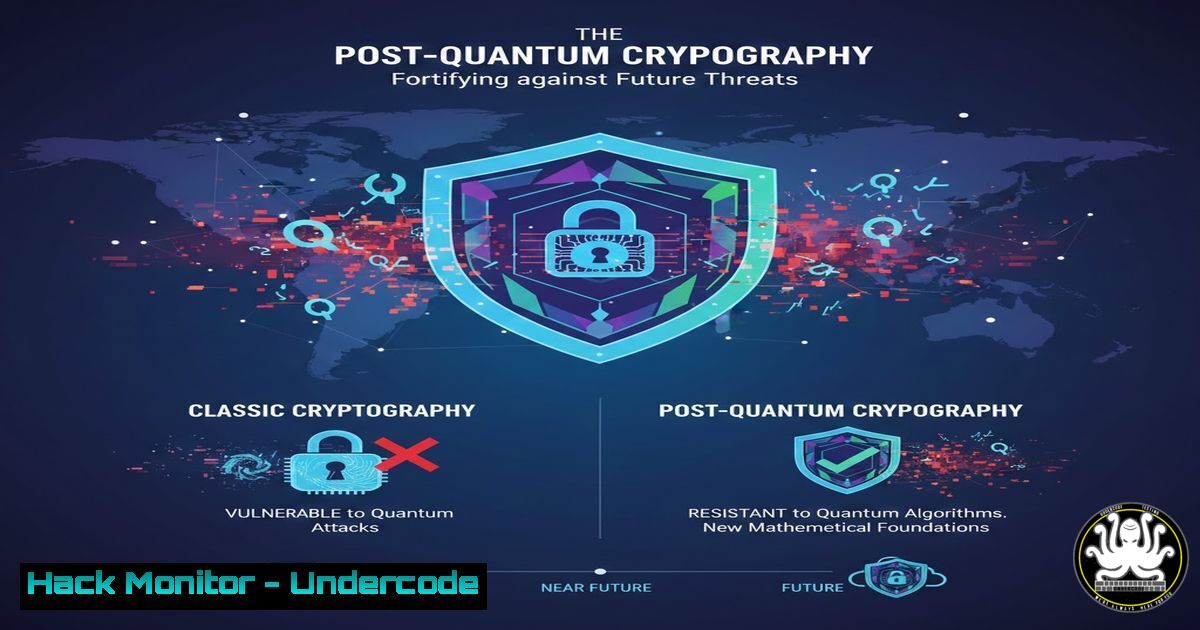
The digital world is on the cusp of a cryptographic revolution. The emergence of quantum computing presents an existential threat to the current global standard for public-key cryptography, which secures everything from online banking to confidential government communications. This article delves into the imperative shift towards Post-Quantum Cryptography (PQC), a new class of cryptographic algorithms designed to be secure against both classical and quantum computer attacks.
Learning Objectives:
- Understand the vulnerability of current asymmetric cryptography (like RSA and ECC) to quantum attacks, specifically Shor’s algorithm.
- Learn the core families of Post-Quantum Cryptography and how they derive their quantum resistance.
- Gain practical insight into initial steps for integrating PQC into existing IT and development workflows.
You Should Know:
1. The Looming Quantum Threat to Today’s Encryption
The security of modern asymmetric cryptography rests on the computational difficulty of certain mathematical problems. RSA, for instance, relies on the challenge of factoring large prime numbers, while Elliptic-Curve Cryptography (ECC) depends on the elliptic curve discrete logarithm problem. For classical computers, solving these problems is infeasible. However, Peter Shor’s algorithm, designed to run on a sufficiently powerful quantum computer, can solve these problems efficiently, rendering our primary encryption and digital signature methods obsolete. This isn’t a theoretical future problem; “harvest now, decrypt later” attacks are already a concern, where adversaries collect encrypted data today to decrypt it once a quantum computer is available.
2. The Pillars of Post-Quantum Cryptography
Post-Quantum Cryptography encompasses several families of algorithms, each based on mathematical problems believed to be hard for quantum computers to solve. The U.S. National Institute of Standards and Technology (NIST) has been leading a standardization process to select the most promising PQC algorithms.
Lattice-Based Cryptography: Relies on the difficulty of finding the shortest vector in a high-dimensional lattice. Examples include CRYSTALS-Kyber (for key encapsulation) and CRYSTALS-Dilithium (for digital signatures), both selected by NIST for standardization.
Code-Based Cryptography: Based on the problem of decoding a general linear code. The Classic McEliece cryptosystem is a leading candidate in this category.
Multivariate Cryptography: Depends on the difficulty of solving systems of multivariate quadratic equations over finite fields.
Hash-Based Cryptography: Used primarily for digital signatures (e.g., SPHINCS+), its security is directly linked to the security of the underlying cryptographic hash function.
- Getting Started with PQC: A Developer’s First Steps
Integrating PQC begins with experimentation in development and testing environments. The Open Quantum Safe (OQS) project provides open-source software that is an excellent starting point.
Step-by-Step Guide: Testing PQC with OpenSSL via OQS
- Install the OQS-OpenSSL Provider: First, you need to build and install the OQS-provider, which adds PQC algorithms to OpenSSL.
Clone the OQS-OpenSSL-Provider repository
git clone https://github.com/open-quantum-safe/oqs-provider.git
cd oqs-provider
Build and install according to the project's README
./configure && make && sudo make install
-
Generate a PQC Key Pair: Use the installed provider to generate a key pair using a NIST-finalist algorithm, like Dilithium2.
Generate a private key using Dilithium2
openssl genpkey -algorithm dilithium2 -out dilithium2_priv.key
Extract the public key from the private key
openssl pkey -in dilithium2_priv.key -pubout -out dilithium2_pub.key
-
Create a Digital Signature: Sign a file (e.g.,
document.pdf) using your new private key.Create a signature for the document openssl dgst -sign dilithium2_priv.key -keyform PEM -out document.pdf.sig document.pdf
-
Verify the Signature: Use the public key to verify the signature’s authenticity.
Verify the signature
openssl dgst -verify dilithium2_pub.key -keyform PEM -signature document.pdf.sig document.pdf
A successful verification confirms the integrity and origin of the document.
4. PQC and API Security: Hardening Your Endpoints
APIs are critical attack vectors and must be among the first components hardened for the quantum era. This involves transitioning from traditional cryptographic tokens to PQC-secured ones.
JWT with PQC: JSON Web Tokens (JWTs) typically use RSA or ECDSA for signing. Migrate to using PQC algorithms like Dilithium for signing your JWTs. Update your authentication libraries to support these new algorithms.
TLS 1.3 and Hybrid Modes: For web traffic, the immediate path forward is “hybrid” key exchange. This combines a traditional algorithm (like ECDH) with a PQC algorithm (like Kyber). This provides security even if one of the two algorithms is broken in the future. Server configurations must be updated to support these hybrid cipher suites.
5. The Cloud Migration Path to Quantum-Safe Systems
Major cloud providers (AWS, Azure, Google Cloud) are already offering services and tools to begin the PQC transition.
AWS: Explore their “PQCSL” (Post Quantum Custom Symmetric Loader) and Key Management Service (KMS) which are evolving to support PQC.
Microsoft Azure: Investigate Azure Key Vault’s roadmap for PQC algorithm support and their implementation of hybrid TLS certificates.
Google Cloud: Google has been a pioneer in testing PQC in real-world scenarios, such as using hybrid Kyber-ECDH in parts of Chrome and their internal services.
Actionable Step: Review your cloud provider’s security and cryptography documentation. Identify where your stored keys are used and create a timeline for testing their PQC-enabled services as they become generally available.
6. Vulnerability Management in the Quantum Age
The threat landscape is expanding. A new class of vulnerabilities, specific to the implementation of PQC algorithms, will emerge.
Side-Channel Attacks: Many PQC algorithms are vulnerable to timing and power analysis attacks. Mitigation requires constant-time implementations and thorough code reviews.
Cryptographic Agility: The most critical mitigation strategy is to design systems with cryptographic agility. This means building applications so that cryptographic algorithms can be swapped out without needing to overhaul the entire system. This is achieved through abstraction layers in code, allowing for a smoother transition from RSA to Dilithium, for example.
What Undercode Say:
- The transition to Post-Quantum Cryptography is not a future problem but a present-day operational necessity. The “harvest now, decrypt later” threat model means that data encrypted today with vulnerable algorithms must be considered at risk.
- Cryptographic Agility is the most important non-cryptographic concept in this transition. Organizations that build modular, agile systems today will survive the quantum transition; those with rigid, hard-coded cryptographic dependencies will face existential operational disruption.
The LinkedIn post alludes to man-made concepts challenging natural laws. In cybersecurity, this is precisely what is happening: our mathematical constructs (RSA) are being challenged by the natural laws of quantum mechanics. The response is not to abandon mathematics, but to evolve it, creating new, more robust constructs like lattice-based cryptography that can withstand this new computational paradigm. The brilliance of “Quantum Encrypted Agentic Blockchains” and “Agentic AI” mentioned in the post will only be secure if their foundational cryptographic layer is quantum-resistant. The convergence is not just between technologies, but between theoretical mathematics and practical, resilient system design.
Prediction:
The arrival of cryptographically relevant quantum computers will trigger the most significant and rapid forced migration in the history of information technology. Organizations that have procrastinated will face catastrophic data breaches and operational failure. Conversely, this will create a massive new market for quantum-safe solutions, from hardware security modules and PKI services to specialized consulting. The cybersecurity industry will bifurcate into pre-quantum and post-quantum eras, and the organizations that begin their migration now will not only survive but will establish a dominant trust advantage in the new digital landscape.
🎯Let’s Practice For Free:
IT/Security Reporter URL:
Reported By: Trey Rutledge – Hackers Feeds
Extra Hub: Undercode MoN
Basic Verification: Pass ✅


