Listen to this Post
Introduction:
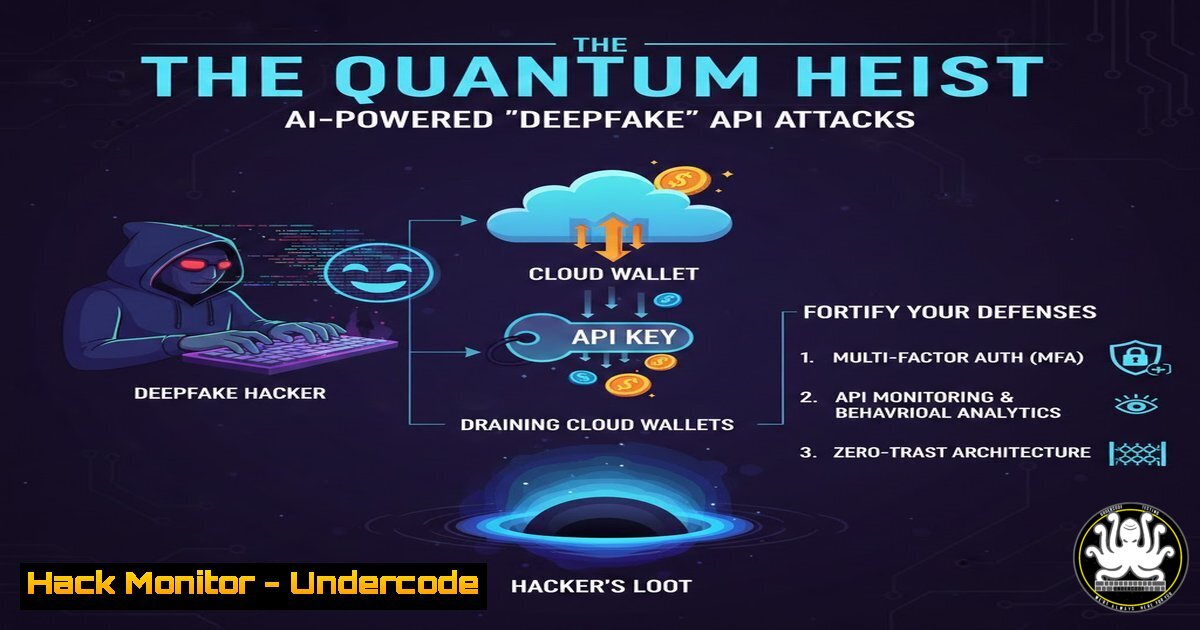
A new wave of sophisticated cyberattacks is leveraging artificial intelligence to craft hyper-realistic deepfakes for social engineering, specifically targeting API keys and cloud service credentials. This multi-vector threat combines AI-generated audio/video with automated scanning tools to bypass traditional security, leading to significant financial loss and data exfiltration from poorly configured cloud environments. Understanding this evolving tactic is critical for any organization utilizing cloud infrastructure and APIs.
Learning Objectives:
- Decode the technical workflow of an AI-powered social engineering and cloud exploitation attack chain.
- Implement immediate hardening steps for cloud storage (AWS S3, Azure Blobs, GCP Buckets) and API security.
- Master defensive scripting and monitoring techniques to detect credential leakage and anomalous cloud activity.
You Should Know:
- The Attack Chain: From Deepfake Phish to Cloud Enumeration
This attack doesn’t rely on a single vulnerability but a process. It begins with an AI-generated voice or video call (deepfake) impersonating a trusted colleague or executive, pressuring a developer or ops engineer to reveal a temporary access token or approve an MFA prompt. With initial credentials, attackers move to cloud enumeration.
Step‑by‑step guide explaining what this does and how to use it.
Step 1: Initial Access via Compromised Credential.
The attacker uses a harvested API key, OAuth token, or IAM user credential.
Step 2: Environment Reconnaissance.
Using tools like awscli, az cli, or gcloud, they map the environment.
 Example of attacker reconnaissance with AWS CLI
aws sts get-caller-identity  Identify the compromised account
aws s3 ls  List all S3 buckets
aws ec2 describe-instances  Enumerate EC2 instances
Step 3: Identify Misconfigurations.
They scan for public-facing storage buckets, databases with weak authentication, or over-permissive IAM roles.
2. Exploiting Public Cloud Storage: The Low-Hanging Fruit
Unsecured S3 buckets or Azure Storage Containers are primary targets for data theft and “cryptojacking” setups.
Step‑by‑step guide explaining what this does and how to use it.
Step 1: Discover Buckets.
Using the initial access, an attacker lists buckets and checks their permissions.
aws s3api get-bucket-acl --bucket company-data-bucket
aws s3api get-bucket-policy --bucket company-data-bucket
Step 2: Exfiltrate Data or Deploy Malware.
If write permissions are open, attackers may upload crypto-mining software or backdoors.
 Attacker command to download all bucket contents
aws s3 sync s3://company-data-bucket ./stolen-data/ --no-sign-request
Mitigation Command (Defensive):
 Apply a strict bucket policy denying public read/write
aws s3api put-bucket-policy --bucket your-bucket-name --policy file://strict-policy.json
3. Hardening IAM & API Key Security
The principle of least privilege is non-negotiable. Over-permissive IAM roles are a ticket to full compromise.
Step‑by‑step guide explaining what this does and how to use it.
Step 1: Audit Existing IAM Policies.
Use cloud provider tools to find policies with wildcards (“).
 AWS: Get all IAM policies and analyze for permissiveness
aws iam list-policies --scope Local --only-attached
Step 2: Implement Key Rotation and Use Temporary Credentials.
Enforce short-lived credentials via AWS STS or Azure Managed Identities.
Step 3: Require MFA for Console and Critical API Actions.
Implement conditional IAM policies that require MFA for sensitive operations.
- Monitoring & Anomaly Detection with CloudTrail & SIEM
Logging is your digital CCTV. Without it, you are blind to attacker movements.
Step‑by‑step guide explaining what this does and how to use it.
Step 1: Enable Comprehensive Logging.
Ensure AWS CloudTrail, Azure Activity Logs, or GCP Audit Logs are enabled and delivered to a secure, immutable storage.
Step 2: Create Alerts for High-Risk Activities.
Use CloudWatch Alarms or Sentinel/SIEM rules to trigger on:
– API calls from unfamiliar geolocations.
– `GetSecretValue` calls outside of normal CI/CD pipelines.
– Large numbers of `DescribeInstances` or `ListBuckets` calls in a short time.
Step 3: Query Logs Proactively.
-- Sample AWS Athena query to find S3 bucket enumeration
SELECT eventTime, userIdentity.arn, eventName, requestParameters.bucketName
FROM cloudtrail_logs
WHERE eventSource = 's3.amazonaws.com'
AND eventName IN ('ListBuckets', 'GetBucketAcl', 'GetBucketPolicy')
AND eventTime > '2023-10-01T00:00:00Z'
- Defensive Scripting: Automated Scanning for Your Own Misconfigurations
Become the attacker against your own environment to find flaws first.
Step‑by‑step guide explaining what this does and how to use it.
Step 1: Use Open Source Security Scanners.
Integrate tools like `Prowler` (AWS), `ScoutSuite` (multi-cloud), or `Terrascan` (IaC) into your CI/CD pipeline.
 Run a basic Prowler scan for CIS benchmarks
prowler aws --quick-inventory
prowler aws --group cislevel1
Step 2: Create Custom Scripts for Your Compliance Rules.
Write a Python script using `boto3` to check for public ECR repositories or unencrypted RDS instances.
import boto3
def check_public_buckets():
s3 = boto3.client('s3')
buckets = s3.list_buckets()
for bucket in buckets['Buckets']:
acl = s3.get_bucket_acl(Bucket=bucket['Name'])
for grant in acl['Grants']:
if 'URI' in grant['Grantee'] and 'AllUsers' in grant['Grantee']['URI']:
print(f"PUBLIC BUCKET: {bucket['Name']}")
6. API Security Gateways and Rate Limiting
APIs are a direct conduit to your data and logic. Protect them beyond just keys.
Step‑by‑step guide explaining what this does and how to use it.
Step 1: Deploy an API Gateway.
Use AWS API Gateway, Azure API Management, or Kong to enforce request throttling, schema validation, and API key management.
Step 2: Implement Rate Limiting and JWT Validation.
Prevent credential stuffing and brute force attacks by limiting requests per API key/IP.
Step 3: Use a Web Application Firewall (WAF).
Configure WAF rules (e.g., AWS WAF) to block common exploit patterns and suspicious IPs.
7. Incident Response: Isolating a Compromised Key
When a breach is detected, speed is critical. Have a runbook ready.
Step‑by‑step guide explaining what this does and how to use it.
Step 1: Immediate Key Revocation.
Identify and deactivate the compromised credential in the IAM console or via CLI.
aws iam update-access-key --user-name compromised-user --access-key-id AKIAEXAMPLE --status Inactive
Step 2: Terminate Unauthorized Resources.
Look for newly launched instances, lambda functions, or stored files and remove them.
 Identify and terminate unauthorized EC2 instances
aws ec2 describe-instances --filters "Name=tag:Owner,Values=unauthorized" --query 'Reservations[].Instances[].InstanceId' --output text | xargs aws ec2 terminate-instances --instance-ids
Step 3: Rotate All Potentially Exposed Credentials.
Assume lateral movement and rotate keys, passwords, and tokens systematically.
What Undercode Say:
- The Human Firewall is Now the Primary Target: AI-powered deepfakes represent a quantum leap in social engineering, making traditional employee training obsolete. Defense must shift to zero-trust technical controls that assume initial credential compromise.
- Cloud Complexity is the Adversary’s Ally: The sheer scale of configurable cloud services creates an exponentially larger attack surface. Security must be automated, codified, and continuously validated, not manually checked.
-
Analysis: This attack paradigm signals a convergence of threats. It merges the psychological manipulation of advanced social engineering with the automation and scale of cloud-centric attacks. Defenders can no longer compartmentalize “people risks” and “technical risks.” The financial motive—direct cloud wallet draining for cryptocurrency mining or ransomware data exfiltration—is clear and potent. Organizations that fail to implement mandatory MFA for all operations, enforce aggressive IAM least-privilege policies, and maintain rigorous, queryable audit trails will be fundamentally vulnerable. The tools and commands to defend exist; the imperative is to operationalize them ruthlessly before a deepfake call targets your team.
Prediction:
The near future will see these AI-driven social engineering attacks become commoditized, available as a service in dark web marketplaces. This will lower the entry barrier for less sophisticated attackers, increasing the frequency of such incidents exponentially. Simultaneously, we will see a rise in defensive AI—automated systems that monitor internal API and cloud traffic for behavioral anomalies, potentially flagging and isolating compromised sessions in real-time before financial damage occurs. The arms race will shift from vulnerability exploitation to the manipulation and detection of synthetic identity and authority within digital workflows.
▶️ Related Video (70% Match):
🎯Let’s Practice For Free:
IT/Security Reporter URL:
Reported By: Evabenn Stress – Hackers Feeds
Extra Hub: Undercode MoN
Basic Verification: Pass ✅


