Listen to this Post
Introduction:
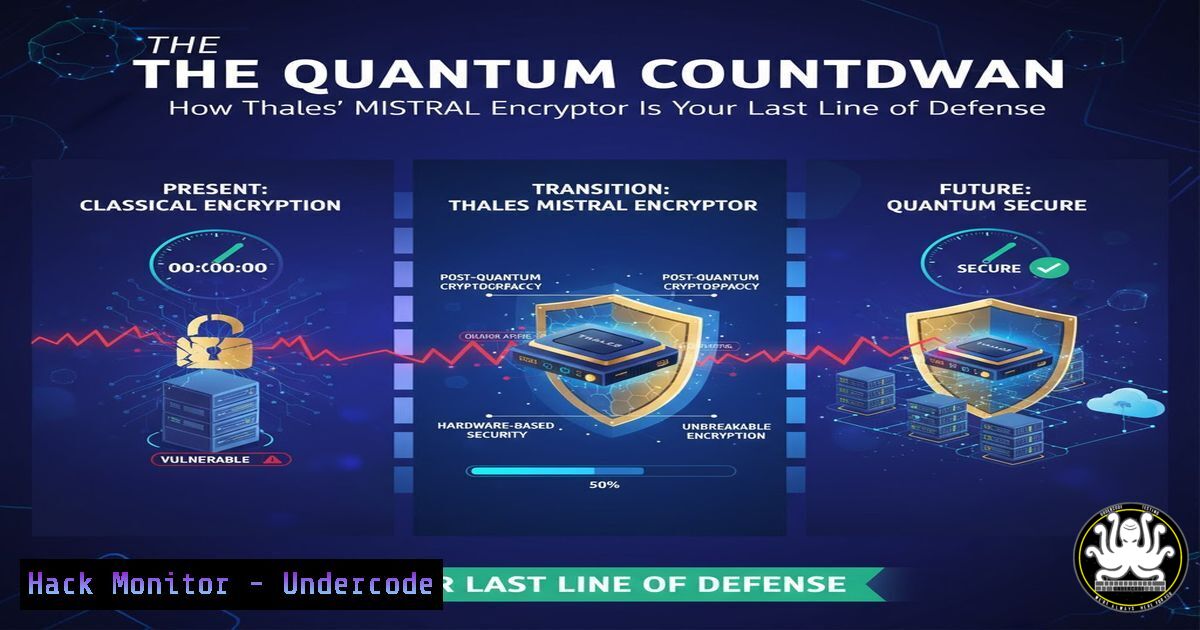
The race to secure our digital future has entered a critical new phase with the advent of quantum computing. While promising unprecedented computational power, quantum machines threaten to shatter the foundational encryption protocols that currently protect the world’s most sensitive communications. In a preemptive strike against this looming threat, Thales Group has launched MISTRAL, a certified post-quantum encryptor designed to future-proof data links across Europe, signaling a pivotal moment for governments and enterprises to begin their cryptographic migration.
Learning Objectives:
- Understand the fundamental vulnerability that quantum computing poses to current asymmetric encryption.
- Learn the practical steps for integrating post-quantum solutions into existing security architectures.
- Identify the key algorithms and migration strategies recommended by global standards bodies.
You Should Know:
1. The Quantum Threat to Your Current Encryption
The security of the modern internet, from HTTPS to VPNs, relies heavily on asymmetric cryptography like RSA and Elliptic Curve Cryptography (ECC). These systems are secure because factoring large prime numbers or solving discrete logarithm problems is intractable for classical computers. However, Shor’s algorithm, when run on a sufficiently powerful quantum computer, can solve these problems exponentially faster, rendering these encryption methods obsolete.
Step-by-step guide explaining what this does and how to use it:
While you cannot run Shor’s algorithm on a classical machine, you can use open-source tools to understand the key sizes involved and the sheer scale of the problem.
On a Linux/macOS system, use OpenSSL to generate a current-standard RSA key and then inspect its properties:
 Generate a 2048-bit RSA private key
openssl genrsa -out traditional_rsa.key 2048

Extract the public key
openssl rsa -in traditional_rsa.key -pubout -out traditional_rsa_public.key

View the detailed structure of the key (modulus = the large number to factor)
openssl rsa -in traditional_rsa.key -text -noout
The `modulus` value you see is the number a quantum computer using Shor’s algorithm would aim to factor. For a 2048-bit key, this number is astronomically large, securing it from classical attacks but fundamentally vulnerable to quantum attack.
2. How Post-Quantum Cryptography (PQC) Fights Back
Post-quantum cryptography refers to cryptographic algorithms that are believed to be secure against attacks by both classical and quantum computers. They are based on mathematical problems that are currently hard for quantum computers to solve, such as:
Lattice-based cryptography (e.g., Kyber, the selected algorithm for NIST’s key encapsulation)
Hash-based signatures (e.g., SPHINCS+)
Code-based cryptography (e.g., Classic McEliece)
Multivariate cryptography (e.g., Rainbow)
Thales’ MISTRAL system integrates these types of vetted PQC algorithms into a certified, tamper-resistant hardware module, ensuring that data in transit is protected against both present and future threats.
3. Integrating PQC into Your Existing Network
Deploying a solution like MISTRAL isn’t about replacing your entire infrastructure; it’s about strategically encrypting the most critical data links. These encryptors are typically deployed as inline hardware devices at network boundaries.
Step-by-step guide for a conceptual integration:
- Identify Critical Links: Pinpoint the network connections carrying your most sensitive data (e.g., data center interconnects, WAN links to remote offices, government communications).
- Physical Installation: Install the MISTRAL encryptors at both ends of the identified link. This often involves connecting the device between your router and the wide-area network (WAN) interface.
- Configuration: Using the administrative interface (often a web GUI or CLI), establish a secure session between the two encryptors. This is where they will negotiate a session key using a PQC algorithm like Kyber.
- Traffic Encryption: Once the secure tunnel is established, all data passing through the devices is automatically encrypted with quantum-resistant algorithms before being sent over the potentially vulnerable link.
- Monitoring & Management: Integrate the devices into your existing network management system for monitoring traffic flow, key health, and security alerts.
-
A Glimpse into the PQC Toolkit with Open-Source Code
While commercial solutions like MISTRAL provide certified, hardened security, developers can experiment with PQC algorithms today using open-source libraries. The Open Quantum Safe (OQS) project provides a great starting point.
Step-by-step guide to using the OQS OpenSSL fork:
 On a compatible Linux system, clone the OQS OpenSSL repository
git clone https://github.com/open-quantum-safe/openssl.git
cd openssl

Compile and install the library (this requires build-essential, cmake, etc.)
./Configure && make -j$(nproc) && sudo make install

Generate a post-quantum key pair using the Kyber algorithm
openssl genpkey -algorithm kyber512 -out pq_private_key.pem

Extract the public key
openssl pkey -in pq_private_key.pem -pubout -out pq_public_key.pem
This demonstrates how future TLS handshakes and software applications can be modified to use PQC for key exchange, moving beyond the vulnerable RSA and ECC.
5. The Inevitable Hybrid Migration Path
The transition to a full PQC world will not happen overnight. The recommended path is a “hybrid” mode, where traditional and post-quantum algorithms are used together.
Step-by-step guide to a hybrid approach:
- In a key exchange protocol (like TLS 1.3), the client and server would perform two independent key exchanges.
- First, they perform a standard ECDH (Elliptic Curve Diffie-Hellman) key exchange.
- Second, they perform a PQC key exchange (e.g., using Kyber).
- The final shared secret is derived by combining the secrets from both exchanges.
- This method provides cryptographic agility: even if one of the algorithms is broken in the future (be it ECC by quantum or a PQC algorithm by a classical attack), the connection remains secure.
6. Why Hardware Security Modules (HSMs) Are Non-Negotiable
Software-based cryptography stores keys in system memory, which is vulnerable to memory-scraping attacks. For the root of trust in a PQC system, Hardware Security Modules (HSMs) are essential. Thales’ MISTRAL is, in effect, a specialized HSM. They generate, store, and manage PQC keys in a tamper-resistant, FIPS-certified environment, preventing physical and logical key extraction.
7. Your Action Plan for the Quantum Era
Waiting for a cryptographically relevant quantum computer to arrive before acting is a catastrophic strategy. The threat of “harvest now, decrypt later” means adversaries are likely already intercepting and storing encrypted data to decrypt it later.
Step-by-step action plan:
- Inventory: Catalog all systems using long-term sensitive data and the cryptographic protocols that protect them.
- Prioritize: Focus first on data that has a long shelf-life (e.g., state secrets, intellectual property, health records).
- Experiment: Begin testing PQC solutions in lab environments using open-source tools and vendor evaluations.
- Create a Crypto-Agility Roadmap: Plan for a hybrid, then full-PQC transition, ensuring your systems can easily swap out cryptographic algorithms as standards evolve.
- Engage Vendors: Pressure your security and software vendors to announce and deliver their PQC migration timelines.
What Undercode Say:
- The “Harvest Now, Decrypt Later” attack is already underway. The most immediate danger is not from a quantum computer that exists today, but from the fact that nation-states and advanced threat actors are harvesting encrypted data now, with the full expectation of decrypting it once a quantum computer is available. MISTRAL and similar systems are a direct counter to this long-term strategy.
- Cryptographic Agility is the New Mandate. This launch underscores that the static cryptographic deployments of the past are a liability. Organizations must build systems that can be rapidly updated with new algorithms without requiring a full infrastructure overhaul. The time to build that agility is now, not when the quantum break is announced.
The launch of Thales’ MISTRAL is less of a product announcement and more of a starting gun. It marks the beginning of the end for RSA and ECC and validates the urgency of the PQC migration. For cybersecurity leaders, this is a definitive signal to move PQC from a theoretical research topic to a concrete budgeted project. The integration of these systems into European communications is a state-level action that private sector entities must emulate to protect their own crown jewels. The transition will be complex and multi-year, but the consequence of inaction is the total compromise of our digital secrets.
Prediction:
Within the next 3-5 years, post-quantum cryptography will become a baseline requirement in all RFPs for government and critical infrastructure projects, mirroring the adoption of FIPS 140-2 standards. We will witness the emergence of the first major “PQC-native” startups, and a significant industry will grow around crypto-agility consulting and migration services. Furthermore, the regulatory landscape will harden, with laws mandating PQC for the protection of specific classes of citizen data, forcing a global, multi-trillion-dollar technological shift that will define the next era of cybersecurity.
🎯Let’s Practice For Free:
IT/Security Reporter URL:
Reported By: Jmetayer Thales – Hackers Feeds
Extra Hub: Undercode MoN
Basic Verification: Pass ✅


