Listen to this Post
Introduction:
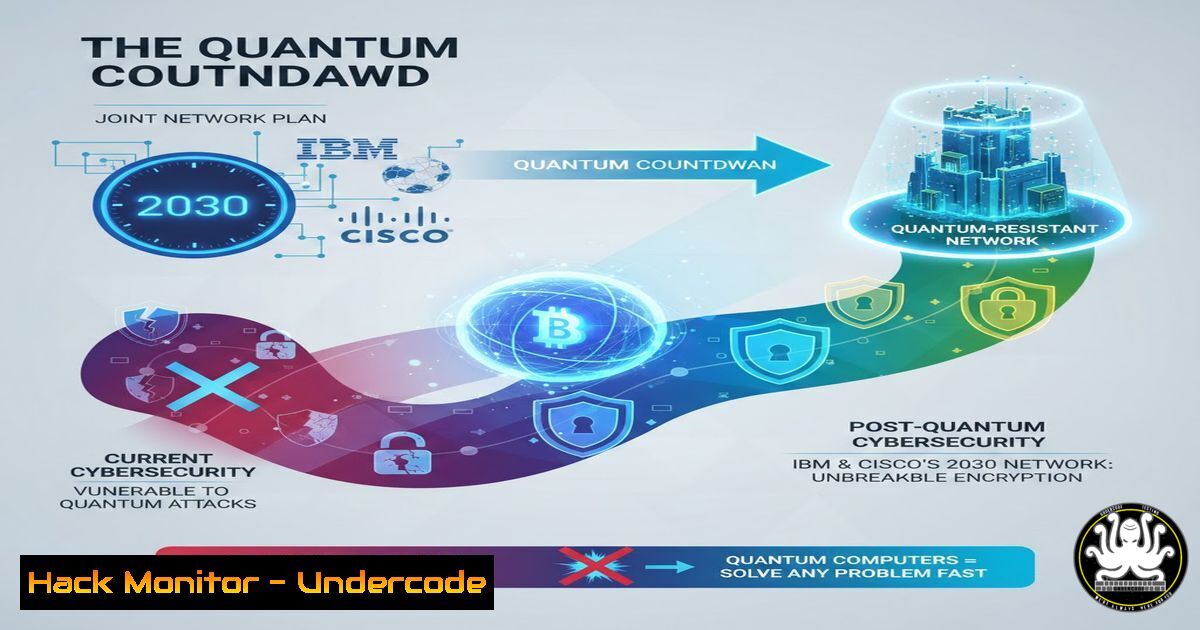
The strategic partnership between IBM and Cisco to network quantum computers by 2030 represents a paradigm shift not just in computing, but in the very fabric of digital security. This initiative, aiming to demonstrate a proof-of-concept quantum network by the end of the decade, directly threatens the cryptographic foundations of our modern internet. The core challenge they are tackling—maintaining quantum entanglement over distance—is the same mechanism that will render current public-key encryption obsolete, forcing a complete overhaul of global cybersecurity protocols years before a full-scale quantum internet arrives.
Learning Objectives:
- Understand the fundamental threat quantum networking poses to asymmetric cryptography (RSA, ECC).
- Learn the immediate steps to begin post-quantum migration, including cryptographic discovery and inventory.
- Explore the emerging security paradigms enabled by quantum networks, such as Quantum Key Distribution (QKD).
You Should Know:
1. The Incoming Cryptographic Apocalypse
The bedrock of modern secure communication—from HTTPS to VPNs—relies on the computational difficulty of problems like integer factorization (RSA) and discrete logarithms (ECC). A sufficiently powerful fault-tolerant quantum computer, especially one networked to amplify its power, can solve these problems in hours using Shor’s algorithm. The IBM-Cisco collaboration is a concrete signal that the timeline for this event is now being actively engineered, moving from theory to a projected reality.
Step-by-step guide:
Step 1: Cryptographic Inventory. You cannot protect what you do not know. Use discovery tools to map all cryptographic assets across your network.
Command (OpenSSL on Linux): `openssl s_client -connect example.com:443 -servername example.com | openssl x509 -noout -text | grep -E “Signature Algorithm|Public Key Algorithm”`
This command connects to a server and extracts the certificate details, showing you the signature and public key algorithms in use (e.g., `sha256WithRSAEncryption` or id-ecPublicKey).
Step 2: Vulnerability Assessment. Categorize systems based on their use of vulnerable cryptographic schemes. Systems using RSA or ECC for TLS, SSH, or code signing are at direct risk.
Step 3: Prioritize. Focus first on externally facing systems, data-in-transit encryption, and long-term data storage, which are the most immediate targets.
2. Migrating to Post-Quantum Cryptography (PQC)
The US National Institute of Standards and Technology (NIST) has already selected a suite of PQC algorithms designed to be resistant to attacks from both classical and quantum computers. Migration is a multi-year process that must begin now to avoid a last-minute, insecure scramble.
Step-by-step guide:
Step 1: Test in Lab Environments. Begin testing NIST-standardized PQC algorithms (e.g., CRYSTALS-Kyber for key exchange, CRYSTALS-Dilithium for signatures) in development and non-critical environments.
Step 2: Implement Hybrid Cryptography. A best-practice transitional strategy is to implement hybrid systems. For example, in TLS 1.3, combine a traditional ECDHE key exchange with a PQC key exchange. This ensures security even if one of the algorithms is broken.
Conceptual Code Snippet (Pseudocode):
 Hypothetical hybrid key exchange in a TLS handshake
traditional_shared_secret = ECDHE(exchange_parameters)
pq_shared_secret = KYBER(exchange_parameters)

Combine both secrets to derive the final master secret
final_master_secret = KDF(traditional_shared_secret + pq_shared_secret)
Step 3: Patch and Update. Work with vendors to ensure your hardware security modules (HSMs), load balancers, and software libraries support PQC standards as they become available.
- Quantum Key Distribution (QKD): The Next-Gen Secure Channel
While PQC replaces the mathematical “locks,” QKD uses the principles of quantum mechanics to create potentially unhackable key exchange. The IBM-Cisco network’s focus on entanglement is a precursor to robust QKD at scale, leveraging quantum properties to detect any eavesdropping attempt.
Step-by-step guide:
Step 1: Understand the Principle. QKD (like the BB84 protocol) encodes information into photons. Any measurement by an eavesdropper inevitably disturbs the quantum state, alerting the legitimate parties to the presence of an intruder.
Step 2: Assess Feasibility. Current QKD systems are limited by distance and require dedicated fiber-optic lines or line-of-sight free-space optics. They are best suited for securing high-value, point-to-point links (e.g., between data centers or financial institutions).
Step 3: Plan for Integration. QKD does not replace encryption; it secures the key exchange. Plan for how a QKD system would integrate with your existing encryptors to provide quantum-safe keys for protocols like IPsec.
4. Hardening Your PKI for the Transition
Your Public Key Infrastructure (PKI) is the epicenter of the quantum threat. A phased hardening process is essential to maintain trust.
Step-by-step guide:
Step 1: Audit Certificate Authorities (CAs). Identify which CAs are planning support for PQC certificates and their projected timelines.
Step 2: Plan for Certificate Lifetime. Do not issue long-term certificates with RSA/ECC keys. Shorten certificate validity periods to ease the transition to PQC when the time comes.
Step 3: Develop a Crypto-Agility Framework. The goal is to build systems where cryptographic algorithms can be swapped out without redesigning the entire protocol or platform. This requires modular code and standardized APIs.
- Cloud and API Security in a Pre-Quantum World
Cloud providers are already preparing for PQC. Your responsibility is to ensure your cloud deployments and APIs are configured to use the most secure available options and are ready to adopt quantum-resistant ones.
Step-by-step guide:
Step 1: Enforce Strict TLS Policies. Use tools to scan your API endpoints and cloud services.
Command (Nmap on Linux/Windows): `nmap –script ssl-enum-ciphers -p 443 your-api.endpoint.com`
This script lists the cipher suites supported by the endpoint, allowing you to identify and disable weak ciphers.
Step 2: Leverage Cloud Provider Tools. Utilize services like AWS Cryptographic Computing and Azure’s Post-Quantum Cryptography initiatives to future-proof new applications.
Step 3: API Security Gateways. Configure your API gateways to prefer PQC ciphersuites as they become standardized and supported by clients, ensuring a seamless upgrade path.
What Undercode Say:
- The Timeline is Now. The 2030 target for a networked quantum proof-of-concept is not a distant future problem. The migration to PQC is a 5-10 year project for most enterprises. Starting today is not premature; it is late.
- Cryptographic Agility is Non-Negotiable. The biggest lesson from this announcement is that we are entering an era of rapid cryptographic evolution. Systems designed without the ability to easily update their cryptographic core will become technical debt and security liabilities overnight.
The IBM-Cisco partnership is a market signal that transcends R&D; it is a call to action for every CISO and network architect. The threat is not the quantum computer itself, but our lack of preparedness for its arrival. The companies and governments that treat this as a strategic, long-term project will navigate the transition securely. Those who wait for a working quantum computer to appear on Shodan will face catastrophic data breaches and insurmountable migration costs. This is a race to build the next internet, and the starting pistol has already fired.
Prediction:
The successful demonstration of a networked quantum system by 2030 will trigger a “Quantum Y2K” level of global investment and regulatory pressure, fundamentally reshaping the cybersecurity industry. We will see the rise of mandatory PQC compliance standards, a booming market for quantum-safe solutions, and the first instances of “Harvest Now, Decrypt Later” attacks being used to target high-value intellectual property and state secrets, forcing a pre-emptive data destruction and crypto-migration strategy for sensitive sectors by 2035.
🎯Let’s Practice For Free:
IT/Security Reporter URL:
Reported By: Bobcarver Quantumcomputing – Hackers Feeds
Extra Hub: Undercode MoN
Basic Verification: Pass ✅


