Listen to this Post
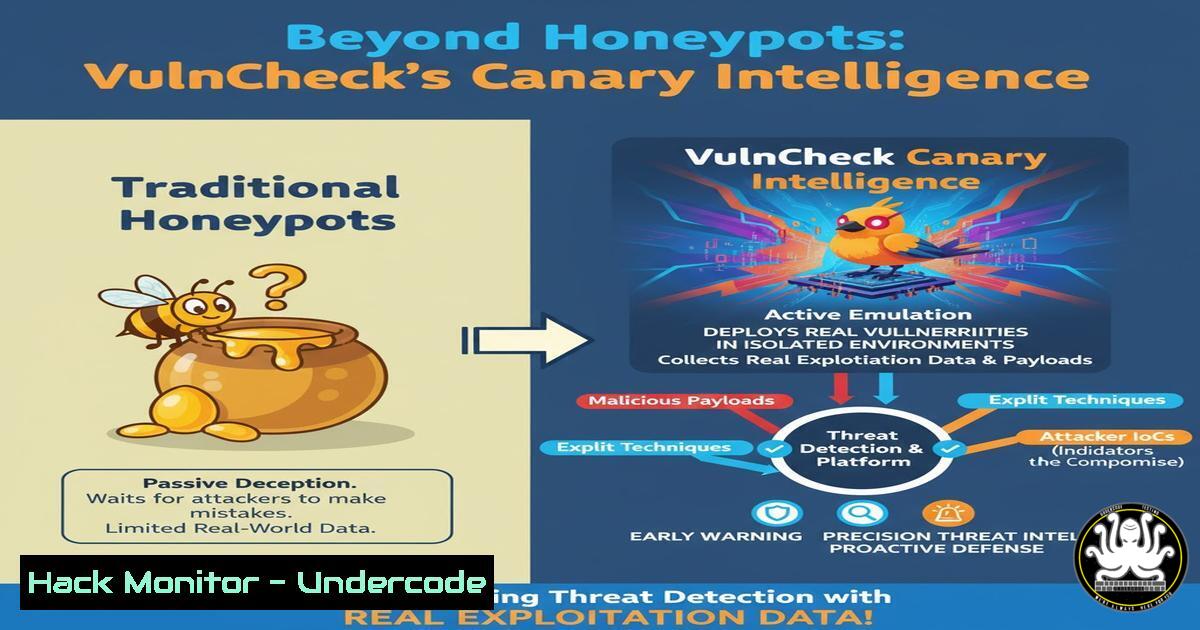
Introduction:
The cybersecurity landscape is shifting from theoretical vulnerability scoring to evidence-based threat intelligence. VulnCheck’s newly launched Canary Intelligence platform represents a paradigm shift by deploying real, vulnerable infrastructure across the internet to capture and verify active exploitation attempts, providing defenders with irrefutable proof of what attackers are actually targeting.
Learning Objectives:
- Understand the critical difference between honeypot-based detection and Canary Intelligence’s real vulnerable system approach.
- Learn how to leverage verified exploitation data to prioritize patching and defensive measures.
- Explore the operational process of integrating active threat intelligence into a Security Operations Center (SOC).
You Should Know:
1. The Fundamental Flaw in Traditional Honeypots
Traditional honeypots are decoy systems designed to lure attackers. However, they are often easily identifiable by sophisticated threat actors due to their emulated services, lack of realistic traffic, and known configurations. Canary Intelligence, by contrast, uses real software with actual vulnerabilities, deployed in target-rich internet environments. This makes them indistinguishable from genuine, poorly secured assets, thereby attracting more authentic and advanced attack methodologies.
Step‑by‑step guide explaining what this does and how to use it.
Concept: The system provisions cloud instances or physical servers and installs unpatched, vulnerable versions of common software (e.g., web servers, VPN gateways, IoT services).
Deployment: These systems are seeded with fake but realistic data and placed in IP ranges known to be heavily scanned by malicious actors.
Monitoring: Every packet, connection attempt, and payload directed at these systems is meticulously logged and analyzed.
Verification: Any interaction that successfully triggers the known vulnerability is automatically flagged, and the exploit code or technique is extracted and cataloged. This process verifies that a vulnerability is not just theoretically exploitable but is actively being weaponized in the wild.
- From Data to Action: Integrating Intelligence into Your SIEM
Raw exploitation data is useless unless it is operationalized. The true power of a feed like Canary Intelligence is its integration into existing security workflows, primarily through the Security Information and Event Management (SIEM) system.
Step‑by‑step guide explaining what this does and how to use it.
Step 1: Ingest the Intelligence Feed. VulnCheck likely provides an API or a formatted data feed (e.g., JSON, STIX/TAXII). Use your SIEM’s built-in data ingestion tools or a custom script to pull this data periodically.
Example using `curl` to test the API (hypothetical):
curl -H "Authorization: Bearer YOUR_API_KEY" https://api.vulncheck.com/intel/exploits
Step 2: Create Correlation Rules. Build custom rules in your SIEM to correlate the external threat intelligence with your internal network logs.
Example Splunk SPL:
index=firewall (dest_ip IN ("1.2.3.4", "5.6.7.8")) | lookup vulncheck_exploits.csv dest_ip OUTPUT exploit_cve | search exploit_cve=
This search would alert if your firewall registered a connection attempt to an internal IP that matches an IP known to be actively scanning for vulnerabilities according to the VulnCheck feed.
Example Sigma Rule (YAML) for detection:
title: Detection of VulnCheck Verified Exploit Attempt
logsource:
category: firewall
detection:
selection:
dest_ip:
- '1.2.3.4'  From VulnCheck Intel
- '5.6.7.8'  From VulnCheck Intel
condition: selection
falsepositives:
- 'Legitimate security scanning'
level: high
Step 3: Automate Alerting and Ticketing. Configure your SIEM to automatically create high-priority tickets in your SOAR or ticketing system (like Jira or ServiceNow) when a correlation is found, forcing immediate investigation.
3. Prioritizing Vulnerability Management with Evidence
Vulnerability scanners often produce thousands of results. Canary Intelligence provides the context needed to cut through the noise. If VulnCheck reports that CVE-2024-12345 is being actively exploited, that single piece of data should immediately elevate the patching of that CVE to a P0 or Critical priority across your entire environment.
Step‑by‑step guide explaining what this does and how to use it.
Step 1: Cross-Reference Scan Results. Export your latest vulnerability scan report (e.g., from Nessus, Qualys) and cross-reference the list of discovered CVEs with the VulnCheck active exploitation list.
Step 2: Scripting for Automation. Write a simple script to automate this prioritization.
Example Python Pseudocode:
import requests

Get your internal vuln scan results
my_cves = get_my_scan_results()

Get VulnCheck's active exploitation list
vc_response = requests.get('https://api.vulncheck.com/active-cves', headers=auth_headers)
active_cves = vc_response.json()

Find the intersection
critical_cves = set(my_cves) & set(active_cves)

print(f"P0 - Actively Exploited CVEs to patch NOW: {critical_cves}")
Step 3: Enforce Patching Policy. Use this filtered list to create emergency change controls and mandate patching within a drastically reduced timeframe (e.g., 24-48 hours) for the confirmed, exploited vulnerabilities.
4. Hardening Cloud Infrastructure Against Verified Threats
Attackers frequently target cloud services. Intelligence about which cloud-native vulnerabilities are being exploited allows for proactive hardening.
Step‑by‑step guide explaining what this does and how to use it.
Threat: Active exploitation of a misconfigured Kubernetes `kubelet` API.
Mitigation Command (Linux): Secure the `kubelet` by enabling authentication and authorisation.
1. Edit the kubelet configuration file (`/var/lib/kubelet/config.yaml`).
2. Ensure the following parameters are set:
authentication:
anonymous:
enabled: false
webhook:
enabled: true
authorization:
mode: Webhook
3. Restart the kubelet service: `sudo systemctl restart kubelet`
Cloud Security Group Rule: If intelligence shows exploitation from a specific ASN or IP range, you can create a temporary, explicit deny rule in your cloud security group or NACL while you patch the underlying vulnerability.
- The Future of Threat Hunting with Live Exploit Code
Access to the actual exploit code used in attacks is a game-changer for threat hunters. It allows them to search their own networks for Indicators of Compromise (IOCs) and attack patterns with extreme precision.
Step‑by‑step guide explaining what this does and how to use it.
Step 1: Analyze the Payload. When Canary Intelligence captures an exploit, analyze the signature of the attack. This could be a unique string in the exploit code, a specific sequence of packets, or a particular user-agent.
Step 2: Hunt with YARA. Create a YARA rule to scan your systems or network traffic for the presence of this exploit signature.
Example YARA Rule:
rule VulnCheck_Exploit_Apache_Active {
meta:
description = "Detects payload from active Apache exploit per VulnCheck Intel"
author = "Your SOC"
cve = "CVE-2024-5678"
strings:
$s1 = "malicious_payload_signature_123"
$s2 = { 48 8b 05 00 00 00 00 48 89 44 24 }
condition:
any of them
}
Step 3: Deploy and Alert. Use this YARA rule with tools like Thor-Linux, VirusTotal Enterprise, or your EDR’s built-in hunting capabilities to proactively search for compromise.
What Undercode Say:
- Evidence Beats Theory: The shift from CVSS scores and theoretical risk to verified, evidence-based exploitation data is the most significant advancement in practical threat intelligence in years. It forces a re-evaluation of what “critical” truly means.
- Proactive Defense is Now Tangible: This intelligence allows organizations to move from a reactive posture (“we were hacked”) to a proactively defensive one (“we are blocking confirmed attack vectors before they can be used against us effectively”).
The announcement by VulnCheck signals a maturation of the cybersecurity industry. Relying on honeypots and delayed public advisories has left a critical gap in a defender’s understanding of the immediate threat landscape. By using real vulnerable systems, Canary Intelligence closes this gap, providing a near-real-time view of attacker behavior. This methodology doesn’t just tell you what might be a problem; it shows you what is a problem right now. For security teams, this is actionable intelligence of the highest order, enabling precise resource allocation and fundamentally strengthening their defensive posture against emerging and ongoing campaigns.
Prediction:
The success of VulnCheck’s Canary Intelligence will catalyze a broader industry-wide move towards first-party, evidence-grounded threat intelligence. Within two years, this approach will become the benchmark for premium threat feeds, forcing legacy providers to adapt or become obsolete. This will lead to a “hardening wave,” where organizations, armed with precise data, will rapidly patch and mitigate the most relevant threats, thereby raising the cost and complexity for attackers. Consequently, we will see a shift in attacker tactics towards more stealthy, targeted attacks as widespread, opportunistic exploitation becomes less effective.
🎯Let’s Practice For Free:
IT/Security Reporter URL:
Reported By: Jaywallacevps Vulncheck – Hackers Feeds
Extra Hub: Undercode MoN
Basic Verification: Pass ✅


