Listen to this Post
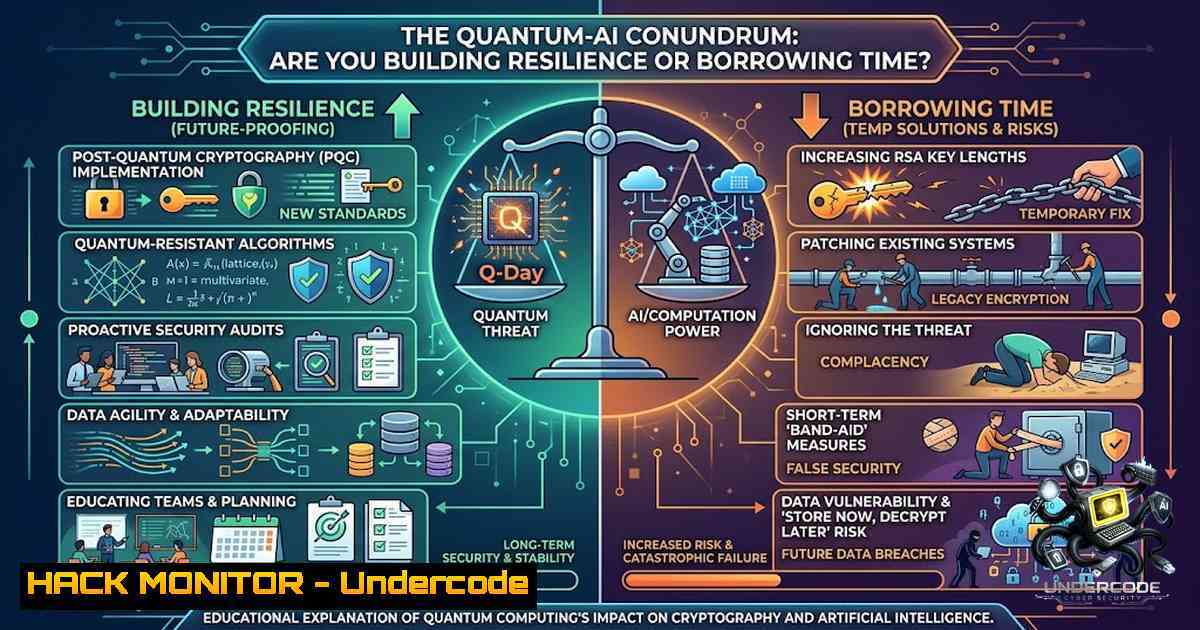
Introduction:
The modern boardroom is awash with discussions on Artificial Intelligence (AI) adoption, yet a parallel and equally existential threat lurks in the shadows of technological advancement: the migration to Post-Quantum Cryptography (PQC). While AI promises unprecedented operational efficiency, it simultaneously accelerates adversarial capabilities, creating a dual-edged sword that cuts to the core of cryptographic trust. Concurrently, “harvest now, decrypt later” (HNDL) attacks render current data protection strategies obsolete before quantum computing even matures, meaning decisions made today regarding AI and cryptography are intrinsically linked strategic bets on an organization’s long-term resilience.
Learning Objectives:
- Understand the convergence of AI governance and PQC migration as a unified strategic board-level priority.
- Identify the specific risks associated with AI-driven offensive security and the vulnerabilities in current public-key infrastructure (PKI).
- Comprehend the technical requirements for cryptographic agility, including discovery, inventory, and migration planning.
- Learn practical command-line tools and frameworks for assessing cryptographic weaknesses and AI threat vectors in hybrid environments.
You Should Know:
- The Technical Anatomy of “Harvest Now, Decrypt Later” (HNDL)
The premise of HNDL is deceptively simple: adversaries are currently exfiltrating vast amounts of encrypted data—VPN traffic, email archives, and stored database backups—with the expectation that they will possess the quantum capability to break RSA and ECC encryption within the next decade. This is not a future theoretical risk; it is an ongoing operational threat to data longevity.
Step‑by‑step guide for defensive assessment:
To understand your exposure, you must perform a cryptographic inventory across your infrastructure. This involves identifying where asymmetric encryption (RSA, ECDSA, ECDH) is used in TLS certificates, code signing, and authentication tokens.
– Linux (OpenSSL) : To inspect a certificate’s algorithm and key length, use:
`openssl x509 -in certificate.crt -text -1oout | grep “Public-Key”`
Note: RSA-2048 and ECDSA-256 are vulnerable to Shor’s algorithm in a quantum environment.
– Windows (PowerShell) : To scan for TLS certificates in the local machine store that use weak RSA keys:
`Get-ChildItem -Path Cert:\LocalMachine\My | Where-Object { $_.PublicKey.Key.KeySize -lt 3072 }`
– Network Scan : Use `nmap` with `ssl-enum-ciphers` to identify exposed services using weak key exchange algorithms:
`nmap –script ssl-enum-ciphers -p 443,8443 `
This script highlights ciphers using RSA or Diffie-Hellman (DH) that lack quantum-resistant properties.
- AI as an Amplifier: Enhancing Threat Intelligence and Attack Surface
AI is not merely a defensive tool; it is a force multiplier for adversarial tactics. Machine Learning (ML) models are being used to automate vulnerability discovery, generate polymorphic malware, and socially engineer access credentials at scale. However, from a defensive standpoint, AI allows for the rapid aggregation of threat intelligence (IoCs) that helps identify exfiltration patterns indicative of HNDL data harvesting.
Step‑by‑step guide for detection:
Implement anomaly detection models to monitor data flows for unusual bulk exports that mimic data harvesting.
– Linux (Network Monitoring) : Use `tcpdump` to capture metadata, then feed it into a simple ML pipeline for baseline analysis.
`tcpdump -i eth0 -s 0 -w harvest_traffic.pcap`
View details: `tshark -r harvest_traffic.pcap -Y “ssl.handshake.certificate”`
- Windows (Sysmon) : Configure Sysmon to log Event ID 3 (Network Connection) to track outbound connections to unknown IPs. Combine this with threat intelligence feeds to correlate if data is being exfiltrated to state-actor known infrastructure.
- AI Integration: Use `YARA` rules generated via ML classification to scan for signatures of known exfiltration tools, ensuring the AI model is trained on “quantum-ready” evasion techniques.
3. Cryptographic Agility: The Core of Migration Strategy
Cryptographic agility refers to the ability to swap out algorithms without modifying the underlying infrastructure. The National Institute of Standards and Technology (NIST) has standardized CRYSTALS-Kyber (Key Encapsulation) and CRYSTALS-Dilithium (Digital Signatures). However, migrating to these standards requires a “Hybrid Mode” approach—combining classical and post-quantum algorithms to prevent transitional downgrade attacks.
Step‑by‑step guide for hybrid configuration:
- Linux (OpenSSL Provider) : Install the `oqs-provider` to enable PQC algorithms in OpenSSL 3.0.
`sudo apt-get install liboqs-dev && git clone https://github.com/open-quantum-safe/oqs-provider`
Configure applications to use `openssl s_client` with `-groups kyber768` to test hybrid key exchange. - Windows (Schannel) : While native support is evolving, implement application-level hybrid encryption using Bouncy Castle libraries. For IIS, prioritize TLS 1.3 which allows for post-quantum extensions in the future.
- Cloud Hardening: In Azure/AWS, implement Key Vault rotation policies to ensure keys are rotated frequently (mitigates harvest longevity). Use `az keyvault key create –1ame “pqc-hybrid” –ops encrypt decrypt –kty RSA-HSM –size 4096` (while waiting for PQC support) combined with quantum-safe KMS integrations.
- Cost and Operational Governance: Balancing AI Spending with PQC Investment
The board’s cost concern is valid; PQC migration involves not just replacing certificates but updating firmware, HSM modules, and legacy systems that lack the memory for new, larger post-quantum signatures. AI, conversely, requires massive computational overhead.
Step‑by‑step guide for cost assessment:
- Linux (Resource Monitoring) : Run `htop` and `nvidia-smi` to assess GPU/CPU utilization for AI workloads, then compare against the overhead of running hybrid cryptographic operations on the same node to avoid resource contention.
- Windows (Performance Monitor) : Use `perfmon` to track “Processor Time” and “Network Bandwidth” while performing TLS handshakes with simulated PQC payloads.
- Vendor Dependencies Audit: Use `Trivy` to scan container images for cryptographic libraries:
`trivy image –severity HIGH,CRITICAL –security-checks vuln your-alpine-image`
This identifies if your AI model pipeline is dependent on libraries (like older OpenSSL versions) that cannot support the new PQC standards, requiring costly re-architecting.
- Exploitation and Mitigation: Defending Against the “AI-Powered Quantum Pre-Processor”
Current attack vectors include adversaries using AI to analyze encrypted metadata—even without decryption—to infer business strategies (e.g., executive email metadata revealing M&A activity). Mitigation requires both AI-resistant data obfuscation and PQC-ready integrity checks.
Step‑by‑step guide for immediate hardening:
- API Security: Implement mutual TLS (mTLS) with mandatory certificate revocation checking, ensuring that obsolete algorithms are rejected.
Linux Command: `curl –cacert ca.crt –cert client.crt –key client.key –tlsv1.3 –curves X25519:kyber768 https://api.secureendpoint.com` - Integrity Checks: Generate immutable logs using post-quantum signatures (Dilithium) to prevent adversaries from modifying logs to cover their “harvest” tracks.
- AI Threat Mitigation: Implement strict input validation to prevent prompt injection attacks on your internal AI copilots, as this can leak sensitive data that may be harvested for decryption later.
What Undercode Say:
- Key Takeaway 1: The convergence of AI and PQC is not a technology issue but a risk governance issue; the board must bridge the gap between CIO/CISO strategies and business continuity.
- Key Takeaway 2: Organizations that fail to implement “Cryptographic Agility” today will pay a premium in operational downtime and data breach liability when the quantum era arrives, regardless of their AI efficiency.
- +Analysis: The strategic implication is clear: AI increases the efficiency of data classification, which ironically helps attackers identify which data is worth harvesting now. Conversely, AI-driven network analysis is our best defense against detecting these massive exfiltration volumes. The board must push for “zero-trust” architectures that assume data is already harvested. This requires a shift from perimeter defense to “Data-Centric Security” where the encryption itself is the final layer of defense. By treating AI and PQC as intertwined financial metrics rather than IT project lines, boards can forecast the “Quantum Tax”—the cost of replacing hardware that doesn’t support new algorithms. This convergence forces a reevaluation of data lifecycle management; if we cannot guarantee decryption security in 10 years, we must minimize data retention today.
Prediction:
- +1: Integration of AI will accelerate the discovery of cryptographic assets, reducing the timeline for PQC discovery phases from 18 months to under 6, enabling faster hybrid rollouts.
- -1: Adversarial AI will likely defeat early hybrid migration attempts by exploiting human errors in key rotation, leading to a “false sense of security” that results in high-profile data breaches by 2028.
- +1: The standardization of PQC will drive innovation in hardware HSMs, creating a new market for “Quantum-Safe as a Service” that simplifies board-level governance.
- -1: Organizations focusing solely on cost savings via AI will neglect the “inflationary” cost of PQC hardware upgrades, leading to a severe budget crisis where critical infrastructure remains exposed for an additional 3-5 years.
▶️ Related Video (88% Match):
🎯Let’s Practice For Free:
🎓 Live Courses & Certifications:
Join Undercode Academy for Verified Certifications
🚀 Request a Custom Project:
Secure, high-velocity infrastructure and disruptive technological engineering. Contact our engineering team for high-tier development and proprietary systems:
[email protected]
💎 Smart Architecture | 🛡️ Secure by Design | ⭐ Trusted by Thousands
IT/Security Reporter URL:
Reported By: Cyberstrategy Artificialintelligence – Hackers Feeds
Extra Hub: Undercode MoN
Basic Verification: Pass ✅


