Listen to this Post
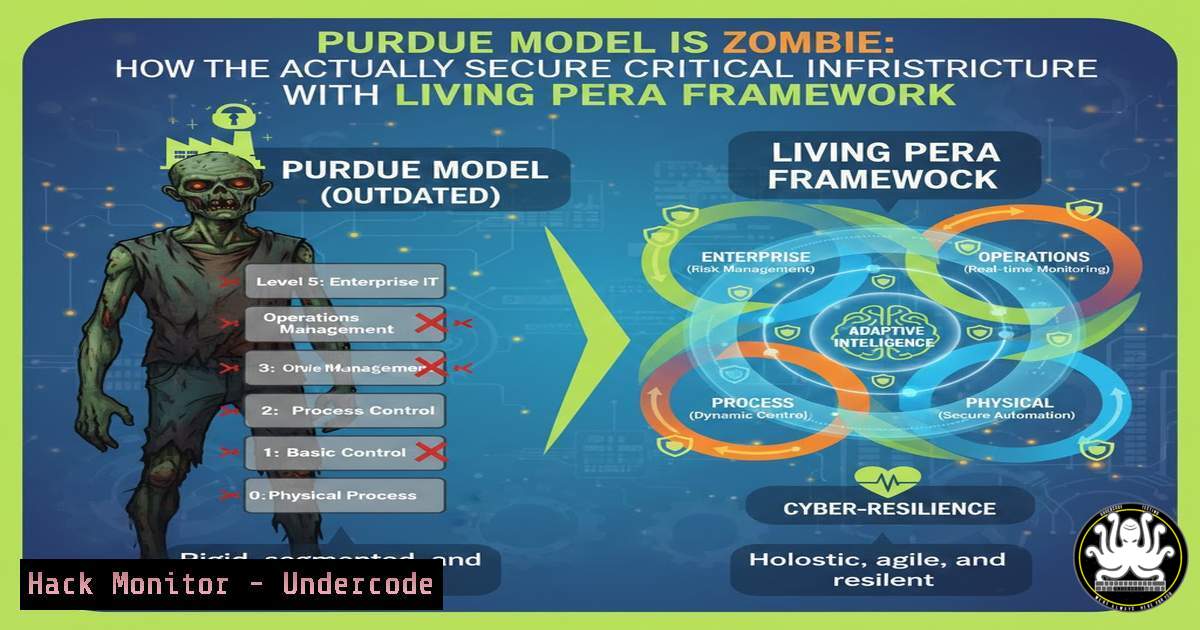
Introduction:
The industrial cybersecurity community has spent years debating the relevance of the Purdue Model, often dismissing it as an outdated network diagram. This debate misses the mark entirely because the real methodology—the Purdue Enterprise Reference Architecture (PERA)—is not a static network map but a dynamic, consequence-aware framework for integrating enterprise and control systems. This article resurrects the core principles of PERA to provide a practical roadmap for securing operational technology (OT) environments against modern threats.
Learning Objectives:
- Deconstruct the common myths surrounding the Purdue Model and understand the comprehensive, consequence-focused PERA methodology.
- Learn the critical technical distinction between Level 0 (the physical process) and Level 1 (basic control) and how to architect their segregation.
- Develop a practical strategy to implement “Industrial Independence” through secure data exchange, moving beyond simple network segmentation.
You Should Know:
- From Cartoon to Consequence: Reclaiming the Real PERA Framework
The industry’s “Great Reduction” transformed PERA from a holistic enterprise integration guide into a simplified six-layer cartoon used to sell firewalls. The authentic PERA framework, as documented in its original literature, is a consequence-aware architecture. It mandates that every integration decision—from sensor placement to cloud connectivity—must be evaluated based on its potential impact on safety, production, and revenue, not just its network topology.
Step‑by‑step guide explaining what this does and how to use it.
Step 1: Foundation Audit. Don’t start with a network scan. Start by cataloging physical assets (e.g., pressure transmitters, PLCs, HMIs) and mapping them to business consequences. What is the financial, safety, or environmental impact if this asset is manipulated or fails?
Step 2: Consequence-Based Zoning. Using tools like the MITRE ATT&CK for ICS framework, analyze threat actions that could lead to your identified consequences. Group assets not by IP subnet alone, but by shared consequence criticality.
Step 3: Policy Translation. Translate consequence zones into security policies. A high-consequence safety zone requires policies focused on integrity and availability (e.g., strict change control, redundant systems), not just confidentiality.
- The Sacred Divide: Why Level 0 is Not a Network and How to Protect It
The most critical technical insight from PERA is the fundamental difference between Level 0 (The Physical Process) and Level 1 (Basic Control). Level 0 comprises sensors and actuators that interact directly with the physical world—they measure pressure, open valves, and start motors. Misplacing these in a network diagram as just another node is a profound error. They should not have IP addresses or be directly accessible from Level 2 (Supervisory Control). The conduit between Level 0 and Level 1 is a hardwired signal or a dedicated fieldbus protocol (e.g., Profinet, Modbus RTU), not TCP/IP.
Step‑by‑step guide explaining what this does and how to use it.
Step 1: Physical Layer Identification. Use physical walkdowns and engineering drawings—not network discovery tools—to identify all Level 0 assets. Document their connection type: 4-20mA analog signal, discrete I/O, or serial fieldbus.
Step 2: Enforce the Boundary. Ensure no Level 0 fieldbus networks are inadvertently bridged to an Ethernet-based Level 2 network without a proper controller (PLC/RTU) acting as a protocol-aware gateway/firewall.
Step 3: Monitor the Inaccessible. Since you can’t install an agent on a sensor, monitor its expected behavior at the Level 1 controller. Use the controller’s logic or a passive tap to establish baselines for signal ranges and response times. Anomalies can indicate physical tampering or sensor failure.
Example Command (Linux, using `tcpdump` on a mirrored port watching controller traffic):
sudo tcpdump -i eth0 -nn 'dst port 502' -A Capturing Modbus TCP traffic to a PLC to analyze setpoints and readings from Level 0.
- Architecting “Industrial Independence”: Secure Data Exchange, Not Open Connections
PERA’s logical conclusion is “Industrial Independence”—the OT environment must be architected to operate safely even if higher-level IT systems are compromised. This is not air-gapping; it is about controlled, unidirectional data flow. The argument “the cloud exists” is not a valid reason for a programmable, bidirectional pathway from Level 3 (Operations) to a public cloud. Data needed for analytics must be extracted via secure, OT-centric methods.
Step‑by‑step guide explaining what this does and how to use it.
Step 1: Implement Data Diodes or Unidirectional Gateways. For the highest-consequence zones, use hardware-enforced data diodes (e.g., from Owl Cyber Defense or Waterfall) to push historical process data out to a DMZ historian. This physically prevents any return path for commands or malware.
Step 2: Deploy an OT-Specific DMZ. Establish a properly configured DMZ (Purdue Level 3.5) using firewalls with deep packet inspection for ICS protocols (e.g., Trellix/Tripwire Industrial Visibility, Claroty). All data exchanges between OT and IT/Cloud must terminate and be re-initiated from this DMZ.
Step 3: Use Secure APIs for Cloud Data Push. Instead of allowing cloud services to “pull” from controllers, configure your DMZ historian or gateway to push data to the cloud via a secure, authenticated API (like MQTT with TLS) over a restricted outbound firewall rule.
Example Configuration Snippet (AWS IoT Core Policy limiting publisher actions):
{
"Effect": "Allow",
"Action": "iot:Publish",
"Resource": "arn:aws:iot:region:account:topic/plantA/historian/"
}
- Building Consequence-Aware Zones and Conduits with Modern Tools
Modern implementations of PERA’s zones and conduits concept are embodied in standards like IEC 62443. This involves segmenting the control network into cells based on consequence and functional relationship, not just convenience.
Step‑by‑step guide explaining what this does and how to use it.
Step 1: Network Segmentation with VLANs and Firewalls. Use Layer 3 switches to create VLANs for each functional zone (e.g., Boiler Control VLAN, Turbine Control VLAN). Place next-generation firewalls or industrial demilitarized zones (IDMZ) appliances between these VLANs to act as conduits, filtering by specific ICS protocol function codes.
Step 2: Harden Industrial Protocols. Configure firewalls to only allow specific Modbus function codes (e.g., Read Holding Registers 0x03) between defined source/destination pairs and block dangerous codes like Write Multiple Registers (0x10) from less trusted zones.
Step 3: Continuous Monitoring. Deploy a passive network monitoring tool (Nozomi Networks, Dragos, Microsoft CyberX) that understands ICS protocols to detect violations of zone policy, such as a engineering workstation from the Level 3 zone attempting to communicate directly with a PLC in Level 1.
Example PowerShell Command (On Windows, to verify allowed connections to a critical asset):
Get-NetFirewallRule -DisplayName "Allow_Modbus_PLC123" | Get-NetFirewallAddressFilter
5. Operationalizing Consequence-Based Risk Assessment
Move from checkbox compliance to ongoing, consequence-driven risk management. This means your security controls are dynamically prioritized based on the potential impact they mitigate.
Step‑by‑step guide explaining what this does and how to use it.
Step 1: Create a Consequence Matrix. For each system/zone, document the worst-case safety, environmental, production, and reputational consequences of compromise. Use a simple High/Medium/Low scale.
Step 2: Map Threats to Consequences. Use MITRE ATT&CK for ICS to identify techniques that could realize those consequences (e.g., “Impair Process Control” to cause a safety incident).
Step 3: Implement and Test Compensating Controls. For each high-consequence scenario, deploy and regularly test a corresponding detective or preventive control. For example, for a “loss of view” attack on an HMI, ensure independent physical safety alarms and pressure gauges (a Level 0/1 solution) are in place and functional.
Step 4: Tabletop Exercises. Regularly run tabletop exercises with engineering and operations staff where you simulate a breach (e.g., “Attackers have gained access to the engineering VLAN”) and walk through the technical and operational response based on the consequence matrix.
What Undercode Say:
- The Model Isn’t Dead, It Was Never Fully Alive in Practice: The industry has been fighting a phantom. The real battle is implementing the nuanced, consequence-driven PERA philosophy, not defending or attacking a simplistic diagram. The framework provides the “why” for segmentation, which is more vital than the “how.”
- The Future is Asymmetric Security: Defending every sensor is impossible. PERA guides you to focus intense resources on protecting the high-consequence pathways and assets—the controllers and the integrity of the command stream from Level 1 to Level 0. Everything else is a supporting layer.
Analysis: The post hits on a critical failure of communication in OT security. Vendors simplified a complex standard to sell products, and the industry accepted the shorthand, losing the core risk-management doctrine. This has led to misconfigured architectures where sensors are given IP addresses and firewalls are placed without a policy tied to physical consequence. Reviving PERA is not about nostalgia; it’s about recentering security discussions on the fundamental mission of industrial sites: safe, reliable operation. It provides the essential language to bridge the gap between control engineers who understand physical consequences and IT security professionals who understand cyber threats.
Prediction:
The convergence of IT and OT will only accelerate with Industry 4.0 and AI-driven analytics, making the principles of PERA more critical than ever. We will see a shift from networks segmented by simple level to “Consequence- Defined Microsegments.” Regulatory frameworks for critical infrastructure will move beyond prescribing network diagrams and begin mandating consequence-based risk assessments as part of cybersecurity audits. Furthermore, the rise of AI capable of orchestrating complex attacks will make the “Industrial Independence” principle non-negotiable; systems must be designed to fail safely even if upstream networks are fully compromised. The organizations that succeed will be those that use PERA not as a map of cables, but as a blueprint for resilience.
▶️ Related Video (74% Match):
🎯Let’s Practice For Free:
IT/Security Reporter URL:
Reported By: Rivercaudle Otsecurity – Hackers Feeds
Extra Hub: Undercode MoN
Basic Verification: Pass ✅


