Listen to this Post
Introduction:
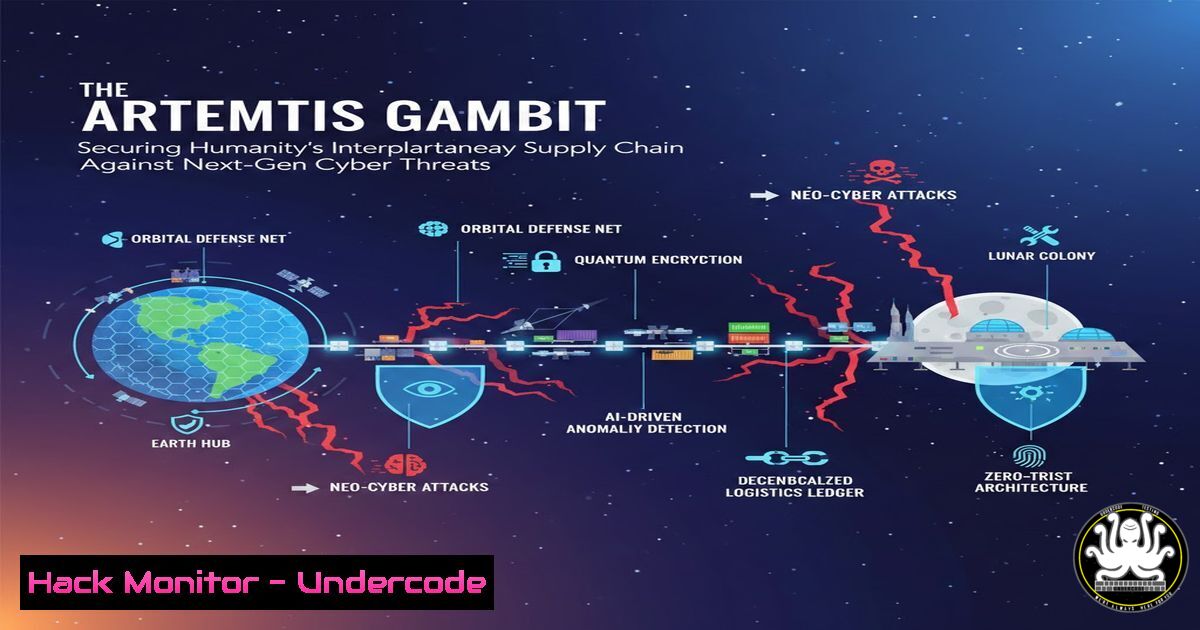
The Artemis program marks humanity’s return to lunar exploration and the dawn of a permanent off-world presence, managed by an unprecedentedly complex, AI-driven, and interconnected supply chain. This new frontier—the Interplanetary Supply Chain—is not just a logistical challenge but a monumental cybersecurity battleground. Protecting the flow of resources, data, and commands across millions of miles requires a fundamental rethinking of security paradigms, moving beyond terrestrial models to defend against attacks that could strand astronauts, sabotage missions, or hijack critical infrastructure in space.
Learning Objectives:
- Understand the unique cyber-physical threats targeting space-based logistics, from autonomous spacecraft to orbital depots.
- Learn to apply and adapt core cybersecurity principles (Zero Trust, Secure Software Development Lifecycle) to the constraints of space systems.
- Implement practical hardening techniques for the software and communication layers critical to space supply chain operations.
You Should Know:
- The New Attack Surface: From Launchpad to Lunar Lagrangian Point
The space supply chain extends the traditional IT/OT attack surface into the celestial domain. Threat actors, from state-sponsored groups to hacktivists, now have viable targets in satellite communication links, telemetry data, autonomous navigation systems, and the ground-based AI “orchestration platforms” managing it all. A compromised sensor on a fuel depot or a malicious update to a lander’s inventory software could cascade into catastrophic failure.
Step-by-step guide explaining what this does and how to use it:
The first step is asset and communication mapping. You must inventory every component that transmits or receives data.
On Linux/Mission Control Systems: Use tools like `nmap` and Wireshark to map network traffic between ground stations, simulation clusters, and relay satellites. Crucially, analyze proprietary protocols.
 Scan a ground control network segment for active devices and open ports
nmap -sV -O 192.168.1.0/24 -oN ground_station_network_scan.txt
 Capture traffic to analyze proprietary spacecraft command protocols
tcpdump -i eth0 -w mission_control_traffic.pcap
Action: Create a dynamic map linking every physical asset (sensor, thruster, comms array) to its digital twin and data pathways. This map is the foundation for intrusion detection and impact analysis.
- Hardening the Cosmic Last Mile: Securing Autonomous Rendezvous & Docking
Autonomous spacecraft performing orbital resupply are high-value targets. Their systems rely on machine vision, lidar, and complex relative navigation software. An attack could spoof docking targets or corrupt navigation data to cause a collision.
Step-by-step guide explaining what this does and how to use it:
Implement integrity checks and anomaly detection at the sensor fusion level.
Code/Concept (Python – Simplified Anomaly Detector): Create a baseline model for expected sensor readings during approach and flag deviations.
import numpy as np
from sklearn.ensemble import IsolationForest

Simulated training data: normal ranges for relative velocity, distance, alignment
normal_sensor_data = np.random.normal(0.1, 0.02, (1000, 3))
clf = IsolationForest(contamination=0.01)
clf.fit(normal_sensor_data)

Live prediction on incoming sensor stream
live_data = np.array([[0.12, 0.09, 0.11], [5.2, -0.3, 10.1]])  Second entry is anomalous
predictions = clf.predict(live_data)
 Output: [1, -1] => 1=normal, -1=anomaly
Action: Deploy such models on edge computing modules within the spacecraft to make real-time “abort/continue” decisions independent of potentially delayed or compromised ground commands.
3. Zero Trust in a Zero-G Environment
The principle “never trust, always verify” is paramount when your network includes nodes 384,400 km away. Assume any command from Earth or a partner’s system is potentially hostile until cryptographically proven otherwise.
Step-by-step guide explaining what this does and how to use it:
Enforce strict mutual TLS (mTLS) and short-lived certificates for all communications.
Linux/OpenSSL Command for Generating Short-Lived Certificates:
 Generate a private key and a certificate valid for only 24 hours (86400 seconds)
openssl req -x509 -newkey rsa:4096 -keyout spacecraft_key.pem -out spacecraft_cert.pem -days 1 -nodes -subj "/C=US/O=NASA/CN=Artemis_Orion_001"
Configuration Snippet (Example for a Go-based ground service):
config := &tls.Config{
ClientAuth: tls.RequireAndVerifyClientCert, // Enforce mTLS
Certificates: []tls.Certificate{myCert},
ClientCAs: myClientCAPool,
VerifyPeerCertificate: func(rawCerts [][]byte, verifiedChains [][]x509.Certificate) error {
// ADDITIONAL CHECK: Verify certificate's custom extension for mission-ID
cert := verifiedChains[bash][bash]
if getMissionID(cert) != "ARTEMIS_II_AUTHORIZED" {
return errors.New("unauthorized mission context")
}
return nil
},
}
Action: Implement a certificate authority (CA) dedicated to the mission with policies for automatic, hourly certificate rotation for all critical command links.
- Securing the In-Situ Resource Utilization (ISRU) Supply Chain
Lunar bases will produce fuel and oxygen from local resources. The industrial control systems (ICS) managing these “lunar factories” are classic OT targets but with no possibility for physical incident response.
Step-by-step guide explaining what this does and how to use it:
Harden the ICS by segmenting networks and monitoring for abnormal process behavior.
Windows (ICS Operator Station) Command for Network Segmentation:
 Create a Windows Firewall rule to only allow Modbus TCP from the specific controller IP
New-NetFirewallRule -DisplayName "Allow_Modbus_From_Main_ISRU_Controller" -Direction Inbound -Protocol TCP -LocalPort 502 -RemoteAddress "192.168.10.50" -Action Allow
Action: Use a passive monitoring tool like GRASSMARLIN to map the ISRU ICS protocol traffic and establish a baseline. Configure alerts for any new, unauthorized device appearing on this isolated network or for commands that would push systems beyond safe operational parameters (e.g., a command to over-pressurize a cryogenic tank).
5. AI-Driven Threat Hunting for Deep Space Anomalies
With communication delays, ground-based SOCs cannot respond in real-time. AI agents must be deployed to hunt threats autonomously within the confined computing resources of a spacecraft or station.
Step-by-step guide explaining what this does and how to use it:
Deploy a lightweight, rule-based AI agent using a tool like Elastic Stack’s Elastic Agent with custom detection rules.
Configuration (Elastic Detection Rule – YAML format):
name: "Suspicious Memory Modification in Navigation Module"
risk_score: 80
severity: high
type: query
index: "spacecraft-logs-"
query: |
process.name: "nav_computer.bin" AND event.action: ("process_memory_write", "library_injection") AND user.name: not "nav_secure_user"
timeline_title: "Potential Navigation System Compromise"
Action: Package these agents within secure, immutable containers and deploy them to critical subsystems. They must compress and queue anomalous log data for transmission during the next scheduled high-bandwidth window to Earth for deeper analysis.
What Undercode Say:
The Ultimate Convergence Testbed: The interplanetary supply chain is becoming the ultimate convergence testbed for cybersecurity, forcing the integration of IT, OT, IoT, and physical security into a single, survivable discipline. Failure is not an option, accelerating innovation in autonomous cyber defense.
The Sovereignty Challenge: As lunar and Martian supply chains evolve, they will be governed by a tangled web of national jurisdictions and commercial contracts. This will create immense complexity for incident response, attribution, and legal liability, potentially creating “sanctuary” zones for malicious actors.
The Artemis program and the ensuing space logistics revolution are not merely engineering challenges. They represent the most high-stakes cybersecurity environment ever conceived. The protocols, frameworks, and tools hardened in the vacuum of space—where patches can’t be shipped and reboots can mean mission failure—will inevitably redefine security standards on Earth. The organizations that learn to secure these celestial supply chains will gain unparalleled expertise in resilience, autonomous response, and trustless systems, giving them a decisive advantage in the next era of global, interconnected industry.
Prediction:
Within the next decade, a significant cyber incident targeting space logistics infrastructure is inevitable. This will not likely be a Hollywood-style “hack of a spacecraft in flight,” but a sophisticated, multi-stage attack on the more vulnerable terrestrial and near-Earth segments—such as a supply chain compromise of satellite components or a ransomware attack on a key launch service provider. This event will be a strategic shock, triggering a “Space Cybersecurity Moonshot.” It will lead to the mandatory creation of international space cybersecurity standards, the rise of “space-ready” secure-by-design hardware/software certifications, and massive investment in quantum-resistant cryptography for deep-space communications, ultimately creating a more resilient security posture for critical infrastructure on Earth as well.
▶️ Related Video (84% Match):
🎯Let’s Practice For Free:
IT/Security Reporter URL:
Reported By: Scottwindonluton Space – Hackers Feeds
Extra Hub: Undercode MoN
Basic Verification: Pass ✅


